
Registon and the tiled madrasa ensemble of Samarkand
Published on 09/23/2026 at 19:17 | Editorial responsibility: Rafael Müller, Editor-in-Chief AD HOC NEWS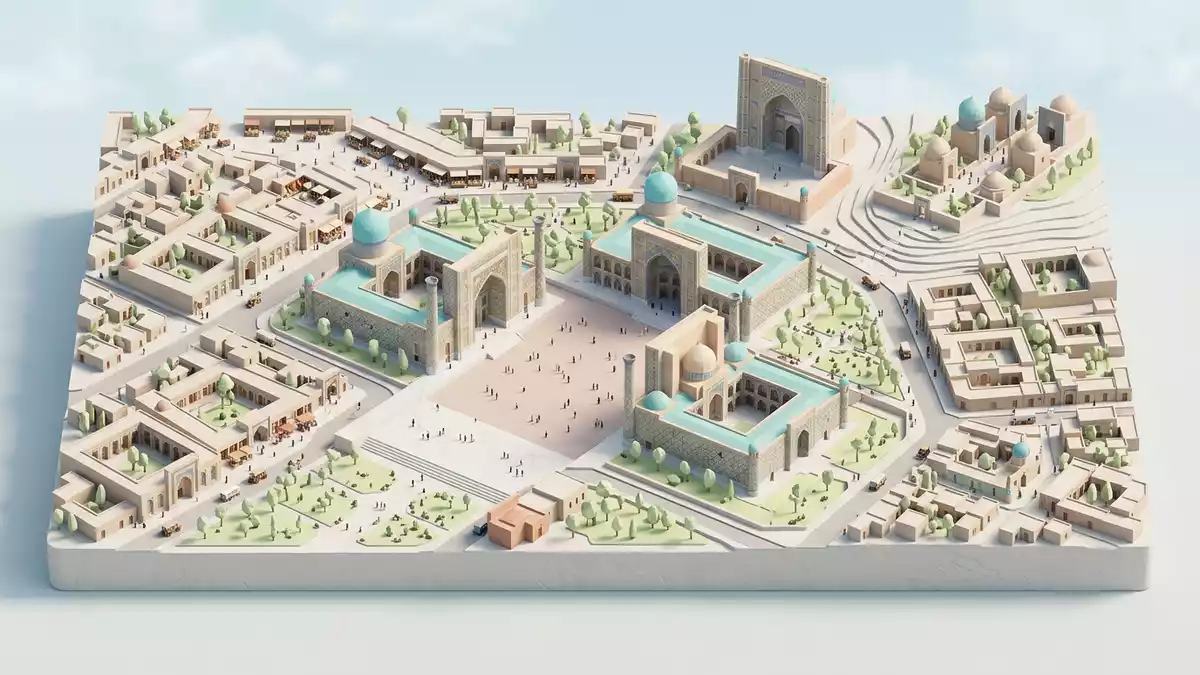
Registon is a broad square in the historic centre of Samarkand, Uzbekistan, enclosed on three sides by monumental Islamic colleges. Its lead feature is the arrangement itself: three richly tiled madrasas face one another across an open paved space, creating an architectural ensemble built across more than two centuries.
Three madrasas around one square
The oldest building is the Ulugh Beg Madrasa, built between 1417 and 1420 under Mirzo Ulugh Beg, the Timurid ruler, mathematician and astronomer. Its façade presents a tall entrance portal framed by blue, turquoise and white tilework, with domed teaching and residential spaces arranged behind it.
The Ulugh Beg Madrasa belongs to the Timurid period, when Samarkand was a major centre of scholarship and imperial culture. Its name remains closely linked with Ulugh Beg, whose work in astronomy and mathematics forms part of the city’s intellectual history. The building is a madrasa, a college for Islamic education, rather than a palace or a military monument.
Ulugh Beg, Sher-Dor and Tilla-Kari
The Sher-Dor Madrasa faces the Ulugh Beg Madrasa across the square. It was built between 1619 and 1636 under Yalangtush Bahadur, a ruler of Samarkand in the post-Timurid period. Its portal carries a distinctive tile composition with tiger-like animals and radiant suns, a feature that gives the building much of its visual identity.
The third building is the Tilla-Kari Madrasa, constructed between 1646 and 1660. Its name means “decorated with gold”, and gilded ornament appears inside its mosque. The complex combines educational rooms, student cells, a courtyard and a mosque, adding a different interior emphasis to the façades around Registon.
Tilework, courtyards and Central Asian history
Registon’s buildings use glazed ceramic tiles, carved stucco, painted decoration and brick construction. Turquoise, deep blue, white and gold appear across portals, domes, arcades and interior surfaces. The repeated geometric patterns belong to the visual language of Islamic architecture in Central Asia.
The square forms part of Samarkand’s historic monuments inscribed on the UNESCO World Heritage List in 2001. Samarkand reached its Timurid prominence during the fourteenth and fifteenth centuries, while the completed ensemble also records the architectural culture of the seventeenth century. Samarkand’s World Heritage listing places Registon within the wider history of the city.
The name Registon comes from a Persian expression connected with sand or a sandy place. Before the monumental façades defined the square, the area served as a civic and commercial space in Samarkand. The surviving ensemble presents that urban history through three buildings with different dates, patrons and decorative programmes.
Visiting Registon: what travellers from Western Europe should know
- Registon stands in the historic centre of Samarkand. The square is reached through the city’s urban streets, with Samarkand railway station connecting the city to Uzbekistan’s rail network.
- The principal spaces are courtyards, arcades, portals and interior rooms within the madrasas. Visitors encounter paved ground, steps and uneven transitions between outdoor and indoor areas.
- The official language is Uzbek and the currency is the Uzbekistani so?m.
- Samarkand’s other Timurid monuments include the Bibi-Khanym Mosque, the Shah-i-Zinda necropolis and the Gur-e-Amir mausoleum.
Searching for Registon on social platforms
These links open searches for Registon on each platform.
Frequently asked questions about Registon
Where is Registon?
Registon is in the historic centre of Samarkand, Uzbekistan. It forms part of the city’s major Timurid and post-Timurid monuments.
What can visitors expect at Registon?
The ensemble contains three madrasas with courtyards, arcades, student rooms, monumental portals and decorated religious interiors. Tilework, brick, carved plaster and gilded ornament appear throughout the complex.
What makes Registon distinctive?
Three madrasas from different periods face the same square. The Ulugh Beg Madrasa dates from 1417–1420, while Sher-Dor and Tilla-Kari belong to the seventeenth century.


