
Reggia di Caserta and the scale of Bourbon power
Published on 08/21/2026 at 06:12 | Editorial responsibility: Rafael Müller, Editor-in-Chief AD HOC NEWS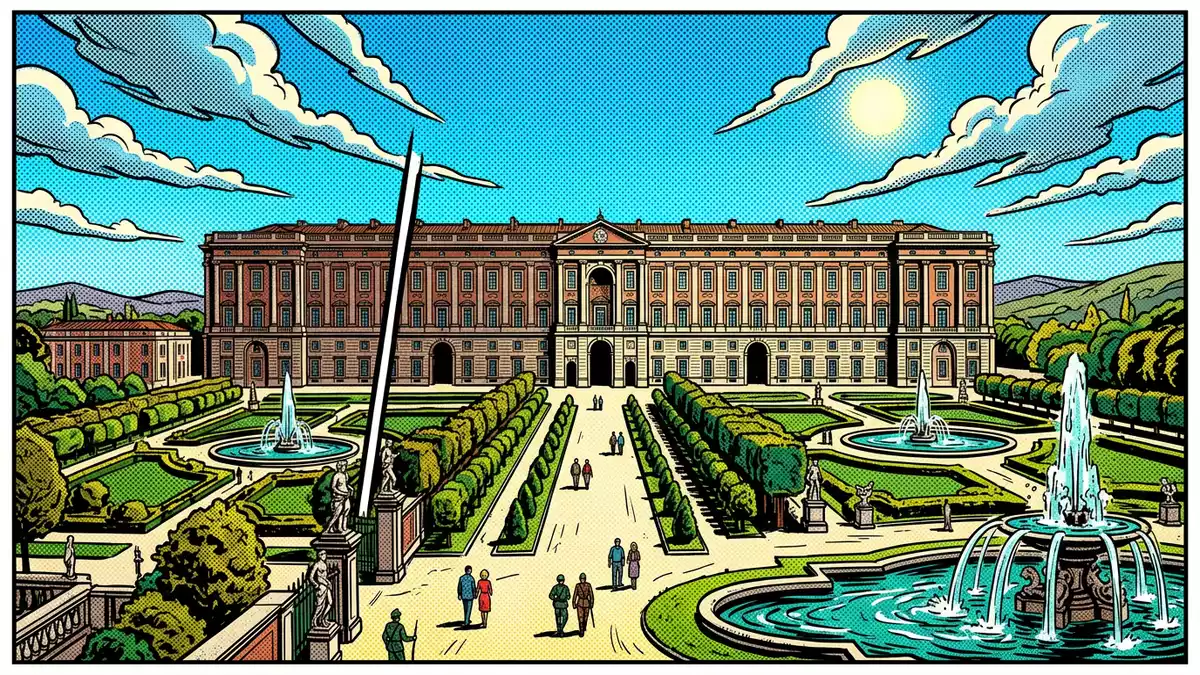
Reggia di Caserta rises in Caserta as a palace of measured grandeur, with broad façades, formal interiors and a long park beyond the main building. Luigi Vanvitelli’s name and the Bourbon court belong to its core identity, and the complex was inscribed on the UNESCO World Heritage List in 1997.
Vanvitelli’s Bourbon palace in Caserta
Charles VII of Naples, later Charles III of Spain, commissioned the project in the eighteenth century, and Vanvitelli shaped the first phase of the royal residence from 1752. The palace was completed in 1845, a date that marks the long span of construction without needing any finer breakdown.
The building belongs to the world of late Italian Baroque and early Neoclassicism, with a formal layout that reads as both palace and state setting. Its name, its patron and its architect give the place historical weight without turning it into a puzzle of motives.
The palace, park and associated monuments
The UNESCO inscription covers the palace, the park, the Aqueduct Carolino and the San Leucio complex. That wider ensemble matters because Reggia di Caserta is not only a façade to walk past, but part of a planned royal landscape stretching into gardens and infrastructure.
The palace is linked to the city of Caserta as a broader Bourbon project, and Vanvitelli also drew up an urban plan for the town. The royal residence therefore sits within a larger eighteenth-century civic setting, not as an isolated monument.
A residence with many layers
Reggia di Caserta is still read through its changing functions: royal residence, state monument and museum. The sequence gives the place depth, while the surviving formal rooms and park keep the original scale visible.
The palace is also associated with a long construction process under different hands after Vanvitelli’s death, including Carlo Vanvitelli. That continuity is visible in the completed whole: a vast court architecture with a park, waterworks and formal urban ambition.
Visiting Reggia di Caserta: what travellers from Western Europe should know
- The palace stands in Caserta, north of Naples, and is reached by rail and road from the city. The complex sits with its park and the Aqueduct Carolino in the same heritage setting.
- The building is large and formal, with long interior sequences and extensive grounds. Its scale belongs to a royal residence rather than a compact city palace.
- The complex includes the palace, the park, the English Garden, Bosco di San Silvestro and the aqueduct. That makes the site more than a single façade or a single garden walk.
- The official language is Italian and the currency is the euro.
- Entry requirements depend on your nationality; UK travellers can check the FCDO travel advice at gov.uk/foreign-travel-advice, Irish travellers the Department of Foreign Affairs at ireland.ie.
Searching for Reggia di Caserta on social platforms
These links open searches for Reggia di Caserta on each platform.
Frequently asked questions about Reggia di Caserta
Where is Reggia di Caserta?
It stands in Caserta, in Campania, north of Naples. The palace forms part of a wider royal complex that includes the park and the Aqueduct Carolino.
What does a visit involve?
The site is a large royal residence with formal rooms and extensive grounds. The scale is architectural and landscape-based rather than compact.
What makes Reggia di Caserta distinctive?
The combination of Vanvitelli, the Bourbon court, the 1845 completion date and the 1997 UNESCO inscription gives the place its profile. The palace, park and aqueduct form a single historical ensemble.


