
Reggia di Caserta and the long royal park
Published on 09/16/2026 at 10:12 | Editorial responsibility: Rafael Müller, Editor-in-Chief AD HOC NEWS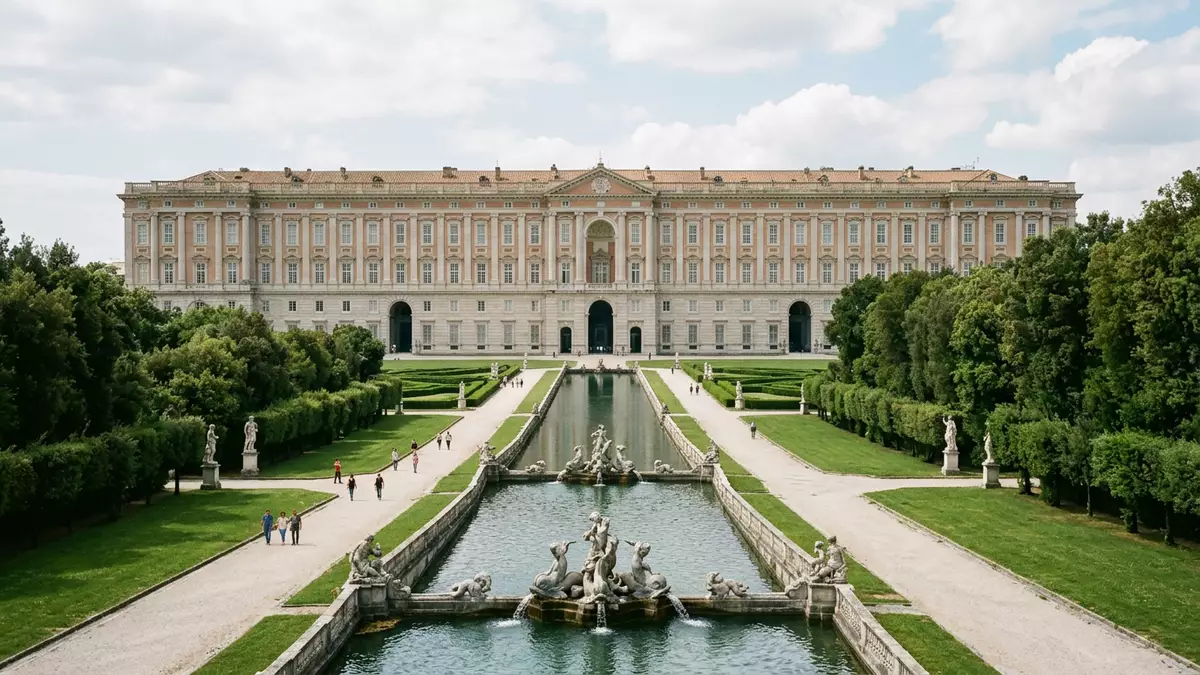
Reggia di Caserta rises in Caserta as a vast Bourbon palace linked to a UNESCO listing and the name of Luigi Vanvitelli. The palace and park read as one ensemble: a long main building, extensive grounds and formal waterworks spread across the site.
Vanvitelli’s palace in Caserta
The palace began in 1752 under the Bourbon court, with Charles VII of Naples as the patron most closely tied to the project. The building presents a large rectangular mass, and the interior programme extends through many chambers and long sequences of rooms.
The Royal Palace is associated with the eighteenth century and with the Baroque world that shaped much of southern Italian court culture. Its formal composition places scale and symmetry before ornament, while the park extends that order into the landscape.
The park, water axis and English Garden
The grounds are a central part of the visitable complex, not a decorative afterthought. The park stretches along a measured axis with canals, basins and fountains, and the English Garden introduces a looser planting style beside the palace grounds.
That mix of geometric order and botanical variety gives the place its distinctive character. The park and the English Garden are part of the same UNESCO-listed property, together with the Aqueduct Carolino and the San Leucio complex.
A palace that changed use over time
Reggia di Caserta was first a royal residence and later passed into different public roles. The palace is now a museum complex, while the rooms, staircases and long façades still preserve the scale of a court residence.
The site is also linked to Italian state history through its later administrative use and the survival of the wider royal ensemble. That layered history sits beside the architecture rather than replacing it, and the visitor sees both the palace and the changing life of the complex.
Visiting Reggia di Caserta: what travellers from Western Europe should know
- Reggia di Caserta stands in Caserta, near the railway station and the city centre. The official address is Piazza Carlo di Borbone.
- The palace and park cover a very large ground plan, so the setting feels expansive on foot. The park is arranged on long straight lines, with the water axis running away from the palace.
- The Royal Park, English Garden and palace belong to one historic ensemble. The broader site also includes the Aqueduct Carolino and San Leucio.
- Entry requirements depend on your nationality; UK travellers can check the FCDO travel advice at gov.uk/foreign-travel-advice, Irish travellers the Department of Foreign Affairs at ireland.ie.
Searching for Reggia di Caserta on social platforms
These links open searches for Reggia di Caserta on each platform.
Frequently asked questions about Reggia di Caserta
Where is Reggia di Caserta?
It stands in Caserta, in Campania, north of Naples. The palace complex sits on Piazza Carlo di Borbone.
What does a visit involve?
The place combines a palace, a large park and an English Garden. The grounds extend in long formal lines, so the site is experienced as a sequence of façades, avenues and planted spaces.
What makes it distinctive?
The combination of a Bourbon palace, a nineteenth-century public landscape setting and a UNESCO-listed complex gives it unusual breadth. The name of Luigi Vanvitelli is central to that identity.


