
Reggia di Caserta, an eighteenth?century royal landscape
Published on 09/21/2026 at 07:48 | Editorial responsibility: Rafael Müller, Editor-in-Chief AD HOC NEWS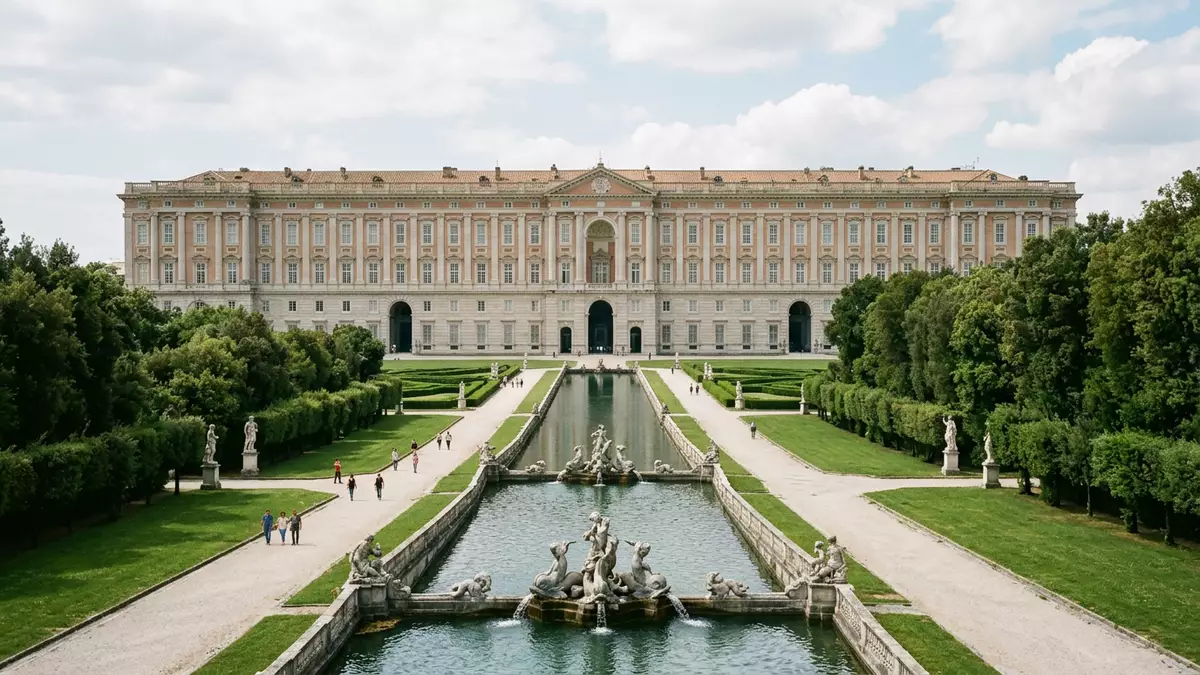
Reggia di Caserta is an eighteenth?century royal palace complex in Caserta whose vast architecture and formal park were conceived as a single, continuous landscape. Built for Charles of Bourbon and designed by Luigi Vanvitelli, it gathers a monumental residence, a geometric park and engineered water axes into one composition recognised as a World Heritage Site in 1997.
An eighteenth?century Bourbon palace on a grand scale
The Royal Palace of Caserta was commissioned by Charles of Bourbon, later Charles III of Spain, in the second half of the eighteenth century as the principal residence of the Bourbon rulers of the Kingdom of Naples.Charles of Bourbon Architect Luigi Vanvitelli began work on the project in 1752, giving the palace a strongly orthogonal plan centred on long axial corridors and courtyards.Luigi Vanvitelli
The palace building forms a large rectangular block rising over several storeys, organised around interior courtyards that admit light and articulate the mass.a large rectangular block Its exterior combines Baroque and Neoclassical elements, with long facades punctuated by evenly spaced windows and a rhythm of pilasters and cornices. Inside, visitors encounter state apartments with stucco work, frescoed ceilings and a monumental central staircase that stages the progression from entrance level to the piano nobile.
Park, water axis and English Garden
Beyond the palace, the Royal Park extends as a formally laid out landscape with straight avenues, clipped lawns and basins aligned along a main water axis.Royal Park This axis follows a broad perspective, leading the eye from the palace towards distant hills and linking a succession of cascades and ornamental pools. The park covers more than 100 hectares, offering long walks under trees and across open lawns framed by the geometry of paths and canals.one of the largest royal residences
On one side of the axis lies the English Garden, laid out in the late eighteenth century with winding paths, varied planting and artificial ruins that contrast with the stricter lines of the Italianate park.English Garden The wider complex includes the Bosco di San Silvestro, a woodland used historically as hunting grounds, and long alignments of trees that bind palace, garden and surrounding countryside into a single scene. The Aqueduct Carolino, also designed by Vanvitelli, feeds the park’s water features, carrying water from the hills over considerable distance to sustain the cascades and basins.Aqueduct Carolino
UNESCO recognition and the San Leucio complex
Reggia di Caserta, together with its park, the Aqueduct of Vanvitelli and the complex of San Leucio, was inscribed on the UNESCO World Heritage List in 1997 under the title “18th?Century Royal Palace at Caserta with the Park, the Aqueduct of Vanvitelli, and the San Leucio Complex”.UNESCO World Heritage List in 1997 The inscription highlights both the architectural quality of the palace and the integrated design of gardens, woodland and hydraulic infrastructure.
San Leucio, located on higher ground near Caserta, developed during the eighteenth century as an industrial settlement devoted to silk production, connected conceptually and functionally with the palace complex through shared water and planning.San Leucio Complex Together, palace, park, aqueduct and industrial quarter form a broad territorial project in which royal representation, everyday court life, engineered water supply and production landscapes were planned as interlocking pieces of one scheme.
Visiting Reggia di Caserta: what travellers from Western Europe should know
- Reggia di Caserta stands in Caserta in southern Italy, north of Naples, with the main entrance facing Piazza Carlo di Borbone and Viale Douhet.
- The palace interior includes long staircases and extended enfilades, while the park involves substantial walking along straight avenues and gently rising ground.
- The wider complex reaches towards the hills, with the Aqueduct Carolino visible in the distance and woodland paths in the Bosco di San Silvestro.
- The official language is Italian and the currency is the euro.
Searching for Reggia di Caserta on social platforms
These links open searches for Reggia di Caserta on each platform.Frequently asked questions about Reggia di Caserta
Where is Reggia di Caserta located?
Reggia di Caserta is in the city of Caserta in Campania, southern Italy, with its address on Viale Douhet close to Piazza Carlo di Borbone.
What can visitors expect at Reggia di Caserta?
Visitors encounter a monumental eighteenth?century palace with grand staircases and historic apartments, together with a formal park, an English Garden and extensive water features.
What makes Reggia di Caserta distinctive among European palaces?
Its distinctiveness lies in the integration of palace, park, woodland, aqueduct and industrial quarter at San Leucio into one planned Bourbon landscape recognised by UNESCO.


