
Reggia di Caserta, an eighteenth?century palace of grand scale
Published on 09/17/2026 at 21:31 | Editorial responsibility: Rafael Müller, Editor-in-Chief AD HOC NEWS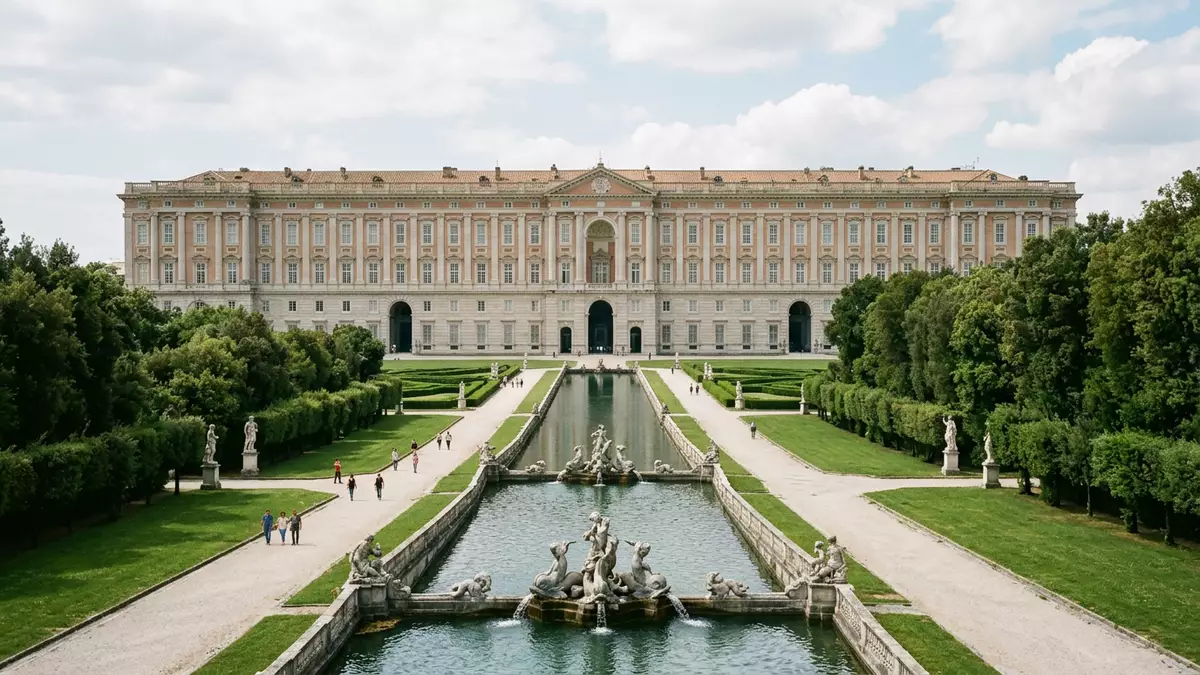
Reggia di Caserta in southern Italy is an eighteenth?century royal palace on the plain beside Caserta, conceived as a residence and administrative centre for the Bourbon kings of Naples and surrounded by a vast formal park. Its sheer scale, from the rectangular block of the palace to the long water axis of the gardens, makes the complex one of the most extensive royal residences built in Europe in that period.
An eighteenth?century Bourbon vision in stone
The Reggia di Caserta was commissioned in the eighteenth century by Charles VII of Bourbon, later Charles III of Spain, when the Kingdom of Naples sought a grand new seat away from the coast around Naples. Construction began in 1752 under architect Luigi Vanvitelli, a leading figure of Italian architecture of the time whose design combined a monumental palace with a planned park and supporting infrastructure such as the Aqueduct Carolino.Construction began in 1752 The palace and its associated features, including the Belvedere of San Leucio and the aqueduct, are recognised together as a World Heritage Site, inscribed by UNESCO in 1997 for their exceptional cultural value.inscribed by UNESCO in 1997
Luigi Vanvitelli’s plan placed the palace on a rectangular grid with multiple internal courtyards, reflecting Enlightenment ideas about order and administration as much as the Baroque taste for spectacle. The complex is traditionally dated to the eighteenth century, with completion in the nineteenth century, and became one of the main residences of the Bourbon-Two Sicilies dynasty.one of the main residences The historic status of the Reggia today includes its role as an Italian state museum, forming part of the network of national cultural institutions.
Architecture on a monumental rectangular plan
The palace itself presents a long, regular façade built in warm stone, articulated by evenly spaced rows of windows and classical details that emphasise its horizontal extent. Behind this front, the building is organised on a rectangular plan divided by four interior courtyards, which bring daylight into the deep block and create sequences of enclosed spaces between the grand halls.rectangular plan divided by four courtyards Inside, Vanvitelli’s architecture mixes Baroque richness with controlled classical rhythm, from the broad Royal Staircase that rises from the lower vestibule to the upper vestibule to the enfilades of rooms along the main axes.
The dimensions of the palace underline its ambition. The built volume extends for hundreds of metres along each side, containing many hundreds of rooms arranged on several levels, together covering tens of thousands of square metres.covering tens of thousands of square metres Within this shell, visitors encounter spaces ranging from richly decorated state apartments to chapels and administrative rooms, each with distinct finishes but united by repeating structural bays and a consistent palette of materials such as stone and stucco.
A palace framed by park, water axis and English garden
Beyond the palace, the Reggia di Caserta is defined by its park, laid out on a long axial composition that stretches from the rear of the building into the countryside. A broad avenue runs away from the palace, flanked by lawns and woodland sections, and along its spine lie basins and fountains that mark the ascent towards the more elevated parts of the park.broad avenue with basins and fountains The Aqueduct Carolino feeds the water features, linking the hydraulic engineering of the surrounding landscape with the formal design of cascades and pools.
The complex also includes an English Garden, created as part of later phases of development and planted with a wide range of species to form a more informal counterpart to the ordered avenues of the main park. This garden, together with the Bosco di San Silvestro woodland and the Belvedere of San Leucio, forms part of the wider Caserta site inscribed by UNESCO, showing how the palace is embedded in a planned cultural landscape rather than standing alone.planned cultural landscape From the higher parts of the gardens, the visitor looks back towards the palace façade framed by open countryside, a view that makes the overall composition of architecture, water and planting legible at a single glance.
Visiting Reggia di Caserta: what travellers from Western Europe should know
- Reggia di Caserta stands in Caserta in Campania in southern Italy, north of Naples, and is reached by rail services that link Caserta station with major cities including Naples.
The palace fronts a broad square aligned with the railway. - Moving through the complex involves substantial walking, first within the multi?storey palace with its broad staircases, then along the park axis, where the main fountains and cascades lie at a considerable distance from the building.
- The wider UNESCO site incorporates the Aqueduct Carolino, the woodland of Bosco di San Silvestro and the Belvedere di San Leucio, which lie in the surrounding countryside and require additional travel from the main palace.
- The official language is Italian and the currency is the euro.
Searching for Reggia di Caserta on social platforms
These links open searches for Reggia di Caserta on each platform.
Frequently asked questions about Reggia di Caserta
Where is Reggia di Caserta located?
Reggia di Caserta stands in the city of Caserta in Campania in southern Italy, on a broad plain north of Naples and close to the Apennine foothills.
What should visitors expect on a visit to Reggia di Caserta?
A visit combines movement through a very large multi?storey palace with grand staircases and halls, and time spent in the extensive axial park with its fountains, cascades and English Garden.
What makes Reggia di Caserta distinctive among European royal residences?
Its distinction lies in the combination of an eighteenth?century palace of exceptional horizontal scale, a rectilinear plan with four courtyards, and a planned landscape including park, aqueduct and industrial complex recognised together on the UNESCO World Heritage List.


