
Recife Antigo, the island quarter where Recife began
Published on 08/31/2026 at 16:58 | Editorial responsibility: Rafael Müller, Editor-in-Chief AD HOC NEWS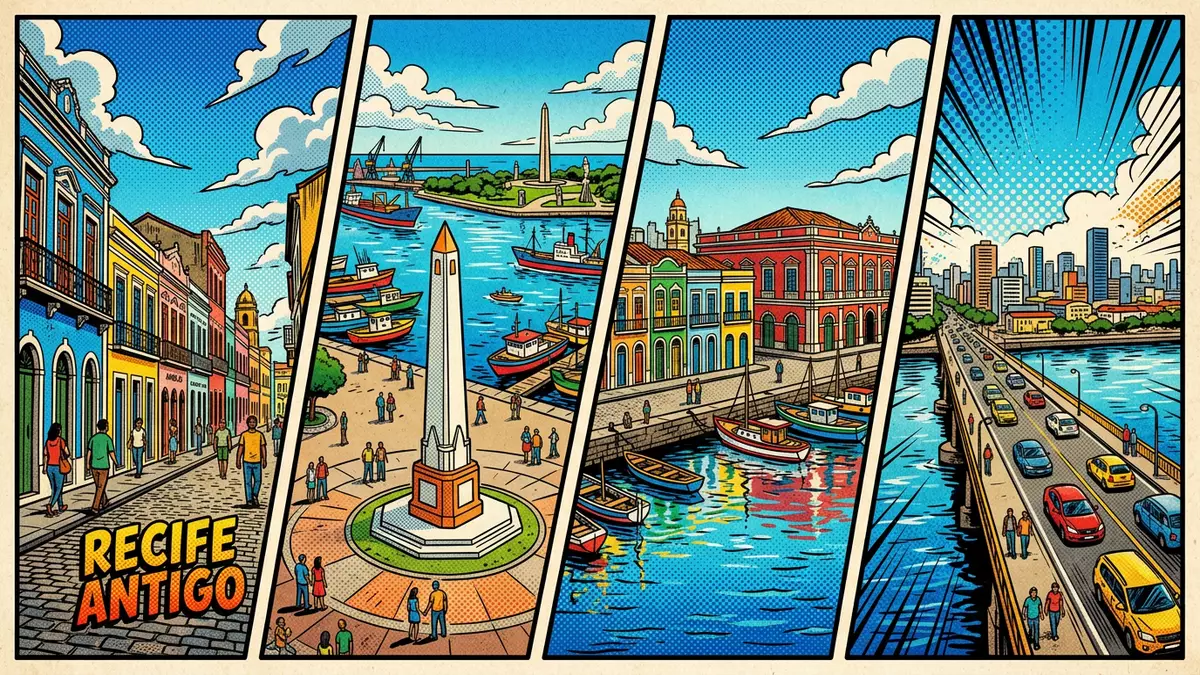
Recife Antigo is the historic island quarter where Recife first took shape, laid out between river channels and the Atlantic harbour on Brazil’s north-eastern coast. It forms the eastern part of Recife’s historic centre and preserves streets, warehouses and civic buildings that show how a colonial port grew into an urban district of culture and technology.
An island of rivers, docks and early streets
Recife Antigo occupies the Island of Recife at the point where the Capibaribe and Beberibe rivers meet the Atlantic Ocean, giving many streets water on one side and built fabric on the other.the Island of Recife The quarter is officially known as Bairro do Recife and corresponds to the eastern section of Recife’s historic centre, with bridges carrying road traffic across the water to adjoining districts.Bairro do Recife
The district developed around a harbour that served the Captaincy of Pernambuco in the sixteenth century, when Portuguese colonial rule turned the natural reef formations and sheltered waters into an anchorage for sugar exports.principal port colonial da região Nordeste Early streets followed the line of the docks and warehouses, and later avenues were driven across the island when Recife’s centre was reorganised in the early twentieth century, leaving a pattern where narrow passageways and broader alignments intersect.
From colonial harbour to architectural urban fabric
By the seventeenth century Recife Antigo contained the first planned urban layout of the port, associated with the period when Maurício de Nassau oversaw works that imposed an ordered design on the previously irregular settlement.Maurício de Nassau Over subsequent centuries, commercial buildings, religious structures and public institutions accumulated on the island, so that by the early twentieth century the neighbourhood concentrated import and export trade, finance and transport services for Recife and the wider region.bairro histórico tombado em 1998
In 1910 a major reform introduced wide, straight avenues and new buildings inspired by Parisian architecture, adding façades with neoclassical French influences to streets still lined with older structures.avenidas largas e retilíneas The resulting urban fabric in Recife Antigo combines ecl éctic architecture with diverse street patterns, and this ensemble was recognised when the historic centre, including Bairro do Recife, was listed by Brazil’s Instituto do Patrimônio Histórico e Artístico Nacional in 1998 as a site of architectural and urban interest.Centro Histórico de Interesse Arquitetônico Urbanístico
A historic core with culture, technology and memory
Recife Antigo retains buildings that recall its role in Atlantic trade, including former port warehouses and commercial houses that line streets close to the quays.initial Portuguese settlement in the 16th century Some of these structures host museums and cultural centres, while others accommodate offices linked to Recife’s technology sector, including the Porto Digital hub that occupies parts of the historic area.high-tech center called Porto Digital
The quarter also contains religious heritage, among it the Kahal Zur Israel Synagogue on Rua do Bom Jesus, recognised as the first synagogue built in the Americas and a reminder of the diverse communities that passed through Recife during the era of sugar exports.first Synagogue built in the Americas Squares such as the central area around the Marco Zero monument, streets with restored façades and spaces adapted for galleries, cafés and performance venues contribute to a district where maritime origins, architectural layers and contemporary culture share a compact island setting.
Visiting Recife Antigo: what travellers from Western Europe should know
- Recife Antigo lies on the Island of Recife at the eastern side of the historic centre, bordered by the Capibaribe and Beberibe rivers and the harbour, and is linked to other districts of Recife by road bridges.
- The terrain consists of level urban streets and paved squares, with some routes following the waterfront and others weaving between warehouses and civic buildings, so walking involves frequent changes between narrower lanes and broader avenues.
- The district forms part of Recife in Brazil, where the official language is Portuguese and the currency is the Brazilian real.
- Entry requirements depend on your nationality; UK travellers can check the FCDO travel advice at gov.uk/foreign-travel-advice, Irish travellers the Department of Foreign Affairs at ireland.ie.
Searching for Recife Antigo on social platforms
These links open searches for Recife Antigo on each platform.
Frequently asked questions about Recife Antigo
Where is Recife Antigo located within Recife?
Recife Antigo is on the Island of Recife, forming the eastern part of the city’s historic centre between the Capibaribe and Beberibe rivers and the harbour.
What can visitors expect when walking through Recife Antigo?
Visitors encounter a compact district of historic streets, port warehouses, civic buildings and squares, where older structures stand beside twentieth-century avenues and adapted cultural spaces.
What makes Recife Antigo distinctive among Brazilian historic quarters?
Recife Antigo combines a sixteenth-century port origin, early planned streets under Maurício de Nassau, French-influenced avenues from 1910 and recognition as part of an IPHAN-listed historic centre on an island setting.


