
Recife Antigo and the streets shaped by port history
Published on 09/23/2026 at 18:19 | Editorial responsibility: Rafael Müller, Editor-in-Chief AD HOC NEWS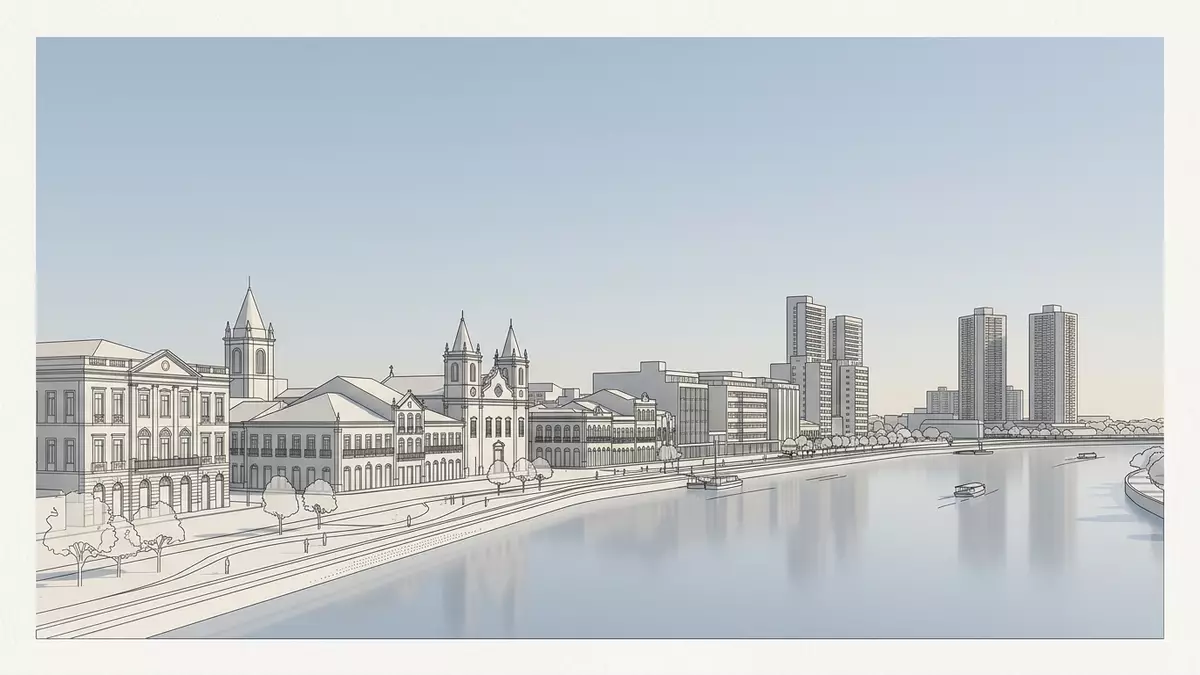
Recife Antigo is the historic waterfront quarter of Recife, Brazil, arranged along the island district known officially as Bairro do Recife. Its compact streets bring together port warehouses, civic squares, religious buildings and cultural venues, with Marco Zero at the centre of the urban story.
Marco Zero and the waterfront island
Praça Rio Branco, known as Marco Zero, occupies the edge of the harbour beside Avenida Alfredo Lisboa. A bronze marker installed in 1938 identifies the reference point from which road distances in the region are measured. The square also carries a monument to the Barão do Rio Branco, inaugurated in 1917 and sculpted by Félix Charpentier.
Across the basin, the Parque das Esculturas Francisco Brennand extends along a pier into the water. Its sculptures form a visible counterpart to the square, while the harbour edge brings Recife’s river and Atlantic setting into the centre of the district. Recife Antigo’s streets remain closely connected to quays, warehouses and the working geography of a port city.
Colonial streets, Dutch traces and coloured façades
Recife Antigo grew from the Portuguese settlement established around Recife’s harbour in the sixteenth century. The district’s street pattern, churches, trading buildings and former warehouses record the port’s role in Pernambuco’s Atlantic history.
Architecture from different periods stands within the same compact area. Baroque and neoclassical churches appear beside civic buildings, former bank headquarters and commercial façades with balconies, shutters, pilasters and moulded cornices. Late nineteenth-century and early twentieth-century additions bring eclectic and art nouveau details to the older urban fabric. The historic quarter was listed in 1998 as a site of architectural and urban interest, recognising its streets, squares and buildings as an ensemble.
Religious memory and cultural life in Bairro do Recife
Rua do Bom Jesus contains the Kahal Zur Israel Synagogue, associated with the Jewish community that lived in Recife during Dutch rule. The synagogue dates from the seventeenth century and is recognised as the first synagogue built in the Americas. Its presence adds religious history to a district also shaped by commerce, defence and administration.
Several cultural institutions occupy buildings connected with the waterfront. Paço do Frevo presents the music and dance tradition associated with Recife’s Carnival, while the Cais do Sertão museum explores the culture of Brazil’s north-eastern hinterland. Torre Malakoff, the Centre of Handicrafts of Pernambuco and former port buildings add further architectural landmarks to the streets around Marco Zero.
Visiting Recife Antigo: what travellers from Western Europe should know
- Recife Antigo occupies the eastern part of Recife’s historic centre, on the Island of Recife between the Capibaribe River and the Atlantic Ocean. Avenida Alfredo Lisboa runs beside Marco Zero and the harbour.
- The district is explored through cobbled streets, waterfront pavements and squares. Walking routes connect Marco Zero with Rua do Bom Jesus, the Kahal Zur Israel Synagogue, Torre Malakoff and nearby cultural buildings.
- The official language is Portuguese and the currency is the Brazilian real.
- Several landmarks stand across the harbour basin, including the Parque das Esculturas Francisco Brennand. Its sculptures are reached from the waterfront by a crossing over the water.
Searching for Recife Antigo on social platforms
These links open searches for Recife Antigo on each platform.
Frequently asked questions about Recife Antigo
Where is Recife Antigo?
Recife Antigo is the historic district of Recife, on the Island of Recife beside the Capibaribe River and the Atlantic Ocean. Its central landmark is Praça Rio Branco, known as Marco Zero.
What can travellers expect to see?
The district contains cobbled streets, waterfront squares, former warehouses, churches, museums and cultural centres. Named landmarks include Rua do Bom Jesus, Torre Malakoff, Paço do Frevo and the Cais do Sertão museum.
What makes Recife Antigo distinctive?
Its compact streets bring together Portuguese colonial foundations, Dutch-period history, later civic architecture and living cultural traditions. The Kahal Zur Israel Synagogue and Marco Zero connect religious memory with the geography of Recife’s harbour.


