
Real Alcazar de Sevilla and its palaces in layered stone
Published on 09/03/2026 at 19:10 | Editorial responsibility: Rafael Müller, Editor-in-Chief AD HOC NEWS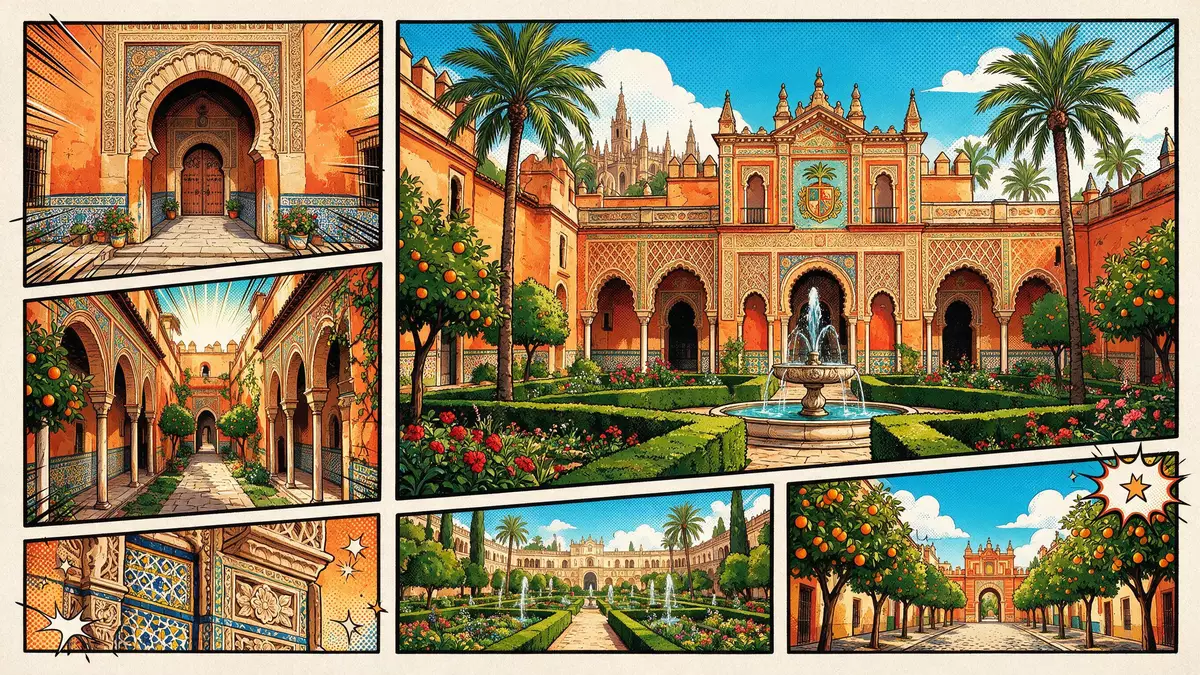
Real Alcazar de Sevilla is a walled royal palace in Sevilla where Islamic foundations, a fourteenth-century Mudéjar residence and later Gothic and Renaissance additions share the same courtyards and gardens within a single enclosure. Built and rebuilt from the early Middle Ages onwards, it forms a compact record of how power, taste and craftsmanship in southern Spain shifted from caliphs and taifa kings to Castilian monarchs and Habsburg emperors.
From Umayyad fort to royal residence
The story of Real Alcazar de Sevilla begins in the early tenth century, when Abd al-Rahman III of the Umayyad dynasty ordered a fortified complex on the southern edge of the Islamic city of Ishbiliya.Abd al-Rahman III ruled from Córdoba and used the site to project authority into this key river port on the Guadalquivir. Over the eleventh and twelfth centuries the fortification evolved into a palatial compound under the Abbadid and Almohad rulers, who extended the walls and laid out early gardens and residential quarters.Abbadid and Almohad rulers
After Fernando III of Castile conquered Sevilla in 1248, the Christian court adopted the Alcazar as its residence and began to reshape it.Fernando III of Castile Alfonso X commissioned a Gothic palace beside the earlier Islamic structures, introducing ribbed vaulting and pointed arches into a setting that still retained Arabic inscriptions and horseshoe arches in older halls.Gothic palace of Alfonso X The transformation from Muslim to Christian seat of power is legible in these overlaps: carved stucco with Arabic script sits close to vaulted chapels and great halls built for Castilian kings.
Pedro I and the Mudéjar palace at the heart of Real Alcazar de Sevilla
The architectural core of Real Alcazar de Sevilla dates from the fourteenth century, when Pedro I of Castile ordered a new residence in the Mudéjar style within the existing enclosure.Palace of King Don Pedro Built between about 1356 and 1366, the Palacio de Pedro I presents itself from the courtyard as a compact palace with a richly decorated façade in brick, carved plaster and polychrome tile.Palacio de Pedro I Inscriptions in Arabic praise the monarch, while heraldic devices assert his Castilian authority.
Inside, the Mudéjar palace gathers a sequence of rooms and courtyards arranged around patios such as the Patio de las Doncellas and Patio de las Muñecas.Patio de las Doncellas and Patio de las Muñecas Walls are lined with glazed ceramic tiles in repeating geometric patterns, above which dense stucco panels frame doorways and windows with interlacing arches and calligraphy. Many of the ceilings are formed from elaborately carved and painted wood, creating coffered surfaces that echo Nasrid palaces in Granada while serving a Christian court in Sevilla.Mudéjar architecture
Gardens, later additions and UNESCO recognition
Beyond the palaces, Real Alcazar de Sevilla opens onto a series of gardens that reflect as many periods as the architecture itself. The oldest parts retain a clear Islamic character, with water channels, pools, tiled edges and citrus trees arranged in geometric plots reputed from early Islamic gardening traditions.Islamic gardens and architecture During the reign of Charles V in the sixteenth century, new Renaissance gardens developed along the western side of the Mudéjar and Gothic palaces, introducing clipped hedges, ornamental ponds such as the Estanque de Mercurio and the elevated Galería del Grutesco that overlooks terraces and parterres.Renaissance gardens and Estanque de Mercurio
Later centuries added further layers, from mannerist and baroque garden elements to nineteenth-century redesigns at the edge of the complex.Later garden designs Across the site, Islamic, Mudéjar, Gothic, Renaissance and baroque features stand within one fortified perimeter, a quality recognised when the Real Alcazar of Sevilla was inscribed as part of the UNESCO World Heritage listing for Sevilla’s cathedral, Archivo de Indias and surrounding ensemble.UNESCO World Heritage listing
Visiting Real Alcazar de Sevilla: what travellers from Western Europe should know
- Real Alcazar de Sevilla stands in the historic centre of Sevilla, a short walk south of the cathedral and close to the Guadalquivir river.
- The palace complex lies within fortified walls, and visiting involves walking across paved courtyards, garden paths and interior floors that vary between broad halls and narrower passageways.
- Several palace levels are linked by staircases, some of them relatively narrow, and the gardens combine open terraces with shaded walks among trees and planted beds.
- Sevilla is the capital of the Andalusia region of Spain, where the official language is Spanish and the currency is the euro.
Searching for Real Alcazar de Sevilla on social platforms
These links open searches for Real Alcazar de Sevilla on each platform.
Frequently asked questions about Real Alcazar de Sevilla
Where is Real Alcazar de Sevilla?
Real Alcazar de Sevilla stands in the historic centre of Sevilla in southern Spain, close to the cathedral and within walking distance of the Guadalquivir river.
What can visitors expect inside the palace?
Visitors encounter fortified walls, Islamic remnants, the richly decorated Mudéjar palace of Pedro I, Gothic halls and gardens laid out in Islamic, Renaissance and later styles.
What makes Real Alcazar de Sevilla distinctive among European palaces?
The complex combines Islamic, Mudéjar, Gothic, Renaissance and baroque architecture inside a single walled royal residence that has evolved since the tenth century.


