
Rapa Nui: stone figures, ocean light and a remote Pacific town
Published on 09/19/2026 at 08:54 | Editorial responsibility: Rafael Müller, Editor-in-Chief AD HOC NEWS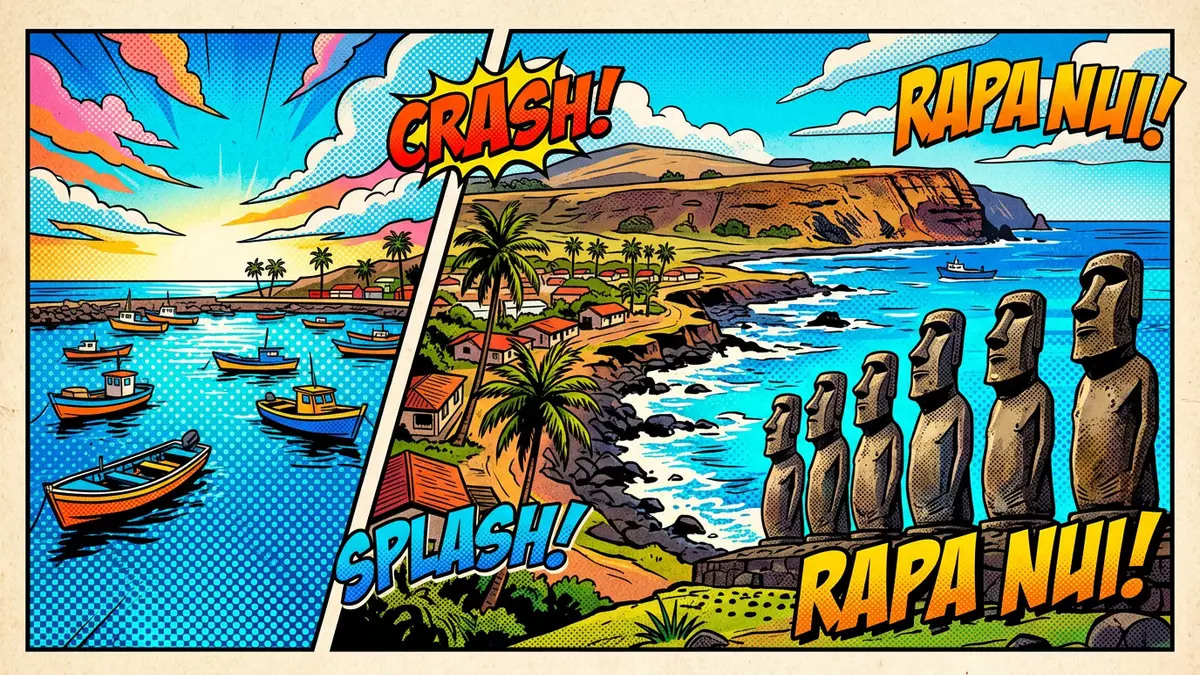
Rapa Nui, better known in English as Easter Island, is a remote volcanic island in the south-eastern Pacific where ancestral stone figures, open ocean light and the daily life of Hanga Roa share the same limited ground. The island forms a special commune of Chile and large parts of it are protected as Rapa Nui National Park, a cultural landscape recognised by UNESCO in the late twentieth century.
Rapa Nui between volcanoes and ocean
Rapa Nui lies in the Pacific Ocean thousands of kilometres west of continental Chile, making it one of the most isolated inhabited islands on Earth. The island belongs to the Valparaíso Region of Chile as the commune of Isla de Pascua, a jurisdiction that covers the main island of Rapa Nui and the distant islet of Salas y Gómez.the commune of Isla de Pascua The landscape is volcanic rather than mountainous, shaped by extinct cones such as Terevaka and Rano Kau that rise from the interior and the southern coast.
Hanga Roa, whose name in the Rapa Nui language refers to a long or wide bay, lies on the south-western shore between the slopes of Maunga Terevaka and the crater of Rano Kau.Hanga Roa on the south-west coast The town faces the open Pacific, with waves breaking on a rocky shoreline and a harbour that links the island to supply vessels. Low houses and small streets spread inland from the waterfront, with views that quickly pick up the green forms of the volcanic hills. Beyond the town, the protected areas of Rapa Nui National Park encircle much of the island, containing ceremonial platforms, quarries and coastal viewpoints.
Rapa Nui National Park and the moai landscape
Rapa Nui National Park covers large portions of the island around Hanga Roa and has been inscribed on the UNESCO World Heritage List as property number 715 since 1995.World Heritage property number 715 UNESCO identifies the site as a cultural property, recognising the archaeological remains of a Polynesian society whose monumental sculpture and stone architecture developed for many centuries without significant outside influence.the UNESCO description of Rapa Nui The park includes coastal ceremonial platforms, inland villages and the main quarry where many of the island’s statues were carved.
Between around the tenth and the sixteenth centuries, Rapa Nui’s inhabitants created enormous stone figures known as moai and placed them on stone platforms called ahu around the island’s perimeter.the monumental tradition of moai and ahu These statues, carved mainly from volcanic tuff, represent ancestors and stand in lines above the sea or in front of village sites. One of the most striking platforms is Ahu Tongariki on the south-eastern coast, where a long basalt-faced platform carries a row of moai against the backdrop of waves and distant cliffs.Ahu Tongariki on the south-eastern coast Other sectors of the park encompass the crater of Rano Raraku, with half-carved statues along its outer slopes, and Orongo, a ceremonial village set beside the dramatic cliff line above the ocean.
Hanga Roa as the everyday centre of Rapa Nui
Hanga Roa serves as the main town, harbour and administrative centre for Rapa Nui, and virtually all permanent residents of the commune live in and around it.Hanga Roa as the capital of the commune The streets bring together Rapa Nui families, Chilean settlers and visitors who stay in small hotels and guesthouses. Everyday life here unfolds among grocery shops, schools, a church and sports fields, with the ocean always close at hand. The waterfront includes a small beach, a jetty, and places where fishing boats and excursion craft come and go.
For many visitors the first sustained impression of the island comes from walking through Hanga Roa, where the built fabric of a small town stands alongside carved wooden figures, murals and references to the moai landscape further out. From the limits of the town, tracks and roads lead into the national park sectors, binding the routines of the harbour and the markets to the more sparse spaces of the archaeological sites. The Mataveri International Airport lies just outside Hanga Roa, its runway aligned along the coast and forming the main air link between Rapa Nui and the Chilean mainland.Hanga Roa and Mataveri International Airport
Visiting Rapa Nui: what travellers from Western Europe should know
- Rapa Nui forms a remote commune of Chile in the Pacific Ocean, reached mainly by air from the Chilean mainland through Mataveri International Airport near Hanga Roa.
- The terrain around the archaeological sites is of volcanic origin, with uneven ground, coastal cliffs and slopes where paths can involve a sustained approach on foot.
- Hanga Roa lies on the south-west coast between the volcanic forms of Terevaka and Rano Kau, so short walks from the town quickly encounter rising ground and views over the Pacific.
- The official language is Spanish and the currency is the Chilean peso, while the Rapa Nui language remains present in place names and local usage.
- Entry requirements depend on your nationality; UK travellers can check the FCDO travel advice at gov.uk/foreign-travel-advice, Irish travellers the Department of Foreign Affairs at ireland.ie.
Searching for Rapa Nui on social platforms
These links open searches for Rapa Nui on each platform.
Frequently asked questions about Rapa Nui
Where is Rapa Nui and how does Hanga Roa fit into it?
Rapa Nui is a volcanic island in the south-eastern Pacific that forms the Chilean commune of Isla de Pascua, with Hanga Roa as its main town and harbour.
What should visitors expect when exploring the island?
Visitors encounter a combination of a small Polynesian town, open Pacific coastline and extensive archaeological sectors of Rapa Nui National Park with moai, platforms and volcanic craters.
What makes Rapa Nui distinctive compared with other Pacific islands?
Rapa Nui combines extreme geographic isolation with a dense landscape of moai and ahu developed by a Polynesian society over several centuries, much of it now protected as a UNESCO World Heritage Site.


