
Rapa Nui National Park and the stone faces of a remote Pacific island
Published on 09/04/2026 at 15:16 | Editorial responsibility: Rafael Müller, Editor-in-Chief AD HOC NEWS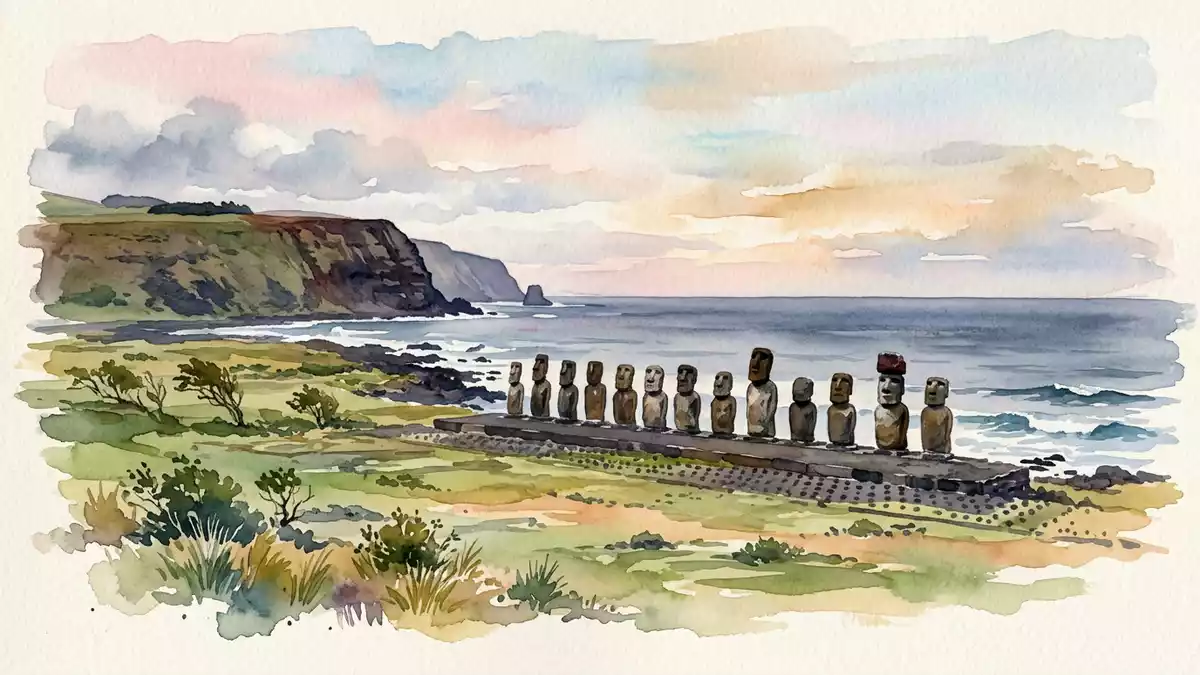
Rapa Nui National Park on Easter Island in the Pacific Ocean is a cultural landscape where volcanic slopes, grassy plains and stone figures come together on a remote Chilean island. The park surrounds Hanga Roa and carries the legacy of the Polynesian Rapa Nui people, whose monumental stone sculptures and ceremonial sites transformed a small triangle of land into one of Chile’s best known archaeological areas.
Stone figures and ceremonial platforms facing the ocean
The most immediately recognisable feature of Rapa Nui National Park is the concentration of moai, large carved stone figures set on coastal platforms and inland sites. These sculptures are part of a monumental tradition developed by a Polynesian society that settled on Easter Island around the first millennium and went on to carve and erect stone figures between the tenth and sixteenth centuries.monumental sculpture and architecture The moai usually stand on ahu, ceremonial platforms made from fitted stone, which form linear terraces along sections of the coastline and at certain inland locations.
Many of the moai visible in the park were carved from volcanic tuff at Rano Raraku, an extinct crater whose inner slopes still carry partially finished figures. From there, completed sculptures were transported to coastal platforms such as Ahu Tongariki, a restored site where a row of figures stands above the surf on a long stone terrace.nearly 1,000 moai and hundreds of platforms Smaller figures, petroglyphs and stone dwellings appear across the park, adding detail to the broader pattern of moai and ahu that structure large parts of the island’s coastline.
A Polynesian cultural landscape recognised by UNESCO
Rapa Nui National Park is both a Chilean national park and a UNESCO World Heritage Site, recognised for its cultural value and the way archaeological remains blend with the island’s volcanic terrain. UNESCO inscribed the park on the World Heritage List in 1995 as a cultural property under criteria that highlight the imaginative power of its sculpture and architecture, its testimony to a society largely isolated from external influences, and the relationship between archaeological remains and their setting.World Heritage inscription in 1995 The designation covers a substantial part of Easter Island and includes nearby islets that carry related remains.
Nearly half of Easter Island lies within the boundaries of Rapa Nui National Park, and the protected area contains thousands of archaeological features. These include almost one thousand moai, around three hundred ceremonial platforms, stone houses, caves and rock carvings spread across the undulating terrain.around 20,000 archaeological remains The park has also been declared a national historic monument, reflecting its importance within Chile and its role in preserving the material record of Rapa Nui society over many centuries.
Volcanic origins and the shape of the island
Easter Island, known to its inhabitants as Rapa Nui, is a volcanic, oceanic island whose triangular form was created by successive eruptions from several main centres. The island’s structure is dominated by three large volcanoes: Terevaka in the north, Poike in the east and Rano Kau in the south, together forming the broad triangle that shapes the park’s geography.volcanic origin and main eruptive centres The highest point, on Maunga Terevaka, reaches about 511 m (1,677 ft) above sea level, while other craters such as Rano Raraku and Rano Aroi add smaller peaks and hollows.
The island has an undulating topography with coastal cliffs in places, particularly around the flanks of Rano Kau and Poike where lava flows meet the ocean. There are no permanent surface rivers: instead, water collects in crater lakes at Rano Aroi, Rano Raraku and Rano Kau and in underground aquifers beneath the volcanic rock.crater lakes and lack of surface streams Within this terrain, the boundaries of Rapa Nui National Park encompass coastal sections, interior slopes and crater rims, offering varied ground conditions around Hanga Roa and across the wider island.
Visiting Rapa Nui National Park: what travellers from Western Europe should know
- Rapa Nui National Park covers much of Easter Island in the Pacific, with Hanga Roa as the main settlement and Mataveri International Airport providing air links to mainland Chile.
- Many archaeological sites lie on uneven volcanic ground, including crater rims and coastal terraces, and approaches often involve walking over slopes, grassland and sections of stone paving.
- The island’s climate brings periods of strong sun and occasional rain, and exposed coastal platforms such as Ahu Tongariki face the ocean with little natural shelter from wind.
- The official language on Easter Island is Spanish and the currency is the Chilean peso.
- Entry requirements depend on your nationality; UK travellers can check the FCDO travel advice at gov.uk/foreign-travel-advice, Irish travellers the Department of Foreign Affairs at ireland.ie.
Searching for Rapa Nui National Park on social platforms
These links open searches for Rapa Nui National Park on each platform.
Frequently asked questions about Rapa Nui National Park
Where is Rapa Nui National Park?
Rapa Nui National Park is on Easter Island in the south-eastern Pacific Ocean and surrounds the town of Hanga Roa, forming part of Chile’s territory in Polynesia.
What should visitors expect when exploring the park?
Visitors encounter moai on coastal platforms and inland sites, volcanic craters with archaeological remains, grassland slopes and views over the ocean from cliffs and high points.
What makes Rapa Nui National Park distinctive among Chile’s protected areas?
The park combines volcanic landforms with an unusually dense concentration of archaeological remains, including nearly a thousand moai and hundreds of ceremonial platforms within a single island setting.


