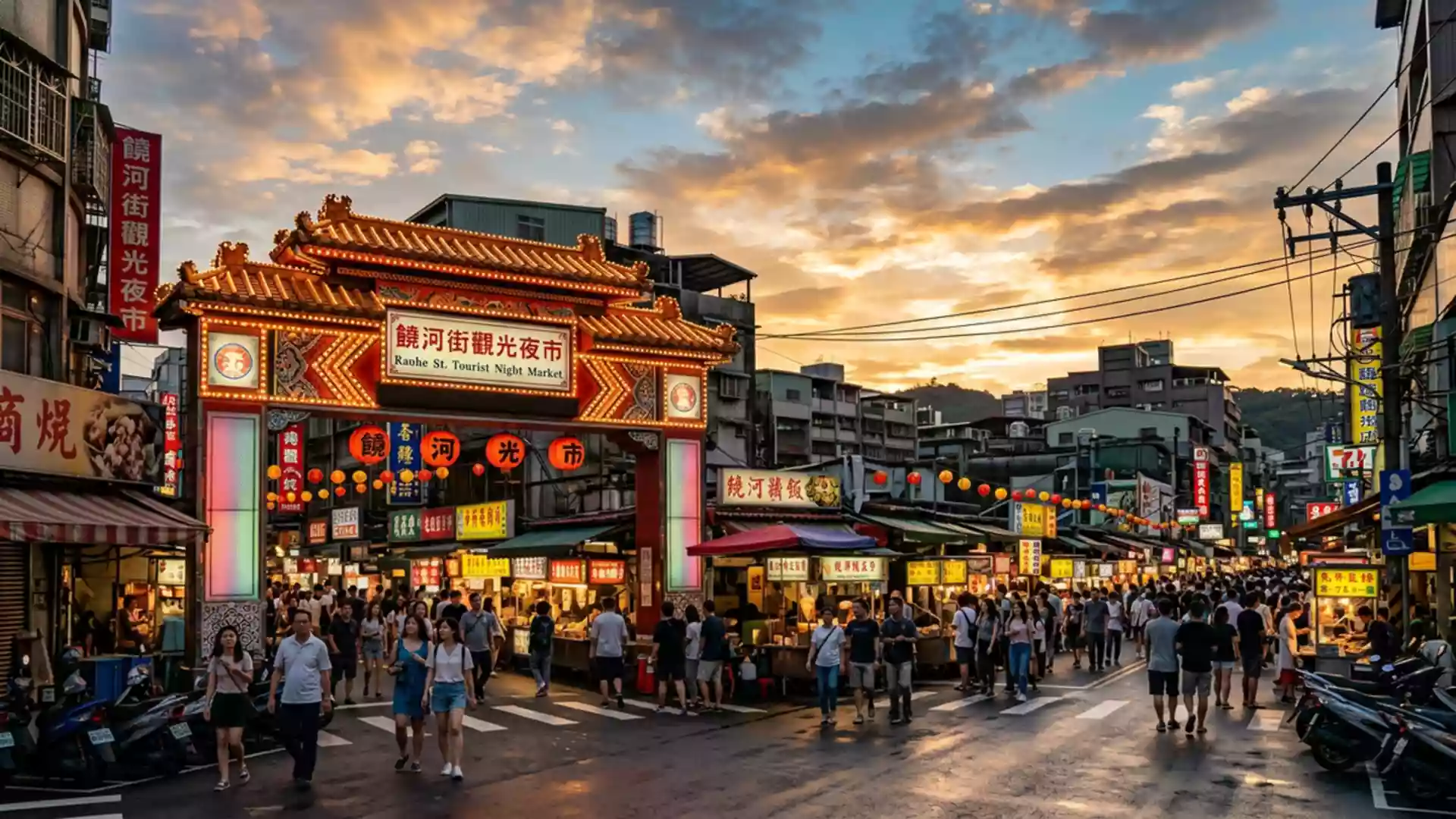
Raohe Yeshi in Taipeh: a night market wrapped around a temple
Published on 09/03/2026 at 21:06 | Editorial responsibility: Rafael Müller, Editor-in-Chief AD HOC NEWS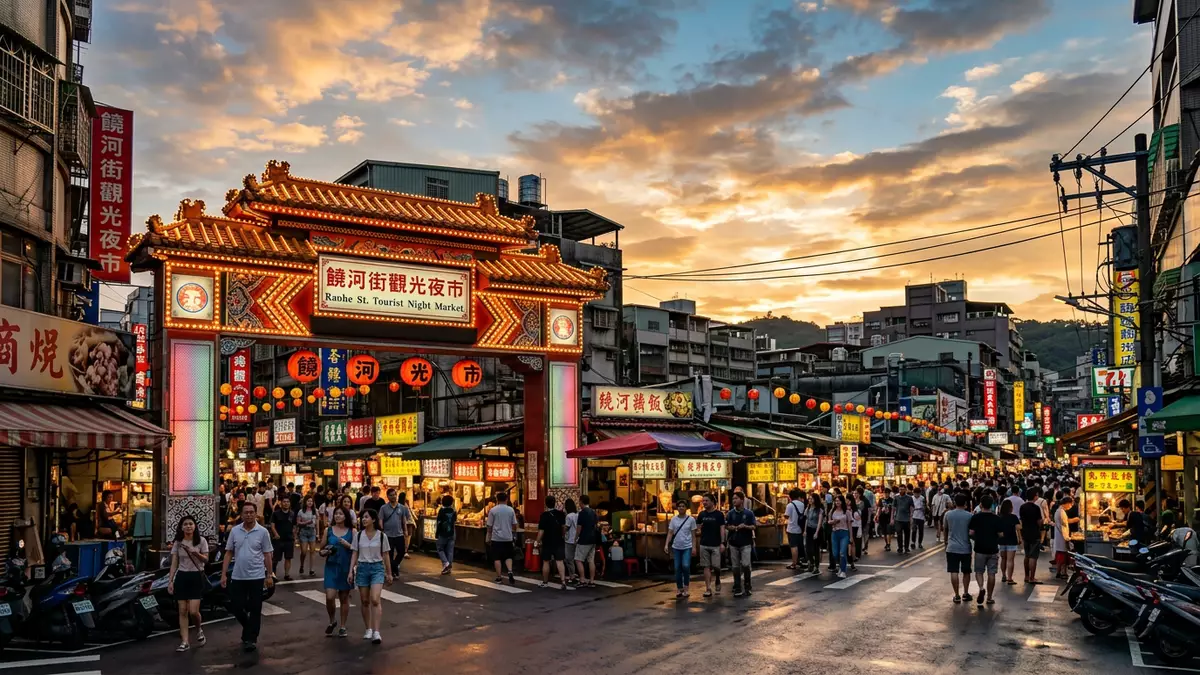
Raohe Yeshi in Taipeh is a compact night market laid out along one straight street, framed at one end by the ornate Songshan Ciyou Temple and lined throughout with dense rows of stalls and shopfronts. Set in the Songshan District of eastern Taipei, the market occupies a stretch of Raohe Street that was formally organised as a tourist night market in 1987, drawing on an older riverside trading neighbourhood beside the Keelung River.
A single corridor of stalls between gates and temple
Raohe Yeshi follows Raohe Street for about 600 m (1,969 ft), forming a continuous pedestrian corridor that fills the roadway between decorative entrance arches and the temple frontage.about 600 meters long Stalls and small premises face each other across this narrow lane, their signs and canopies creating a tightly enclosed passage with only occasional breaks where side streets intersect.
At one end stands a decorated archway marking the official entrance to what is designated the Raohe Street Tourist Night Market, while the other end opens towards the road network around Songshan Station and the Keelung River embankment.Raohe Street Tourist Night Market is located on Raohe Street, Taipei, 600 meters in length Within this frame, the market reads as a single ribbon of trade: food vendors, clothing stands, household goods and small game stalls repeat along the street, with illuminated arches spanning above.
Songshan Ciyou Temple and the older riverside quarter
Songshan Ciyou Temple anchors one end of Raohe Yeshi, its multi-tiered rooflines, lanterns and carved facades forming a backdrop to the entrance gate and the first sequence of stalls.Ciyou Temple, founded in 1753, is one of the prominent landmarks in the area The temple is dedicated to the sea goddess Mazu, reflecting the maritime and mercantile links that once defined this part of Taipei.Songshan Ciyou Temple founded in 1753 and dedicated to Mazu
The wider neighbourhood was historically known as Xikou, a riverside hub where deep water on the Keelung River made it a transfer point for goods moving between ports such as Keelung and the city centre.this area was called Xikou and was a business center because of its location and transportation Shophouses along what is now Raohe Street formed a commercial strip serving traders and worshippers heading to the temple, and the later designation as a tourist night market in 1987 formalised activity in a district whose trading character reaches back into the nineteenth century.
From local marketplace to designated tourist night market
Before its formal recognition as a tourist night market, Raohe Street functioned as a general marketplace and wet market, with daytime stalls and local trade reported along the road and near the riverside.Raohe Night Market started out as a morning wet market near the riverside In 1987, municipal authorities in Taipei established Raohe Street as one of the city’s tourist night markets, restructuring the corridor into a dedicated evening trading zone that retained its small-scale vendors while adding formal gateways and branding.the government set up a night market in 1987
That change marked Raohe Yeshi as one of Taipei’s earliest officially organised tourist night markets, and it has since become a reference point for visitors seeking a night market laid out along a single, recognisable street.one of Taipei’s oldest officially organized tourist night markets Despite this relatively recent designation, the market’s fabric and context are rooted in a long-standing pattern of temples, shophouses and river trade, which continues to shape the way stalls cluster around the temple entrance and the arches of Raohe Street.
Visiting Raohe Yeshi: what travellers from Western Europe should know
- Raohe Yeshi lies in the Songshan District of Taipeh, on Raohe Street near Songshan Station and the Keelung River embankment, in the north-eastern part of the city.
- The market occupies a straight stretch of roadway closed to traffic, and visitors walk along a relatively narrow lane where stalls and shopfronts line both sides.
- Songshan Ciyou Temple stands directly beside one entrance to Raohe Yeshi, and its multi-storey structure can be explored alongside the market during a visit.
- The official language is Chinese and the currency is the New Taiwan dollar.
- Entry requirements depend on your nationality; UK travellers can check the FCDO travel advice at gov.uk/foreign-travel-advice, Irish travellers the Department of Foreign Affairs at ireland.ie.
Searching for Raohe Yeshi on social platforms
These links open searches for Raohe Yeshi on each platform.
Frequently asked questions about Raohe Yeshi
Where is Raohe Yeshi in Taipeh?
Raohe Yeshi occupies a designated night market stretch of Raohe Street in the Songshan District of Taipeh, close to Songshan Station and the Keelung River.
What should visitors expect on a visit to Raohe Yeshi?
Visitors walk along a single pedestrian street lined with food stalls, small shops and illuminated arches, with Songshan Ciyou Temple forming a prominent backdrop at one entrance.
What makes Raohe Yeshi distinctive among Taipeh’s markets?
The combination of a straight, 600 m (1,969 ft) corridor of stalls and the immediate presence of the eighteenth-century Songshan Ciyou Temple gives Raohe Yeshi a clear, temple-centred character.