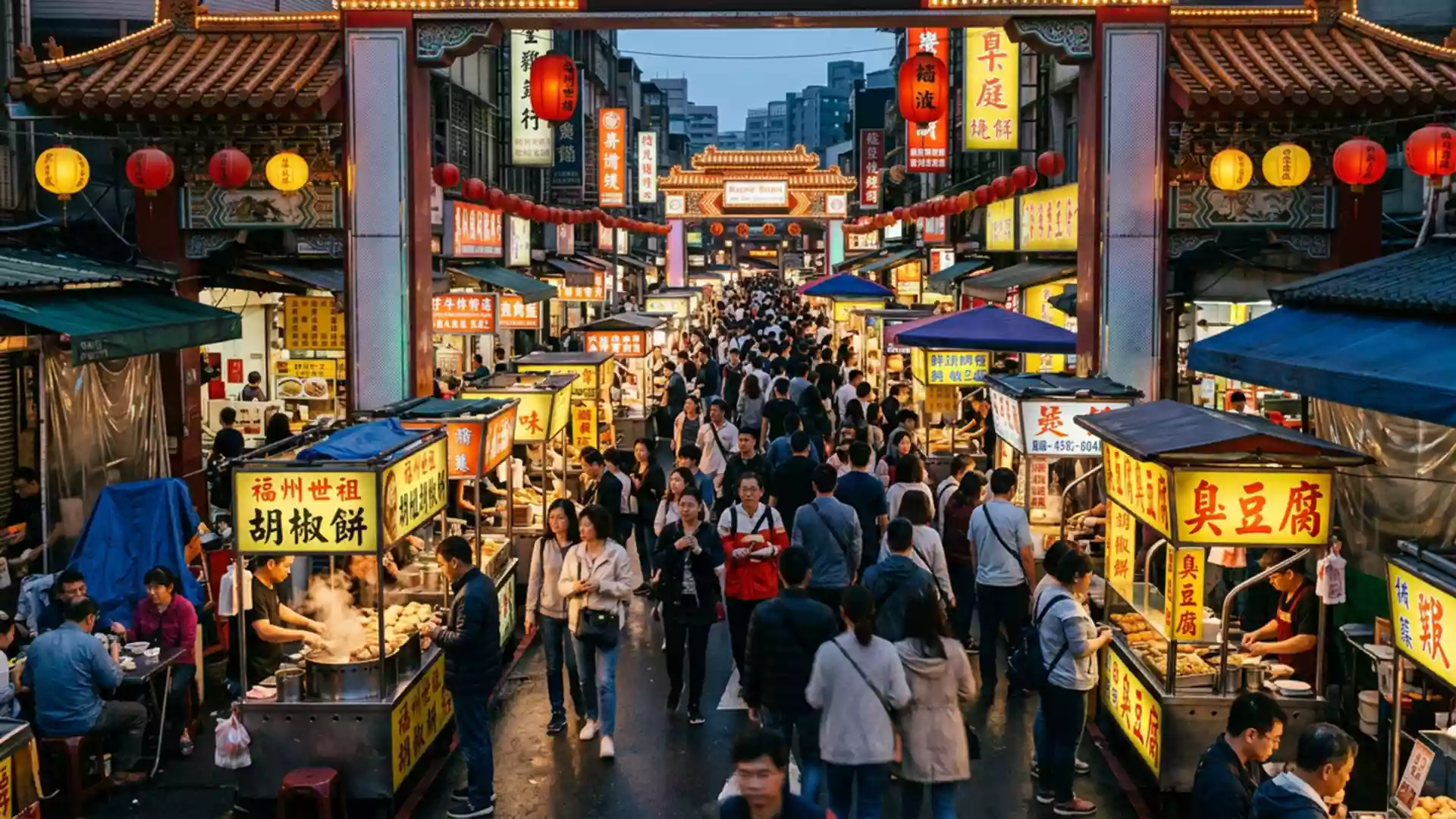
Raohe Yeshi in Taipeh: a night market framed by a temple
Published on 09/15/2026 at 06:32 | Editorial responsibility: Rafael Müller, Editor-in-Chief AD HOC NEWS
Raohe Yeshi in Taipeh is a compact night market laid out along Raohe Street, framed at one end by Songshan Ciyou Temple and at the other by a street gate. Anchored in the Songshan District of eastern Taipei, it occupies a pedestrian corridor beside the Keelung River that has been formally organised as a tourist night market since 1987, drawing on a longer trading tradition in this part of Taiwan.
A straight street turned into a night market
The core of Raohe Yeshi is a single line of stalls arranged along Raohe Street in Songshan District, where the city authorised a tourist night market in 1987 on an already commercial stretch of road.tourist night market The formal designation on Raohe Street placed the market among Taipei’s early organised night markets and confirmed its role as an evening trading strip in eastern Taipeh.Raohe Street Night Market The stalls run between two arched gates on the street, creating a defined entrance and exit and turning the market into a corridor that visitors can walk from end to end.
Raohe Yeshi sits in Songshan, a district that grew as a mixed residential and commercial area near the Keelung River, and the night market follows the alignment of the street rather than forming a square or enclosed court.runs between two arched gates The location beside the river and close to rail connections at Songshan Station links the market to wider movements of people and goods, while still keeping its footprint on a single, walkable road segment. That straight layout makes the night market easy to grasp: there is one clear route, lined with vendors and framed by gates.
Songshan Ciyou Temple as a permanent neighbour
At one end of Raohe Yeshi stands Songshan Ciyou Temple, a richly decorated temple dedicated to the sea goddess Mazu and first completed in 1753.Songshan Ciyou Temple The temple is a major landmark in eastern Taipei and forms part of the identity of the night market, its lanterns, rooflines and carved facades appearing directly behind one of the market’s gates.Songshan Ciyou Temple With the temple so close to the stalls, Raohe Yeshi is one of the places in Taipeh where religious architecture and everyday commerce sit side by side in a continuous streetscape.
Ciyou Temple’s presence predates the formal night market by more than two centuries, and the neighbourhood around the temple developed as a centre for worshippers, traders and travellers long before the 1987 tourist market designation.founded in 1753 The temple is associated with Mazu, a sea deity venerated across Taiwan, and the complex includes richly decorated halls and shrines that remain active throughout the day.dedicated to Mazu Standing at the entrance to Raohe Yeshi, it forms both a visual anchor and a point of continuity, tying the modern street market to older religious and trading patterns.
Raohe Yeshi in the wider Taipeh landscape
Raohe Yeshi belongs to the family of night markets that have become a distinctive feature of urban life in Taipei and other cities in Taiwan, and it occupies a compact site in Songshan rather than spreading across multiple streets.one of Taipei’s oldest The market lies close to Songshan Station on the Taipei Metro and mainline rail network, making it straightforward to reach from other parts of the city by train.near the Songshan MRT station Streets around the market mix residential buildings with small businesses, so the evening crowd moves through a neighbourhood that still carries everyday life.
The Keelung River runs nearby, forming a natural boundary to this part of eastern Taipei, and bridges and embankments along the river can be seen from sections of Raohe Street.beside the Keelung River The combination of river, station and temple makes Raohe Yeshi a compact summary of eastern Taipei’s layout: transport infrastructure on one side, religious architecture at the gate, and a line of evening trading in between. For visitors from Western Europe, it is one of the clearest examples in Taipeh of how a single street can condense transport, worship and commerce.
Visiting Raohe Yeshi: what travellers from Western Europe should know
- Raohe Yeshi is on Raohe Street in the Songshan District of eastern Taipei, close to the Keelung River and near Songshan Station on the Taipei Metro and rail network.
- The market occupies a single pedestrian street with arched gates at each end, so moving through it involves walking along a paved corridor shared with stall structures and other visitors.
- Songshan Ciyou Temple stands directly beside one of the market entrances, and its steps, halls and courtyards add an additional level of movement for anyone combining a temple visit with the night market.
- The official language is Chinese and the currency is the New Taiwan dollar.
- Entry requirements depend on your nationality; UK travellers can check the FCDO travel advice at gov.uk/foreign-travel-advice, Irish travellers the Department of Foreign Affairs at ireland.ie.
Searching for Raohe Yeshi on social platforms
These links open searches for Raohe Yeshi on each platform.
Frequently asked questions about Raohe Yeshi
Where is Raohe Yeshi located in Taipeh?
Raohe Yeshi is on Raohe Street in the Songshan District of eastern Taipei, close to Songshan Station and beside the Keelung River.
What can visitors expect when walking through Raohe Yeshi?
Visitors move along a single pedestrian street lined with stalls, passing under arched gates and seeing Songshan Ciyou Temple standing directly beside one of the market entrances.
What makes Raohe Yeshi distinctive among Taipei’s night markets?
Its compact, straight layout along one street, combined with the presence of Songshan Ciyou Temple, gives Raohe Yeshi a clear structure that ties evening trading to a historic religious landmark.