
Ranthambore National Park where a medieval fort meets tiger forest
Published on 08/26/2026 at 20:17 | Editorial responsibility: Rafael Müller, Editor-in-Chief AD HOC NEWS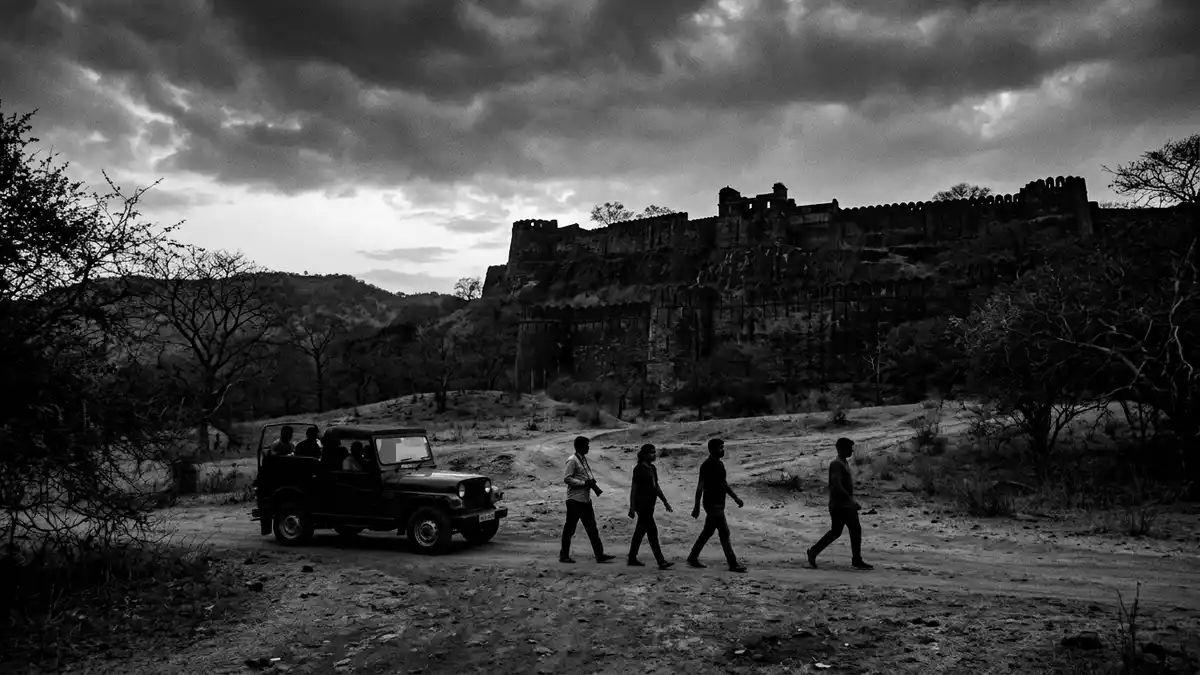
Ranthambore National Park in Rajasthan’s Sawai Madhopur district brings together dry forest, rocky hills and the stone bulk of Ranthambore Fort in a single protected landscape. Established as a wildlife sanctuary in the mid twentieth century and declared a national park in 1980, it is one of India’s better known tiger reserves and a striking example of how a mediaeval stronghold and a modern conservation area can occupy the same ground.
Fortress on a forested plateau
The setting of Ranthambore National Park is defined by a plateau framed by the Aravalli and Vindhya hill ranges, broken by cliffs and studded with lakes and waterholes. Within this terrain, the mediaeval Ranthambore Fort stands on a high outcrop, giving the park both its name and its most recognisable landmark, and turning a visit into a combined encounter with wildlife and stone architecture.Ranthambore National Park derives its name from the historic Ranthambore Fort
The fort itself belongs to a long sequence of Rajput power in this part of Rajasthan. It is associated with the Chauhan dynasty and Sapaldaksha in the tenth century, anchoring the park in a mediaeval political landscape long before conservation entered the picture.The fort is linked to the Chauhan Rajput king Sapaldaksha and dated to the tenth century The stone walls, gateways and temples on the plateau sit above open forest and marshes where deer, monkeys and other animals move below the ramparts.
From hunting ground to tiger reserve
Ranthambore’s twentieth-century story is one of gradual transformation from royal hunting ground to a core part of India’s Project Tiger network. The forests around the fort were declared the Sawai Madhopur Game Sanctuary in 1955 under India’s post-independence conservation laws, marking an early attempt to protect the area’s wildlife.The area was notified as the Sawai Madhopur Game Sanctuary in 1955
In 1973 the reserve became part of Project Tiger, the nationwide programme launched by the Government of India to safeguard Bengal tigers, and in 1980 an inner section of the sanctuary was designated as Ranthambore National Park.Ranthambore was brought under Project Tiger in 1973 and declared a national park on 1 November 1980 Subsequent expansions in 1991 brought the neighbouring Sawai Man Singh and Kailadevi sanctuaries into the wider tiger reserve, creating a large core and buffer area around the original park.
Tigers, lakes and dry deciduous forest
Ranthambore National Park is known for its Bengal tigers, which move through a landscape of dry deciduous forest, scrub and open grassland interspersed with lakes. The park’s core covers just under 400 sq km, while the wider tiger reserve, including buffer forests, extends over more than 1,300 sq km, giving tigers, leopards and other large mammals space to range.The tiger reserve area was enlarged in 1991 to about 1,334 sq km including Sawai Man Singh and Keladevi sanctuaries
A drive through the park passes dhok trees, seasonal streams and reservoirs such as Padam Talao, where chital and sambar deer, langurs and birdlife gather along the water’s edge.The reserve’s fauna includes Royal Bengal tigers, leopards, hyenas, jackals, nilgai, sambar, chital, langurs, sloth bears and a large number of bird species The combination of open forest and waterbodies gives relatively clear views across the terrain, making it easier to see larger animals than in denser jungle, although sightings are never guaranteed.
Visiting Ranthambore National Park: what travellers from Western Europe should know
- Ranthambore National Park lies in the Sawai Madhopur district of southeastern Rajasthan in India, and the nearest major city by rail and road is Jaipur to the north-west.
- The park entrance is reached from Sawai Madhopur town by a road that climbs gently towards the forest edge, and internal tracks can be uneven and dusty.
- The terrain combines low hills and plateaux with shallow valleys and lakes, so wildlife drives involve some bumpy sections and occasional short climbs to reach higher viewpoints.
- The national park forms part of a wider tiger reserve that is bounded by the Banas River to the north and the Chambal River to the south, giving it clearly defined natural edges.
- The official language is Hindi and the currency is the Indian rupee. Entry requirements depend on your nationality; UK travellers can check the FCDO travel advice at gov.uk/foreign-travel-advice, Irish travellers the Department of Foreign Affairs at ireland.ie.
Searching for Ranthambore National Park on social platforms
These links open searches for Ranthambore National Park on each platform.
Frequently asked questions about Ranthambore National Park
Where is Ranthambore National Park?
Ranthambore National Park is in the Sawai Madhopur district of Rajasthan in northern India, between the Banas and Chambal rivers and south-east of Jaipur.
What can visitors expect on a visit?
Visitors travel by shared vehicles along forest tracks, passing dry deciduous forest, lakes and rocky hills, with the chance of seeing tigers, deer, monkeys and a wide range of birds.
What makes Ranthambore National Park distinctive?
Ranthambore is distinctive because a mediaeval hill fort and temples stand inside a protected tiger reserve, so stone walls, reservoirs and palace ruins rise above a living wildlife landscape.


