
Ranthambore National Park and its fort: tigers among ancient stone
Published on 08/14/2026 at 14:02 | Editorial responsibility: Rafael Müller, Editor-in-Chief AD HOC NEWS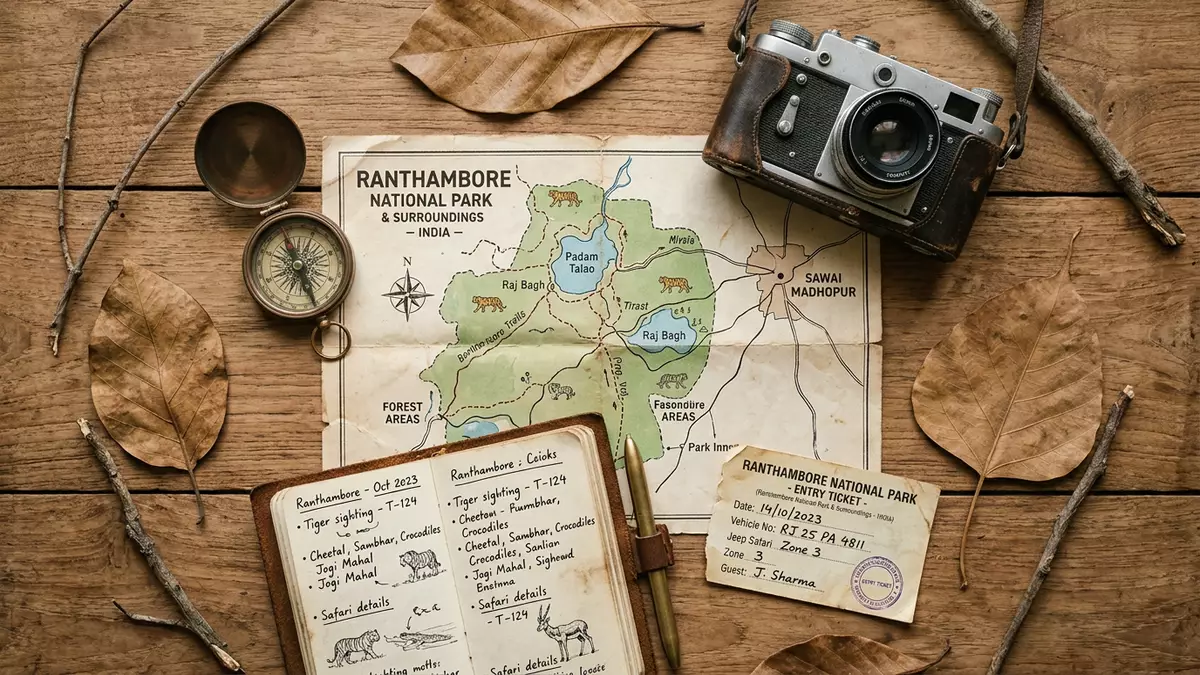
Ranthambore National Park in Sawai Madhopur, Rajasthan, is one of India’s best-known tiger reserves, where dry forest, ancient ruins and the hilltop Ranthambore Fort share the same rugged landscape. The protected area grew out of the former Sawai Madhopur Game Sanctuary in the mid?twentieth century and became a national park in 1980, anchoring conservation efforts around the Bengal tiger in this part of India.
A tiger reserve shaped by forest and rock
Ranthambore National Park lies in eastern Rajasthan, in a belt of hills and plateaus cut by seasonal streams and forested valleys. The park’s core is dominated by dry deciduous forest, scrub and open grassland, broken by patches of rocky outcrop and small lakes that hold water during the cooler months. This mix of cover and open ground is one reason tigers are regularly seen moving through ruins, along tracks and around water bodies, with the stone of the old structures and the pale trunks of dhok trees forming a distinctive backdrop.Ranthambore National Park
Before independence, these forests were the private hunting grounds of the rulers of Jaipur, and royal shikar parties came here to pursue tigers and other large game among the cliffs and valleys surrounding the fort.the hunting grounds of Jaipur That history is part of what makes the park unusual: big cats still move through the same terrain where palaces, pavilions and walls stand in varying states of decay, and some of these structures now serve as viewpoints for watching wildlife rather than as venues for hunts.
From game sanctuary to Project Tiger reserve
The modern story of Ranthambore begins in 1955, when the forest around the fort was declared the Sawai Madhopur Game Sanctuary, ending commercial exploitation of timber and other forest produce in the core area.Sawai Madhopur Game Sanctuary In 1973, Ranthambore was chosen as one of the original reserves under India’s Project Tiger programme, which focused national attention on the conservation of the Bengal tiger and set out a framework for protecting core habitats.
In 1980 a core area of around 282 km² (109 sq mi) was notified as Ranthambore National Park, carving out a protected zone around the fort and its surrounding forest.declared a national park in 1980 Over the following years, additional forest to the north and south was brought under protection as the Keladevi and Sawai Mansingh Sanctuaries, and these areas were later added to the Ranthambore Tiger Reserve to create a larger mosaic of connected habitat.Keladevi and Sawai Mansingh Sanctuaries The protected landscape that visitors see today therefore reflects decades of incremental legal changes as the focus shifted from sport hunting to wildlife protection.
Ranthambore Fort above the forest
High above the forests of Ranthambore National Park stands Ranthambore Fort, a large hilltop stronghold whose walls and bastions crown a plateau within the protected area.Ranthambore Fort The fort is associated with the Chahamana dynasty and other Rajput rulers and has a history that runs back close to a millennium, linking the site to medieval conflicts and later Mughal rule.fort dating back to the Chahamanas dynasty
Ranthambore Fort forms part of the group of hill forts of Rajasthan that has been inscribed as a UNESCO World Heritage Site, recognising both its architecture and its strategic position over the surrounding landscape.UNESCO World Heritage Site From the ramparts and temple courtyards, views open out over forest, lakes and escarpments where tigers, deer and other wildlife move below the ancient stone. The juxtaposition of a fortified hill with the protected forest at its base is one of the defining images of Ranthambore, and many visitors combine time on the tracks in the national park with a walk through the fort’s gateways and ruins.
Visiting Ranthambore National Park: what travellers from Western Europe should know
- Ranthambore National Park lies near the town of Sawai Madhopur in eastern Rajasthan, which sits on a main railway route linking major cities in northern India; Sawai Madhopur Junction is the principal rail station for reaching the park.
- The terrain inside the park and around Ranthambore Fort includes uneven forest tracks, rocky slopes and staircases on the hill, so walks and drives involve surfaces that can feel rough underfoot and require stable footwear.
- Located in India outside the European Union, the official language in the region is Hindi and the currency is the Indian rupee.
- Entry requirements depend on your nationality; UK travellers can check the FCDO travel advice at gov.uk/foreign-travel-advice, Irish travellers the Department of Foreign Affairs at ireland.ie.
Searching for Ranthambore National Park on social platforms
These links open searches for Ranthambore National Park on each platform.
Frequently asked questions about Ranthambore National Park
Where is Ranthambore National Park located?
Ranthambore National Park is in eastern Rajasthan, near the town of Sawai Madhopur in northern India, with the protected forest and fort lying close to the town.
What should visitors expect on a visit to Ranthambore?
Visitors encounter dry forest, rocky hills, lakes and historic ruins, with tracks and viewpoints where vehicles and guided walks bring them into the landscape used by tigers and other wildlife.
What makes Ranthambore National Park distinctive among India’s protected areas?
Ranthambore stands out for the combination of a long?established tiger reserve and the hilltop Ranthambore Fort, part of a UNESCO?listed group of hill forts, sharing a single dramatic setting.


