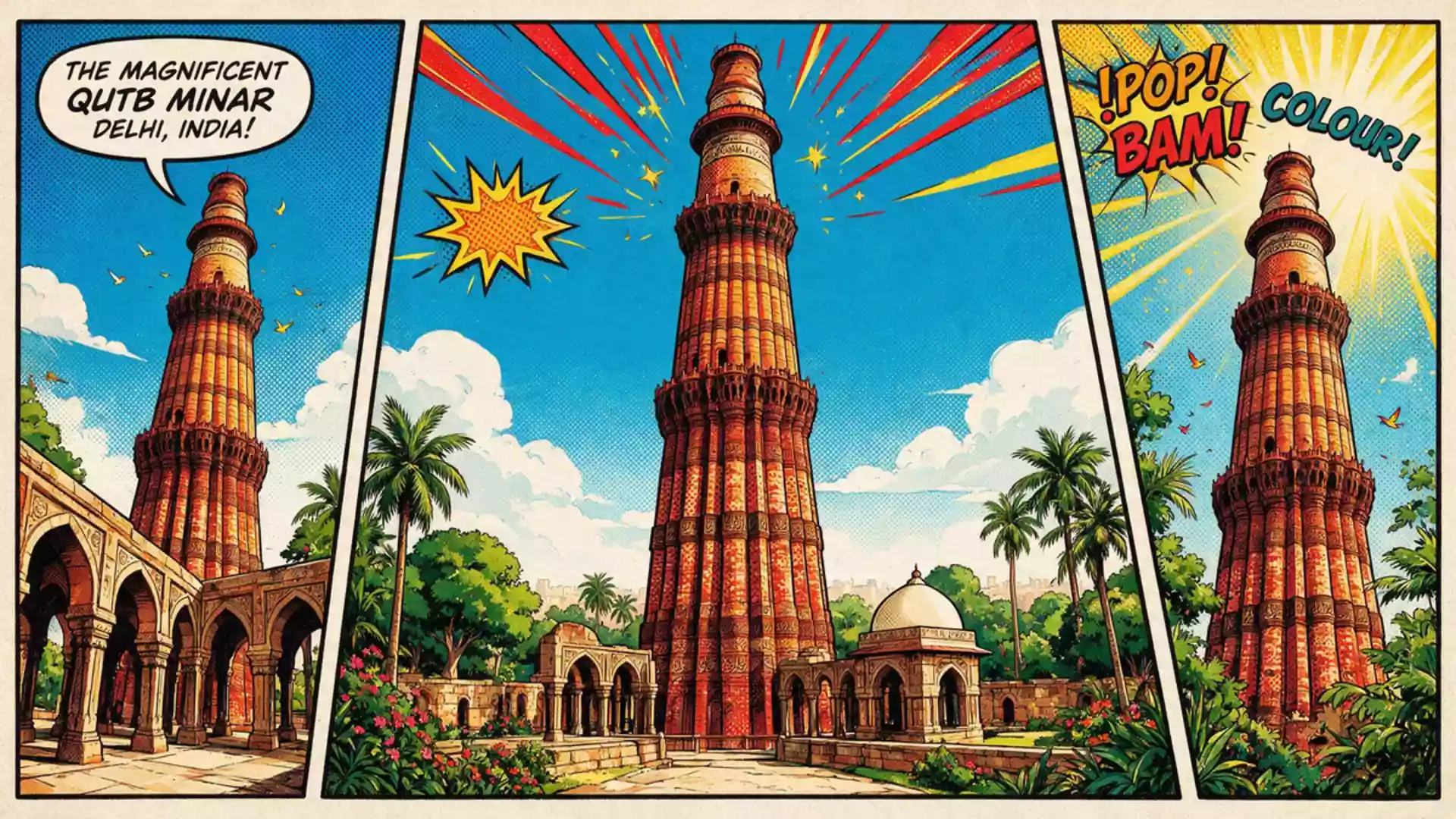
Qutb Minar, Delhi’s tower of stone and sky
Published on 09/04/2026 at 07:30 | Editorial responsibility: Rafael Müller, Editor-in-Chief AD HOC NEWS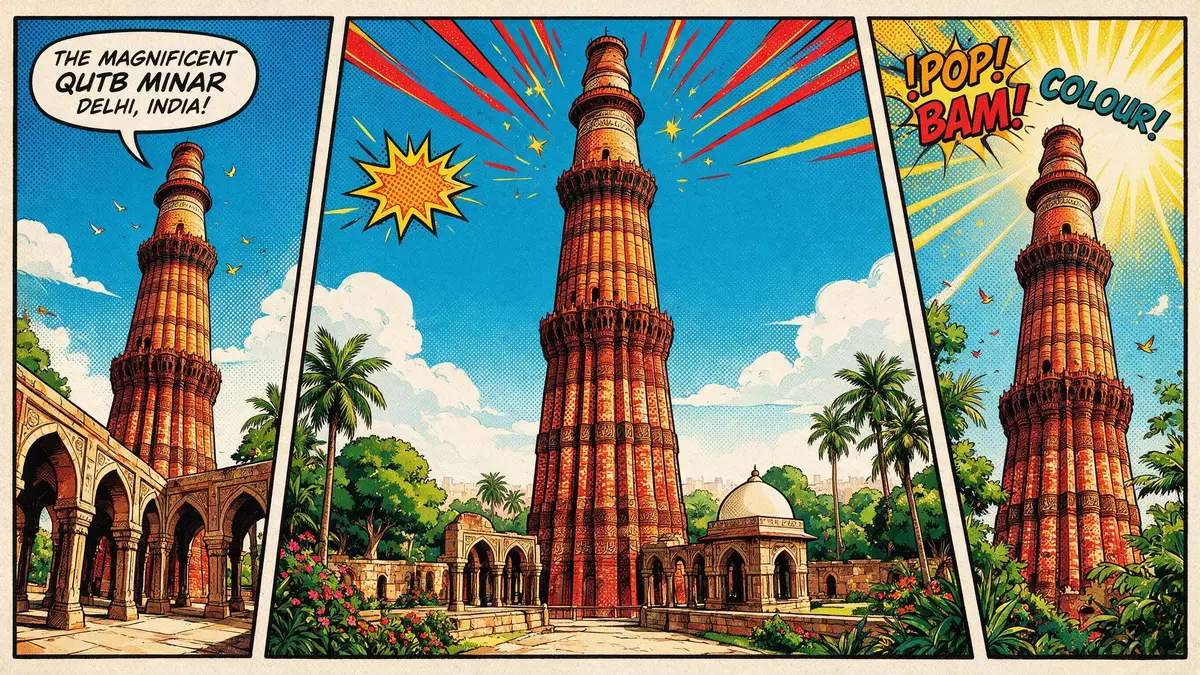
Qutb Minar in Delhi is a towering minaret of red sandstone and marble, rising above the historic Mehrauli area and anchored in the early Delhi Sultanate. Its shaft, carved with bands of inscriptions and geometric ornament, turns a functional tower into a vertical record of changing rulers and styles in medieval north India.
A sandstone victory tower of the thirteenth century
Qutb Minar stands within the Qutb complex in Mehrauli, in the southern part of Delhi, and forms the focal monument of a group of early Sultanate structures. The tower is part of the ensemble recognised as the World Heritage site “Qutb Minar and its Monuments”, inscribed on the UNESCO list in 1993.Qutb Minar and its Monuments The minaret is built mainly of red and buff sandstone, with marble inlays, and was begun around the end of the twelfth century under Qutb-ud-din Aibak, the first ruler of the Delhi Sultanate.Qutb-ud-din Aibak, founder of the Delhi Sultanate
The tower rises in five tapering storeys and reaches a height of about 72.5 m (238 ft), making it the tallest brick minaret in India and among the highest masonry towers in the country.a column built of red and buff sandstone The lower levels belong to the earliest phase under Aibak and his successor Shamsuddin Iltutmish in the early thirteenth century, while the upper storey reflects later fourteenth-century work under Firuz Shah Tughlaq.Aibak, Iltutmish and Firuz Shah Tughlaq From a distance, the shaft reads as a single column; up close, it reveals alternating bands of angular and rounded fluting, projecting balconies and varying stone colours.
The Qutb complex around the minaret
Qutb Minar does not stand alone. It rises beside the ruins and surviving fabric of the Quwwat-ul-Islam Mosque, regarded as the first congregational mosque built in Delhi under the new Sultanate in the late twelfth century.the Quwwat-ul-Islam Mosque The prayer hall, courtyard and arcades of this mosque form a stone framework around the base of the minaret, giving visitors a sense of how the tower once announced the call to prayer over an extensive religious complex.
Within the same enclosure stands the much older Iron Pillar, a wrought-iron column that has resisted significant corrosion for well over a millennium and carries Sanskrit inscriptions from the Gupta period.the Iron Pillar Nearby is the Alai Darwaza, a domed gatehouse built in 1311 under Sultan Alauddin Khalji as a southern entrance to the mosque. It is constructed of red sandstone with marble detailing and is often singled out as an early fully developed example of Indo-Islamic architecture in Delhi.Alai Darwaza in the Qutb complex Tombs and smaller structures from successive Sultanate dynasties dot the surrounding gardens, turning a visit into a walk through layered architectural history.
Detail, inscription and changing styles on the tower
Seen close to its base, Qutb Minar reveals a dense surface of calligraphy and ornamental carving rather than a plain shaft. Bands of Kufic and later naskh script record verses from the Qur’an alongside commemorative texts naming Qutb-ud-din Aibak, Shamsuddin Iltutmish and Firuz Shah Tughlaq, marking the stages of construction and repair.fluted sandstone tower with inscriptional bands The lowest storeys combine corbelled mouldings and decorative motifs derived from earlier north Indian building traditions with the pointed arches and more strictly Islamic geometry that became characteristic of later work.
The tower’s profile changes slightly from level to level, reflecting these shifts in style and technique. The lower sections have pronounced fluting and largely sandstone construction, while higher parts incorporate more marble and different patterns of panelling. Each projecting balcony marks the transition between storeys and is carried on stone brackets carved with stalactite-like forms. Together, these details make Qutb Minar a visible record of how craftsmen in Delhi adapted local materials and established forms to the priorities of successive Sultanate rulers.
Visiting Qutb Minar: what travellers from Western Europe should know
- Qutb Minar stands in the Mehrauli district in South Delhi, a historic area reached by road and by the city’s metro network, with stations serving the wider Qutb complex.
- The site is laid out as a walled complex with stone-paved paths and garden areas; within it, visitors encounter uneven historic surfaces and steps between levels, especially around the mosque remains.
- The complex lies at low elevation on the northern plains of India, with summer heat and humidity that can be intense; shade is provided mainly by trees and the shadows of buildings.
- The official language is Hindi and the currency is the Indian rupee.
- Entry requirements depend on your nationality; UK travellers can check the FCDO travel advice at gov.uk/foreign-travel-advice, Irish travellers the Department of Foreign Affairs at ireland.ie.
Searching for Qutb Minar on social platforms
These links open searches for Qutb Minar on each platform.
Frequently asked questions about Qutb Minar
Where is Qutb Minar located?
Qutb Minar is in the Mehrauli district of South Delhi in India, forming part of the Qutb complex of early Delhi Sultanate monuments.
What should visitors expect when exploring the site?
Visitors walk through a large walled complex with gardens, mosque remains and other monuments, and experience Qutb Minar rising above surrounding stone structures.
What makes Qutb Minar distinctive among Delhi’s monuments?
Its great height, fluted stone surface and dense bands of inscriptions, combined with its role as the centrepiece of a World Heritage complex, make Qutb Minar distinctive.