
Qutb Minar, a spiralling tower of stone and script
Published on 08/26/2026 at 08:59 | Editorial responsibility: Rafael Müller, Editor-in-Chief AD HOC NEWS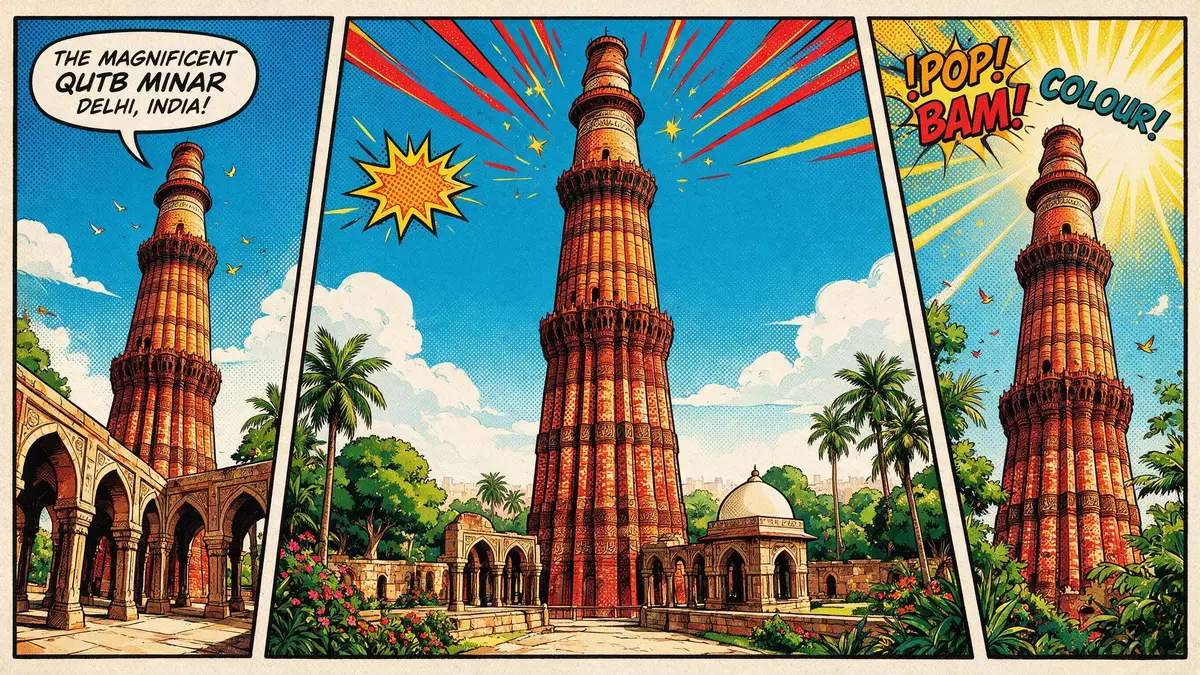
Qutb Minar rises over the southern fringe of Delhi as a tall medieval tower of red sandstone and marble, its tapering shaft wrapped in bands of carved script. Built under the Delhi Sultanate in the early thirteenth century, it anchors a wider complex of mosques, gateways and tombs that together form one of India’s earliest great ensembles of Indo-Islamic architecture.
A medieval victory tower in stone
The story of Qutb Minar begins around 1199, when Qutb-ud-din Aibak, founder of the Mamluk or Slave dynasty and first Sultan of Delhi, ordered the construction of a towering minaret beside a congregational mosque in Mehrauli.Qutb-ud-din Aibak The tower rose in stages under successive rulers of the Delhi Sultanate, with Shams-ud-din Iltutmish extending it upwards in the early thirteenth century and later Firoz Shah Tughlaq completing and repairing its upper sections.early thirteenth century
Measured from its stone plinth, Qutb Minar stands about 72.5 m (238 ft) high, tapering markedly as it climbs.72.5 m (238 ft) high The lower sections are built in red sandstone, while later stages introduce bands and panels of pale sandstone and marble, creating a pronounced contrast in colour and texture along the shaft.red and light sandstone
Carved bands, projecting balconies
From the courtyard of the surrounding complex, the most striking aspect of Qutb Minar is its alternating fluted surfaces and the dense calligraphic bands that encircle each stage.fluted sandstone tower The stone is chiselled into vertical grooves that change profile from one tier to the next, catching the strong Delhi light and throwing sharp shadows across the tower’s surface.
Each of the five principal stages ends in a projecting balcony, carried on stone brackets carved with geometric and vegetal motifs.five principal stages Above the highest gallery, the tower narrows to a short final section which completes the silhouette familiar from textbooks and travel posters of Delhi.
The wider Qutb complex
Qutb Minar does not stand in isolation but forms part of the Qutb complex, a group of early Sultanate monuments in Mehrauli recognised as a UNESCO World Heritage Site.Qutb Minar and its Monuments, Delhi At its base lies the Quwwat-ul-Islam Mosque, begun in the late twelfth century and considered the earliest extant congregational mosque in northern India.
Within the same enclosure stands the famous Iron Pillar, a much older column from the Gupta period, whose corrosion-resistant iron has long drawn the interest of historians of metallurgy.Iron Pillar Nearby, the Alai Darwaza, completed in 1311 under Alauddin Khalji, presents a compact domed gateway faced in red sandstone and white marble, with intricate stone latticework framing its pointed arches.Alai-Darwaza Gate
Visiting Qutb Minar: what travellers from Western Europe should know
- Qutb Minar stands in the Mehrauli area of south Delhi, a little way south-west of the historic centre, and is reached by road and the Delhi Metro network.
- The complex is laid out on largely level ground, but visiting involves walking between scattered ruins and courtyards on uneven stone and packed earth paths.
- The surrounding monuments include roofed halls and open courtyards, so visitors move between areas of direct sun and deep shade during a circuit of the site.
- The official language is Hindi and the currency is the Indian rupee. Entry requirements depend on your nationality; UK travellers can check the FCDO travel advice at gov.uk/foreign-travel-advice, Irish travellers the Department of Foreign Affairs at ireland.ie.
Searching for Qutb Minar on social platforms
These links open searches for Qutb Minar on each platform.
Frequently asked questions about Qutb Minar
Where is Qutb Minar located?
Qutb Minar stands in the Mehrauli district of south Delhi, in northern India, within a larger archaeological complex of early Sultanate monuments.
What can visitors expect to see at Qutb Minar?
Visitors encounter the tall stone minaret itself, the remains of the Quwwat-ul-Islam Mosque, later gateways such as the Alai Darwaza and the much older Iron Pillar.
What makes Qutb Minar distinctive among historic towers?
Qutb Minar combines its considerable height with a richly articulated exterior, alternating fluted surfaces, carved calligraphy bands and contrasting layers of red sandstone and pale stone.


