
Quebrada de Humahuaca, a painted Andean corridor of history
Published on 08/18/2026 at 13:35 | Editorial responsibility: Rafael Müller, Editor-in-Chief AD HOC NEWS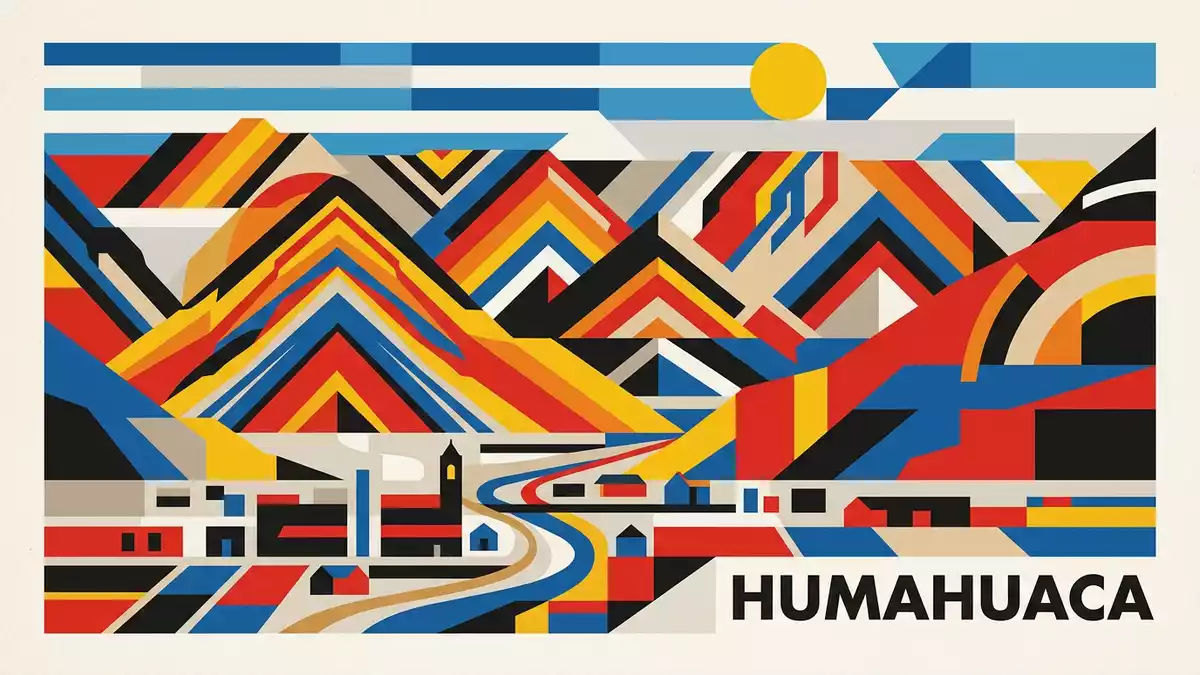
Quebrada de Humahuaca is an Andean valley in the province of Jujuy in northern Argentina, recognised as a cultural landscape on the UNESCO World Heritage List since 2003.UNESCO World Heritage List Stretching for about 155 km (96 mi) along the valley of the Río Grande, it forms a north–south corridor linking the high plateau of the Puna with the eastern lowlands and plains.155 km corridor
An Andean valley painted in geology and altitude
Quebrada de Humahuaca follows the course of the Río Grande de Jujuy, a river that has carved a narrow valley between mountain chains over thousands of years.narrow mountainous valley The valley lies between roughly 1,600 m and 4,500 m (5,250–14,760 ft) above sea level, so every journey through it is a movement through altitude as well as distance.altitude range Exposed sedimentary layers form slopes in reds, ochres, greens and greys, and in places entire hillsides are banded with colour, a visible record of geological time.
The corridor runs from the cold high desert plateau of the High Andean lands down to its confluence with the Río León to the south, where the valley opens towards lower country.High Andean plateau to Río León Along the way, towns and villages such as Purmamarca, Tilcara and Humahuaca stand on terraces above the river, framed by coloured hills and alluvial fans that show how water and gravity have shaped the landscape.towns and landforms The result is a valley where human settlements, cultivated plots and Andean geology sit together in a single visual sweep.
A corridor of cultures and routes over 10,000 years
Quebrada de Humahuaca is not only a landscape; it is a route that has carried people, goods and ideas for around 10,000 years between the Andean highlands and the plains.10,000-year route Pre-Hispanic and pre-Inca settlements, with their associated field systems, stand on slopes and terraces above the valley floor, showing how communities used the corridor for agriculture and trade long before colonial times.pre-Hispanic settlements Traces of the Camino Inca, the Inca road system, follow the valley in sections, underlining its role as part of a wider Andean network.
In 2003 UNESCO inscribed Quebrada de Humahuaca as a World Heritage Site under cultural criteria (ii), (iv) and (v), recognising its function as a passage, its ensemble of settlements and fields, and the way human use has shaped the valley.cultural criteria The designation as a “cultural landscape” reflects the combination of ancient routes, agricultural terraces, colonial churches and present-day villages within one continuous corridor.cultural landscape For travellers, the visible history lies in adobe houses, small plazas, nearby archaeological sites and the alignment of roads that still follow the line of the valley.
Quebrada de Humahuaca around Humahuaca town
The town of Humahuaca sits in the northern section of the valley, where the Río Grande continues its path between high ridges and plateaus. Streets laid out on a slope lead towards viewpoints from which the river corridor and surrounding mountains can be seen as a broad band stretching north and south. Nearby, routes climb towards higher ground, giving wide views of the quebrada and the surrounding Puna.
Within Humahuaca and neighbouring settlements, religious and civic buildings from the colonial period stand beside traditional houses built in local materials. Markets and small businesses cluster around central squares, while roads and tracks lead back towards the river and the terraces above it. The setting makes Quebrada de Humahuaca around Humahuaca a place where the everyday life of a present town sits directly within an ancient transport and settlement corridor.
Visiting Quebrada de Humahuaca: what travellers from Western Europe should know
- Quebrada de Humahuaca lies in the province of Jujuy in north-western Argentina, and it is reached by road along Ruta Nacional 9 from San Salvador de Jujuy and from Salta.Ruta Nacional 9 access
- The valley’s settlements and viewpoints sit between roughly 1,600 m and 4,500 m above sea level, so visits involve walking on sloping streets, tracks and paths at altitude.
- The terrain consists of mountain slopes, river terraces and dry valley floors; approaches to viewpoints and archaeological sites can involve unpaved paths, loose rock and exposure to sun and wind.
- The official language is Spanish and the currency is the Argentine peso.
- Entry requirements depend on your nationality; UK travellers can check the FCDO travel advice at gov.uk/foreign-travel-advice, Irish travellers the Department of Foreign Affairs at ireland.ie.
Searching for Quebrada de Humahuaca on social platforms
These links open searches for Quebrada de Humahuaca on each platform.
Frequently asked questions about Quebrada de Humahuaca
Where is Quebrada de Humahuaca?
Quebrada de Humahuaca is a mountain valley in the province of Jujuy in north-west Argentina, following the Río Grande de Jujuy between the Puna plateau and eastern wooded areas.location in Jujuy
What can travellers expect on a visit?
Travellers encounter high-altitude towns and villages, coloured mountain slopes, river terraces and archaeological sites, all arranged along a 155 km valley corridor shaped by the Río Grande.length and landscape
What makes Quebrada de Humahuaca distinctive?
The valley combines dramatic Andean geology with 10,000 years of human use as a cultural route, recognised by UNESCO as a cultural landscape with pre-Hispanic and colonial settlements still visible along its length.cultural route and landscape


