
Qubbat as-Sakhra and the golden geometry of Jerusalem
Published on 09/14/2026 at 17:15 | Editorial responsibility: Rafael Müller, Editor-in-Chief AD HOC NEWS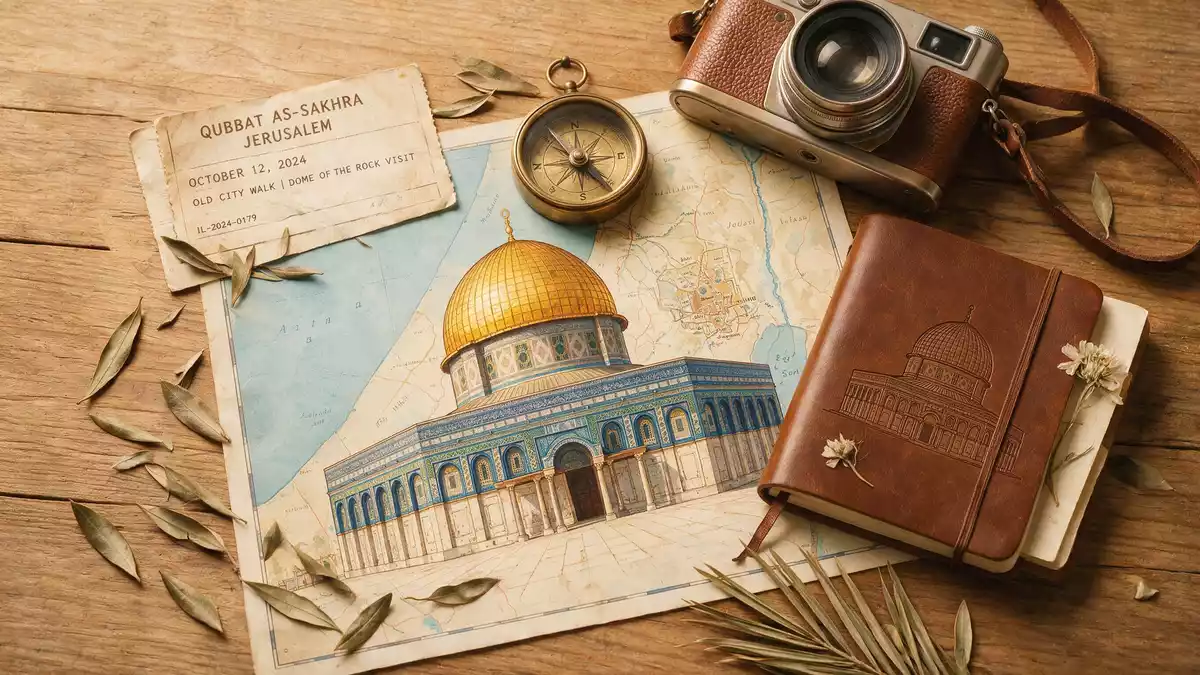
Qubbat as-Sakhra in Jerusalem, known in English as the Dome of the Rock, is an early Islamic shrine where a gilded dome, octagonal geometry and exposed bedrock meet on the Haram al-Sharif plateau. Built under the Umayyad caliph Abd al-Malik ibn Marwan in the late seventh century, it rises above the Foundation Stone on the elevated platform long associated with the ancient Temple Mount.
An octagonal shrine around the rock
Qubbat as-Sakhra stands near the centre of the Haram al-Sharif in Jerusalem’s Old City, set within the broad esplanade that Jews know as the Temple Mount and Muslims as the Noble Sanctuary.octagonal Islamic shrine The building takes the form of an octagon wrapped around a natural outcrop of bedrock, the Foundation Stone, which remains visible beneath the dome at the heart of the structure.Foundation Stone at the centre
The shrine’s core dates to the Umayyad period and was completed around 691–692 CE, a date preserved in its own inscriptions and repeated in later historical summaries.completion in 691–692 CE Abd al-Malik ibn Marwan, who ruled the Umayyad Caliphate from 685 to 705, is consistently named as the patron who ordered its construction, making Qubbat as-Sakhra one of the earliest surviving major monuments linked directly to a Muslim ruler.commissioned by Abd al-Malik
Geometry, mosaics and the gilded dome
From the Haram al-Sharif platform, Qubbat as-Sakhra is immediately recognised by its gilded dome rising above an octagonal drum and layered arcades. The overall composition draws on late antique and Byzantine models while marking a distinct early Islamic approach to geometry and decoration.Byzantine-rooted structure and ornament Inside, concentric ambulatories ring the exposed rock, separated by arcades of columns that give visitors multiple vantage points on the bedrock below the dome.
The interior walls and drum carry bands of mosaic and long inscriptions in Arabic, recording Qur’anic passages and affirmations of faith from the period of Abd al-Malik.early Islamic inscriptions and mosaics Later Ottoman work added extensive tile cladding to the exterior, particularly Iznik-style tiles in blue and white, fixing much of the building’s present surface character while leaving the underlying Umayyad structure in place.Ottoman tile decoration
Haram al-Sharif and layered sacred meanings
Qubbat as-Sakhra occupies the highest part of the Haram al-Sharif plateau, sharing the esplanade with the congregational Al-Aqsa Mosque at its southern edge.location on the Haram al-Sharif platform The platform itself corresponds to the area of the ancient Temple Mount, giving the rock at the centre of the shrine a layered significance within Jewish and Islamic traditions. Muslim accounts connect the bedrock to the Prophet Muhammad’s night journey, while Jewish tradition associates the site with the inner sanctuary of the former Temple.
The surrounding esplanade unfolds as a sequence of wide paved spaces, staircases and smaller structures, framing Qubbat as-Sakhra as a focal volume within a larger architectural landscape.Haram al-Sharif plateau Within this setting, the shrine’s octagonal plan and ring of arcades stand out against the more rectilinear lines of nearby buildings, emphasising its role as a distinct architectural object centred on the exposed rock rather than on a broad interior hall.
Visiting Qubbat as-Sakhra: what travellers from Western Europe should know
- Qubbat as-Sakhra stands on the Haram al-Sharif platform above Jerusalem’s Old City, reached through gates in the surrounding walls that lead onto the broad paved esplanade.
- The shrine rises on an elevated stone platform, with staircases connecting the main level of the Haram al-Sharif to the terrace around the building and further steps leading towards the surrounding arcades.
- Jerusalem lies in Israel, where the official languages are Hebrew and Arabic and the currency is the Israeli shekel.
- Entry requirements depend on your nationality; UK travellers can check the FCDO travel advice at gov.uk/foreign-travel-advice, Irish travellers the Department of Foreign Affairs at ireland.ie.
Searching for Qubbat as-Sakhra on social platforms
These links open searches for Qubbat as-Sakhra on each platform.
Frequently asked questions about Qubbat as-Sakhra
Where is Qubbat as-Sakhra located in Jerusalem?
Qubbat as-Sakhra stands near the centre of the Haram al-Sharif platform in Jerusalem’s Old City, on the elevated site associated with the historic Temple Mount.
What should a visitor expect when approaching the shrine?
Visitors encounter a broad paved esplanade, an elevated stone platform and staircases leading towards the octagonal building and its surrounding arcades, with the gilded dome prominent above.
What makes Qubbat as-Sakhra distinctive among Jerusalem’s sacred buildings?
Its combination of an early Umayyad date, an octagonal plan centred on exposed bedrock and a gilded dome over richly decorated interiors distinguishes it within the Haram al-Sharif landscape.


