
Qubbat as-Sakhra and its golden geometry above Jerusalem
Published on 08/21/2026 at 08:36 | Editorial responsibility: Rafael Müller, Editor-in-Chief AD HOC NEWS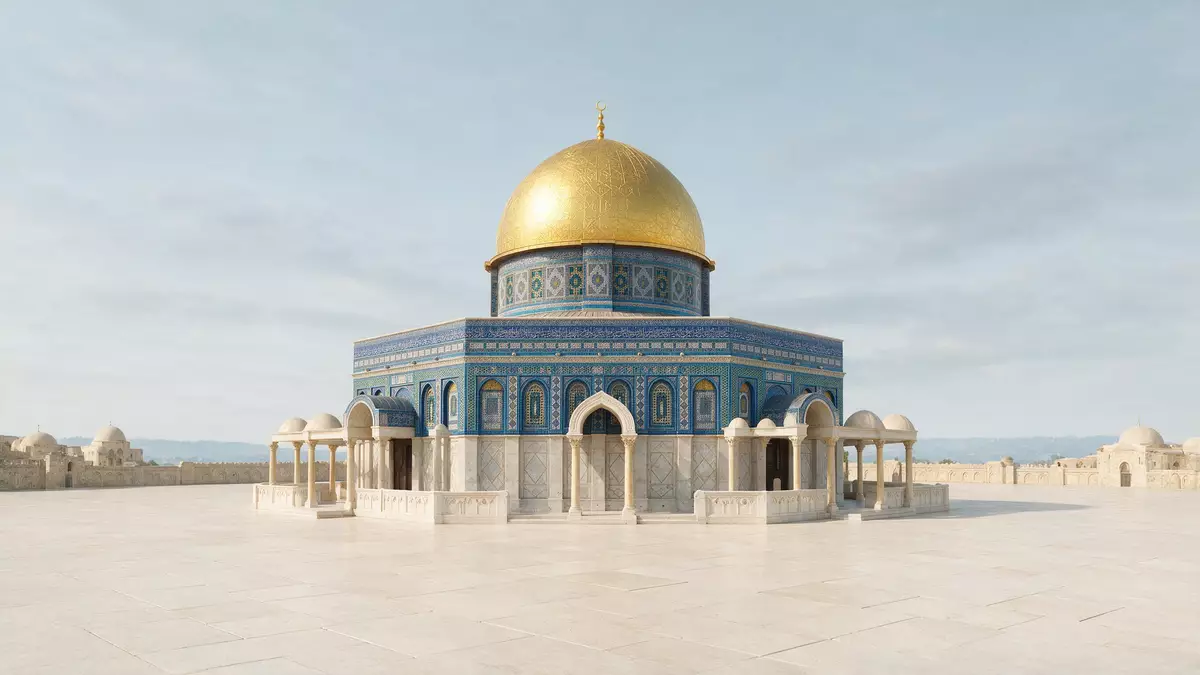
Qubbat as-Sakhra, better known in English as the Dome of the Rock, rises over the Old City of Jerusalem as a gilded landmark of early Islamic architecture. Completed in 691–692 under the Umayyad caliph Abd al-Malik ibn Marwan, it stands on the Haram al-Sharif plateau as a shrine built around the exposed Foundation Stone at its centre.
An octagon of stone, marble and gold
From a distance, Qubbat as-Sakhra reads as a composition of precise geometry. The main structure forms a regular octagon surrounding the central rock, with two concentric ambulatories running around the shrine’s heart.octagonal Islamic shrine This plan echoes late Roman and Byzantine memorial buildings, yet its inscriptions and interior decoration belong firmly to the first century of Islam.oldest extant Islamic monument
The golden-coloured dome crowns this octagonal drum and has become the building’s most recognisable feature on the Jerusalem skyline. Sources describe the dome as rising more than 20 m (over 65 ft) above its supporting drum, which itself rests on a ring of piers and columns.dome diameter and height Below the dome, a belt of clerestory windows admits light into the upper zone of the interior, while the outer walls of the octagon present tall arcades framed by slender colonnettes and panels of coloured stone.
Umayyad ambition in stone and inscription
The chronology of Qubbat as-Sakhra is unusually well documented. An inscription band running within the building records its completion in the year AH 72, corresponding to 691–692 CE, under Abd al-Malik, who ruled the Umayyad Caliphate from 685 to 705.inscription establishing date The shrine therefore belongs to the formative decades of Islam and is frequently described as the earliest surviving monumental building commissioned by a Muslim ruler.first masterpiece of Islamic art
Architecturally, the building stands at the junction of traditions. Its centrally planned octagon and encircling ambulatories recall Byzantine martyria, while its long Quranic inscriptions and avoidance of figural imagery point towards the emerging conventions of Islamic sacred architecture.Byzantine and Islamic visual style Polished marble revetments line the lower interior walls, above which glass tesserae mosaics spread across the arcades and drum, forming bands of vegetal ornament, jewelled motifs and inscriptions rather than human figures.
The Foundation Stone and layered meanings
At the centre of Qubbat as-Sakhra lies the exposed rock from which the shrine takes its name. The Arabic title “Qubbat as-Sakhra” translates as “Dome of the Rock”, referring directly to this outcrop. The stone is enclosed by a circular arcade of columns and piers, which frame views of the rock from the surrounding ambulatory walkways.measurements of the Rock
The rock carries several layers of religious meaning. In Islamic tradition, it is associated with the Prophet Muhammad’s Night Journey and ascent, while in Jewish tradition it has long been identified with the site of Abraham’s near-sacrifice and the location of the First and Second Temples.sacred to Muslims and Jews The shrine therefore mediates between a specific geological feature and narratives shared, in different ways, by the three Abrahamic religions that focus on Jerusalem.
Surfaces of tile, mosaic and calligraphy
A walk around Qubbat as-Sakhra reveals layers of surface decoration added and renewed across the centuries. The lower exterior walls are faced with marble, above which spread large fields of ceramic tiles in blue, turquoise, white and other colours. These tiles, many of which date from Ottoman restoration campaigns, carry stylised vegetal patterns and calligraphic panels, turning each façade into a dense patchwork of repeated motifs.
Inside, mosaic plays the leading role. Scholarly estimates put the area of interior mosaics at around 1,280 m², covering the inner octagonal arcade and the drum beneath the dome.interior mosaic area The motifs again avoid living figures, concentrating instead on scrolling foliage, hanging crowns, jewelled vessels and architectural forms set against shimmering gold backgrounds.non-figural mosaic decoration Long bands of Kufic-script inscriptions run through this field, binding together text, ornament and structure.
Visiting Qubbat as-Sakhra: what travellers from Western Europe should know
- Qubbat as-Sakhra stands on the Haram al-Sharif, the elevated esplanade in the Old City of Jerusalem that is also known as the Temple Mount.
- The shrine occupies a raised platform within the wider enclosure, reached by stairways that climb from the surrounding courtyards up to the level of the octagonal structure.
- Approaches within the Old City involve walking along stone-paved streets and through historic gateways, with changes in level and occasional narrow passages.
- The official languages in Jerusalem are Hebrew and Arabic and the currency is the Israeli new shekel.
- Entry requirements depend on your nationality; UK travellers can check the FCDO travel advice at gov.uk/foreign-travel-advice, Irish travellers the Department of Foreign Affairs at ireland.ie.
Searching for Qubbat as-Sakhra on social platforms
These links open searches for Qubbat as-Sakhra on each platform.
Frequently asked questions about Qubbat as-Sakhra
Where is Qubbat as-Sakhra located?
Qubbat as-Sakhra stands on the Haram al-Sharif plateau in the Old City of Jerusalem, within the historic walled area overlooking surrounding quarters.
What should visitors expect when approaching the shrine?
Visitors encounter stone-paved streets and gateways in the Old City, then climb stairways to a raised platform where the octagonal shrine and its golden-coloured dome stand.
What makes Qubbat as-Sakhra distinctive among religious buildings?
Its early Umayyad date, octagonal plan around the exposed Foundation Stone, extensive non-figural mosaics and gilded dome together form a distinctive ensemble above Jerusalem.


