
Qelat Hewler, the citadel that crowns Erbil’s ancient mound
Published on 09/21/2026 at 07:45 | Editorial responsibility: Rafael Müller, Editor-in-Chief AD HOC NEWS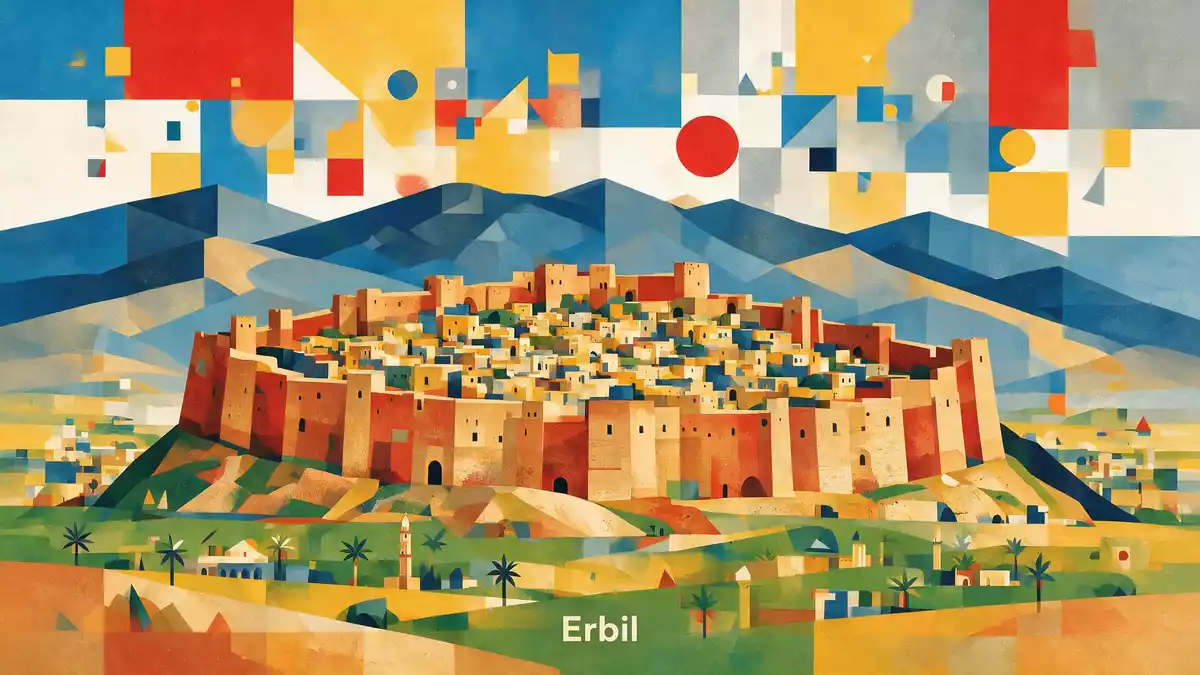
Qelat Hewler, known internationally as the Erbil Citadel, forms a compact urban settlement raised on an ancient mound in the centre of Erbil in northern Iraq. The fortified town stands on an archaeological tell whose layers of habitation reach back to deep antiquity, and it was inscribed as a UNESCO World Heritage Site in 2014 as the historic core of the city.
A walled town on an ancient tell
Seen from the streets of Erbil, Qelat Hewler appears as a continuous ring of façades forming a high perimeter wall around the crest of the mound. This outer edge dates largely from the late Ottoman period, when tall houses were built side by side to create the encircling front that still gives the citadel the look of an elevated fortress above the modern city.A continuous wall of tall nineteenth century façades conveys that impression of a defended place overlooking the surrounding streets.
The ground beneath these houses is an irregular oval-shaped tell formed by many generations of building, collapse and rebuilding in roughly the same footprint.Erbil Citadel is described as a fortified settlement on top of an imposing ovoid-shaped tell, rising tens of metres above its surroundings. Within the walls, lanes and dwellings follow a fan-like pattern that developed in the late Ottoman phase, radiating across the summit of the mound and adapting to its oval outline.
Layers of history in the heart of Kurdistan
Settlement on the mound of Qelat Hewler is traditionally dated to the fifth millennium BC, and written records associate the ancient city here with Arbela, an Assyrian political and religious centre.Historical accounts link the site to ancient Arbela as an Assyrian centre and trace occupation through successive empires. Over millennia the citadel passed through Sumerian, Assyrian, Sassanid, Mongol, Christian and Ottoman periods, with each era adding structures atop earlier ones and contributing to the height of the mound.
In medieval and early Islamic times Erbil was an important centre of Christianity under the Sassanids and the Abbasid Caliphate, while later the fortress on the mound was taken by the Mongols in 1258.Archaeological and textual studies emphasise the citadel’s continuous occupation and its role as Erbil’s historic core, even as the focus of the wider city shifted and expanded on the plain below. Most of the surviving buildings visible in the citadel today date to the late Ottoman period, but they rest on far older foundations concealed within the mound.
A UNESCO-listed urban landscape above Erbil
Qelat Hewler occupies the centre of Erbil in the Kurdistan Region of Iraq, where its high perimeter wall and elevated streets form a distinct urban landscape separate from the traffic below.The citadel is located at the centre of Erbil in northern Iraq, within the Kurdistan Region, and its compact size makes the entire settlement legible from many viewpoints around the city. Within the enclosure, houses, courtyards and former public buildings cluster along narrow passages, reflecting the density of a small town contained by a single wall.
In June 2014 Qelat Hewler was added to the UNESCO World Heritage List as Erbil Citadel, recognised as a rare surviving example of a fortified settlement that has grown on top of an ancient tell and as the first World Heritage Site in the Kurdistan Region of Iraq.The World Monuments Fund records the inscription of the Erbil Citadel as a UNESCO World Heritage Site in 2014 and notes ongoing revitalisation work overseen by a dedicated commission. The citadel’s status highlights its role as a cultural landmark for Erbil and for Iraq as a whole.
Visiting Qelat Hewler: what travellers from Western Europe should know
- Qelat Hewler rises above the centre of Erbil in northern Iraq, reached by road from the surrounding city streets and visible from many points in the urban area.
- Access to the citadel involves a steady ascent from ground level up the flanks of the mound, followed by walking along uneven streets and passages on the summit.
- The wider city of Erbil lies on the plains of the Kurdistan Region, with modern districts surrounding the mound; the official language is Arabic and the currency is the Iraqi dinar.
- Entry requirements depend on your nationality; UK travellers can check the FCDO travel advice at gov.uk/foreign-travel-advice, Irish travellers the Department of Foreign Affairs at ireland.ie.
Searching for Qelat Hewler on social platforms
These links open searches for Qelat Hewler on each platform.
Frequently asked questions about Qelat Hewler
Where is Qelat Hewler located?
Qelat Hewler stands on an ancient mound at the centre of Erbil in the Kurdistan Region of northern Iraq, rising above the surrounding modern streets.
What can visitors expect when exploring Qelat Hewler?
Visitors encounter a compact walled town arranged along narrow streets and passages on the summit of a high tell, with late Ottoman houses lining the perimeter.
What makes Qelat Hewler distinctive among historic sites?
The citadel combines the character of a complete urban settlement with the form of an elevated mound whose occupation stretches back thousands of years and is recognised by UNESCO.


