
Qelat Hewler and the layered citadel above Erbil
Published on 08/31/2026 at 08:15 | Editorial responsibility: Rafael Müller, Editor-in-Chief AD HOC NEWS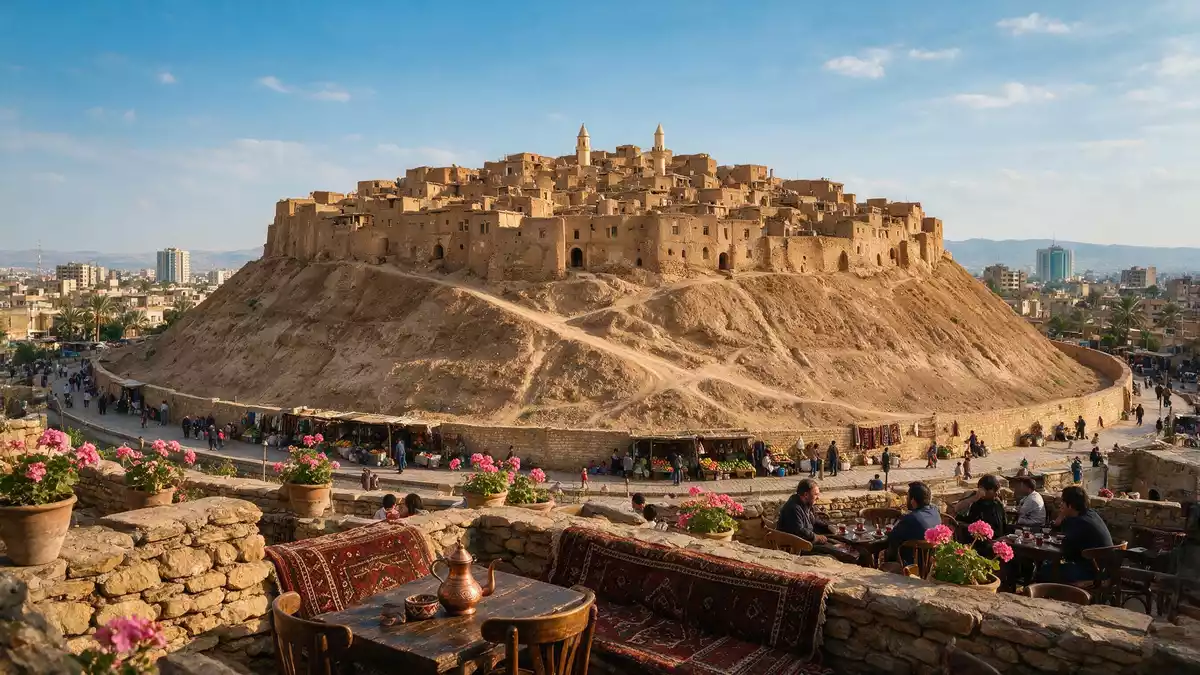
Qelat Hewler rises above central Erbil as a layered tell, with Ottoman street traces and 19th-century façades still visible. The site is also known internationally as Erbil Citadel and was inscribed on the UNESCO World Heritage List in 2014.
The oval mound at Erbil’s centre
Qelat Hewler is a fortified settlement on an ovoid tell, a mound formed by repeated occupation and rebuilding. The broad form is easy to read from the edge of Erbil, where the citadel still dominates the cityscape.
The UNESCO listing describes Erbil Citadel as a rare surviving example of a fortified settlement built on such a mound and notes the city’s late Ottoman street pattern. The layout keeps a fan-like structure, with alleys radiating from the main gate and a dense urban grain inside the perimeter.UNESCO listing
Ottoman streets above deeper layers
The citadel’s surface fabric is mostly urban rather than defensive. Tall house façades form a continuous edge, and many of the visible structures belong to the nineteenth and early twentieth centuries.
Below that visible layer lies a much older settlement sequence. The World Heritage documentation places the mound at the centre of Erbil and describes it as an archaeological complex built over at least six millennia of occupation.archaeological complex
A city landmark with an Assyrian past
Historical records link the site with ancient Arbela, an important Assyrian political and religious centre. That connection gives Qelat Hewler a second identity: not only a citadel, but the historical core of Erbil itself.
The same documents connect the place with a settlement history that extends back through the Neo-Assyrian period and beyond. The citadel also preserves the imprint of later phases, including the Ottoman period and the modern city that spread around it.Assyrian political centre
Visiting Qelat Hewler: what travellers from Western Europe should know
- Qelat Hewler stands in the centre of Erbil, in the Kurdistan Region of Iraq. It is reached through the city streets rather than by a separate approach road.
- The site rises from an archaeological mound with a clear edge and layered ground. Its interior follows an irregular street pattern, with narrow lanes and small courtyards.
- Erbil is the nearest major reference point. The official language is Kurdish and Arabic, and the currency is the Iraqi dinar.
- Entry requirements depend on your nationality; UK travellers can check the FCDO travel advice at gov.uk/foreign-travel-advice, Irish travellers the Department of Foreign Affairs at ireland.ie.
Searching for Qelat Hewler on social platforms
These links open searches for Qelat Hewler on each platform.
Frequently asked questions about Qelat Hewler
Where is Qelat Hewler?
Qelat Hewler is in the centre of Erbil, in northern Iraq, on a mound that forms the citadel’s core. It is the historic heart of the city.
What does a visit involve?
The visit is shaped by a compact urban mound, narrow lanes and layered streets. The site reads more as an inhabited hilltop quarter than as a single monument.
What makes Qelat Hewler distinctive?
Its defining feature is the combination of an ancient tell, Ottoman-period street form and continuous urban layering. The city’s older identity remains visible in the citadel’s fabric.


