
Qelat Hewler and the earthen mound at Erbil's core
Published on 09/10/2026 at 08:17 | Editorial responsibility: Rafael Müller, Editor-in-Chief AD HOC NEWS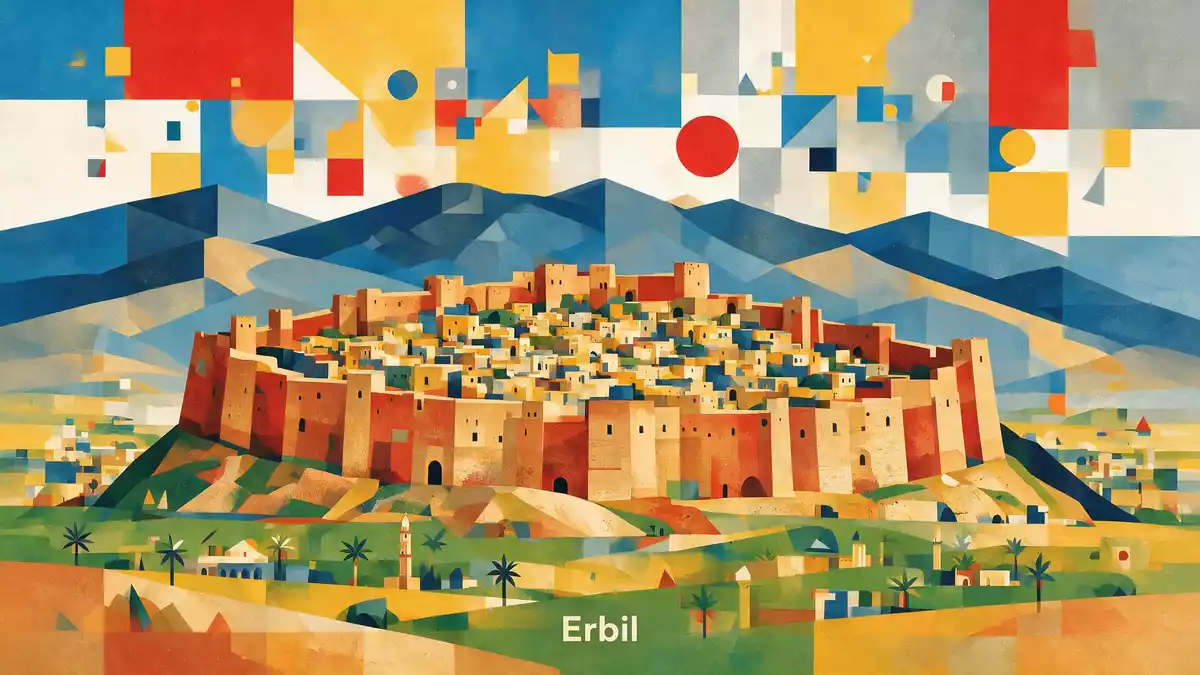
Qelat Hewler rises from central Erbil as a compact hilltop settlement on an earthen mound. The site is the historic core of the city and is formally known as Erbil Citadel, a World Heritage place inscribed in 2014.
Qelat Hewler on its tell in Erbil
The first impression is the mound itself: a built-up hill in the middle of the city, edged by streets below and housing above. Erbil Citadel is the English name used internationally, while Qelat Hewler is the local Kurdish form.
The mound is not a natural rise but an archaeological tell formed by long occupation. UNESCO describes it as an imposing ovoid-shaped settlement mound, and the site remains physically distinct from the lower city around it.
A citadel with layered urban fabric
The place is a fortified settlement, but its identity lies as much in its streets and houses as in any defensive wall. Much of the visible fabric belongs to a nineteenth-century urban landscape, standing over deeper layers of earlier occupation.
That combination of settlement mound, fortified form and dense urban texture gives Qelat Hewler its character. The citadel sits at the centre of Erbil, where the city’s long history is compressed into one elevated cluster of buildings.
Erbil Citadel and its long occupation
The site’s importance rests on continuity. UNESCO records it as a place built on historical layers accumulated over at least six millennia, and the occupied mound has remained a defining feature of Erbil’s centre.
This long sequence of rebuilding is visible in the way the citadel functions as both archaeological mound and living urban quarter. Qelat Hewler therefore reads as a town within the town, with the city of Erbil spreading out around it.
Visiting Qelat Hewler: what travellers from Western Europe should know
- Qelat Hewler stands in central Erbil in the Kurdistan Region of Iraq, above the lower city streets. The access route rises onto the mound from the surrounding urban grid.
- The site has an earthen surface and a noticeable climb. The upper settlement sits on a tell, so the approach is steeper than a level city street.
- The official language is Kurdish and Arabic is also used in the city; the currency is the Iraqi dinar. Erbil is the main urban reference point for orientating a visit.
- The citadel’s profile is a layered urban mound rather than a free-standing monument. Its houses, lanes and compact footprint make the whole hilltop read as a single historic quarter.
Searching for Qelat Hewler on social platforms
These links open searches for Qelat Hewler on each platform.
Frequently asked questions about Qelat Hewler
Where is Qelat Hewler?
Qelat Hewler stands in the centre of Erbil, in the Kurdistan Region of Iraq. It is the hilltop citadel known internationally as Erbil Citadel.
What does a visit involve?
The visit centres on the mound, its slopes and the compact urban fabric on top. The setting is built into the city, so the citadel reads as a raised historic quarter rather than an isolated ruin.
What makes Qelat Hewler distinctive?
Its defining feature is the archaeological tell carrying a fortified settlement at the city’s core. The combination of continuous occupation, elevated form and historic housing gives it a clear identity.


