
Qal'at al-Bahrain, layered capital of Dilmun by the sea
Published on 09/07/2026 at 21:29 | Editorial responsibility: Rafael Müller, Editor-in-Chief AD HOC NEWS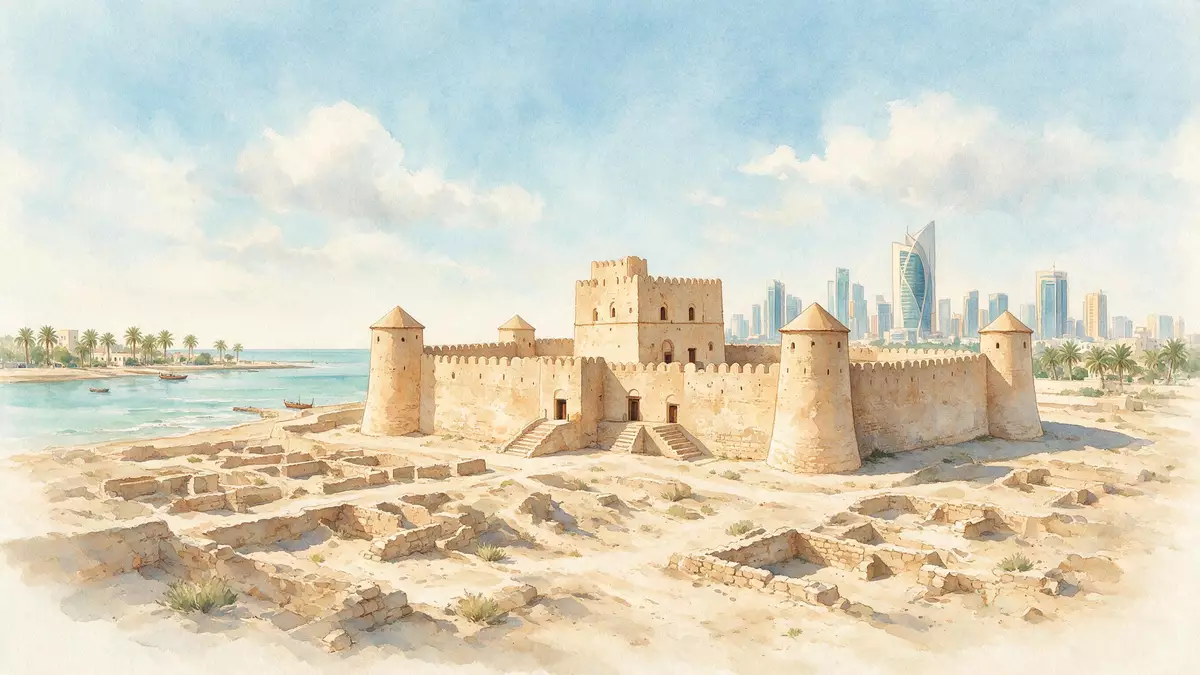
Qal'at al-Bahrain on the north coast of Bahrain near Manama is an ancient settlement mound crowned by a Portuguese-era fortress, bringing several millennia of history into one compact site.Ancient Harbour and Capital of Dilmun is the formal World Heritage name for this archaeological landscape, which combines a substantial tell, fortifications and traces of harbours and palm groves.
A seaside tell with a fort on top
Qal'at al-Bahrain is described as a typical tell, an artificial hill formed by successive layers of human occupation that rise above the flat coastal plain.continuous human presence from about 2300 BC is recorded in its stratigraphy, which preserves traces of the Bronze Age Dilmun civilisation, later classical and Islamic phases and the Portuguese period at the summit.artificial mound created by many successive layers gives the site its characteristic raised profile above the shoreline.
The mound lies on the northern shore of Bahrain Island, west of Manama, the capital of Bahrain, with the fort standing close to the sea like a stone landmark overlooking the Gulf.sentinel near Manama on the fertile north coast is a recurring description, and the World Heritage documentation places the tell in the Northern Governorate at Al Qalah village, adjacent to palm groves and the remains of a sea channel that once linked the harbour structures to deeper water.archaeological tell, sea tower and sea channel together form a coastal ensemble where land, settlement and waterborne trade met.
Capital of Dilmun and layered settlement history
Qal'at al-Bahrain is closely associated with the Dilmun civilisation, which flourished during the Bronze Age and used this harbour settlement as a capital and trading centre linking Mesopotamia with regions across the Gulf.capital of one of the most important ancient civilizations of the region is one of the reasons the site met the cultural criteria for inscription on the UNESCO World Heritage List in 2005.World Heritage site of Qal'at al-Bahrain highlights how its remains illustrate almost unbroken occupation from about 2,300 BC to early modern times.
Excavations have identified palaces, defensive walls, domestic houses, religious structures and workshops within the mound, showing how the settlement evolved through Kassite, Hellenistic, Islamic and Portuguese phases.twelve-metre high mound with seven stratified layers is one summary of the accumulated settlement history, with the uppermost levels associated with the stone fortress that now dominates the skyline and earlier levels preserving the layout of Dilmun-period streets and courtyards.
The Portuguese fort and the site museum
The fortress that crowns Qal'at al-Bahrain dates to the fifteenth and sixteenth centuries, when Portuguese power in the Gulf left a series of coastal strongholds.main fortress dates from the 15th and 16th centuries places the construction of the stone fortifications in this period, while World Heritage evaluation documents describe an impressive Portuguese fort on top of the mound whose name “qal'a” in Arabic simply means “fort”.mound topped by an impressive Portuguese fort explains why the whole site is widely referred to as Qal'at al-Bahrain.
The fortress complex comprises thick outer walls, towers and internal spaces laid out around open areas, all constructed in stone and other durable materials that have withstood centuries of exposure on the coast.massive Hormuzi-Portuguese fortress facing the sea is echoed in several studies, which treat the fort as the final major construction on a site already dense with earlier architecture. A site museum nearby interprets the layers and displays finds from the mound, helping visitors connect the visible walls and courtyards with the deeper timeline that lies beneath the present surface.Ancient Capital and Harbour of Dilmun, the Site Museum describes how the museum presents objects from different periods alongside maps and reconstructions.
Visiting Qal'at al-Bahrain: what travellers from Western Europe should know
- Qal'at al-Bahrain lies on the northern shore of Bahrain Island in the Northern Governorate, west of Manama, and is reached by road through the Al Qalah village district.
- The archaeological mound rises above the surrounding plain, and visiting the fort on top involves walking across uneven ground and climbing gently sloping paths and steps within the ruins.
- The official language is Arabic and the currency is the Bahraini dinar.
- Entry requirements depend on your nationality; UK travellers can check the FCDO travel advice at gov.uk/foreign-travel-advice, Irish travellers the Department of Foreign Affairs at ireland.ie.
Searching for Qal'at al-Bahrain on social platforms
These links open searches for Qal'at al-Bahrain on each platform.
Frequently asked questions about Qal'at al-Bahrain
Where is Qal'at al-Bahrain located in relation to Manama?
Qal'at al-Bahrain stands on the northern coast of Bahrain in the Northern Governorate, west of Manama, on the shore near Al Qalah village.
What can visitors expect when exploring Qal'at al-Bahrain?
Visitors encounter a broad settlement mound with exposed archaeological remains and a stone Portuguese fort on its summit, along with a site museum interpreting the different periods.
What makes Qal'at al-Bahrain distinctive among Gulf heritage sites?
Qal'at al-Bahrain combines a Bronze Age Dilmun capital, later urban layers and a Portuguese coastal fortress in one accessible mound, illustrating continuous occupation across several thousand years.


