
Purnululu National Park and the banded domes of the Bungle Bungles
Published on 09/15/2026 at 09:12 | Editorial responsibility: Rafael Müller, Editor-in-Chief AD HOC NEWS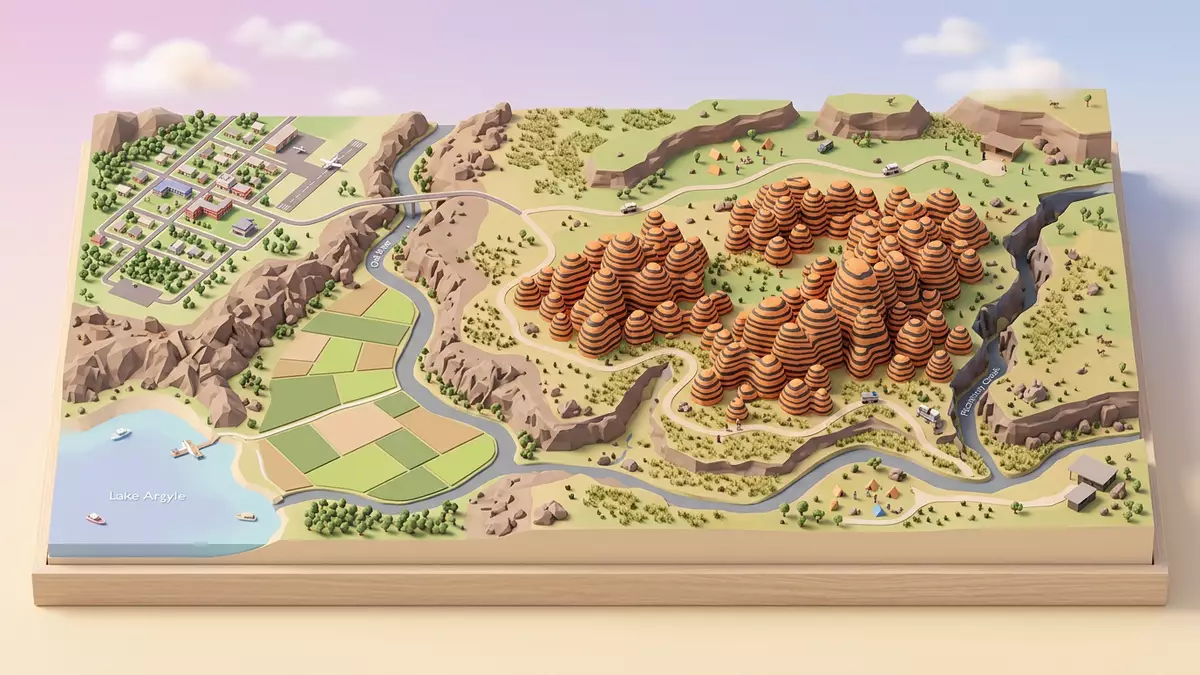
Purnululu National Park in the East Kimberley region of Western Australia is a vast sandstone landscape best known for the banded domes of the Bungle Bungle Range, where ancient sedimentary rock has been sculpted into beehive-like towers above the surrounding savannah. The park was inscribed on the UNESCO World Heritage List in 2003 for its outstanding geological formations and natural beauty, placing this remote area alongside better-known sites while preserving its character as wilderness.
Banded beehive domes in a remote sandstone range
At the heart of Purnululu National Park lies the Bungle Bungle Range, a deeply dissected plateau of sandstones and conglomerates shaped into rounded towers and cones by erosion over millions of years.The Bungle Bungle Range rises above semi-arid grasslands, its steep flanks cut by narrow gorges and gullies that reveal the internal layering of the rock. From a distance, the range appears as a succession of striped domes, their surfaces marked by alternating dark and orange bands.
The orange and dark grey banding on the sandstone towers reflects differences in the rock layers, including moisture retention and mineral content.The coloured bands form horizontal stripes that accentuate the beehive-like shapes, emphasising the regularity of the cone karst forms across the range.Cone karst formations The result is a landscape where each tower shares the same basic form yet differs slightly in profile, creating a dense field of sculptured rock.
Deep time and cone karst: how the Bungle Bungles formed
The rocks of Purnululu National Park record geological processes that stretch back to the Devonian period, when rivers deposited sand and gravel into basins that later became the foundations of the Bungle Bungle Range.Devonian sedimentary deposits Over time, these sediments were compressed into sandstone and conglomerate, then exposed and carved by flowing water into the plateau and domes visible today. The current shapes of the beehive towers represent the erosional remnants of this extensive sedimentary mass, reworked by streams cutting along lines of weakness in the rock.
The cone karst of the Bungle Bungles reflects the interplay of rock type, climate and biological activity across millions of years.Sandstone cone karst Cyanobacteria colonise moisture-holding layers, forming dark crusts that contrast with iron-stained orange bands, while runoff follows the sandstone joints to deepen channels between the towers.Striped sandstone layers Seen from the air, the range forms a complex network of ridges, domes and gorges, a pattern that reflects both the original depositional structures and the subsequent erosional sculpting.
World Heritage wilderness in the East Kimberley
Purnululu National Park covers about 239,723 hectares of remote country in Western Australia, managed as wilderness within the broader East Kimberley landscape.Park area and wilderness The World Heritage property encompasses the Bungle Bungle Range and surrounding plains, where sandstone plateaus rise above grasslands and dry riverbeds. The nearest regional town is Kununurra, which serves as the administrative base for park management and a starting point for overland and air access to the range.Location in relation to Kununurra
The UNESCO World Heritage inscription in 2003 recognises both the aesthetic qualities of the striped domes and their scientific importance as superlative examples of cone karst in quartz sandstone.World Heritage inscription in 2003 Within the park, broad valleys, narrow chasms and sheer sandstone walls sit alongside the banded towers, offering varied views of the same geological system. The combination of scale, colour and form gives Purnululu National Park a character distinct from other Australian sandstone landscapes, while its remote setting preserves a sense of distance from major settlements.
Visiting Purnululu National Park: what travellers from Western Europe should know
- Purnululu National Park lies in the East Kimberley region of Western Australia, with Kununurra as the nearest regional town linked to the park’s management and access routes.
- The terrain within the Bungle Bungle Range includes uneven sandstone surfaces, narrow gorges and plateaus, and many viewpoints are reached by walking on natural tracks and dry creek beds.
- The park sits in a semi-arid environment where daytime temperatures can be high, and visitors encounter open grasslands, sparse woodland and exposed rock alongside shaded gullies.
- Purnululu National Park is within Australia, where the official language is English and the currency is the Australian dollar.
- Entry requirements depend on your nationality; UK travellers can check the FCDO travel advice at gov.uk/foreign-travel-advice, Irish travellers the Department of Foreign Affairs at ireland.ie.
Searching for Purnululu National Park on social platforms
These links open searches for Purnululu National Park on each platform.
Frequently asked questions about Purnululu National Park
Where is Purnululu National Park located?
Purnululu National Park is in the East Kimberley region of north-western Western Australia, with its World Heritage area lying south of the town of Kununurra.
What should visitors expect on a visit?
Visitors encounter banded sandstone domes, gorges and plateaus within a semi-arid landscape, with walks on natural surfaces and viewpoints that look across the Bungle Bungle Range.
What makes Purnululu National Park distinctive among Australian landscapes?
The park is defined by the striped cone karst towers of the Bungle Bungle Range, where orange and dark grey bands encircle rounded sandstone domes in a dense field of sculptured rock.


