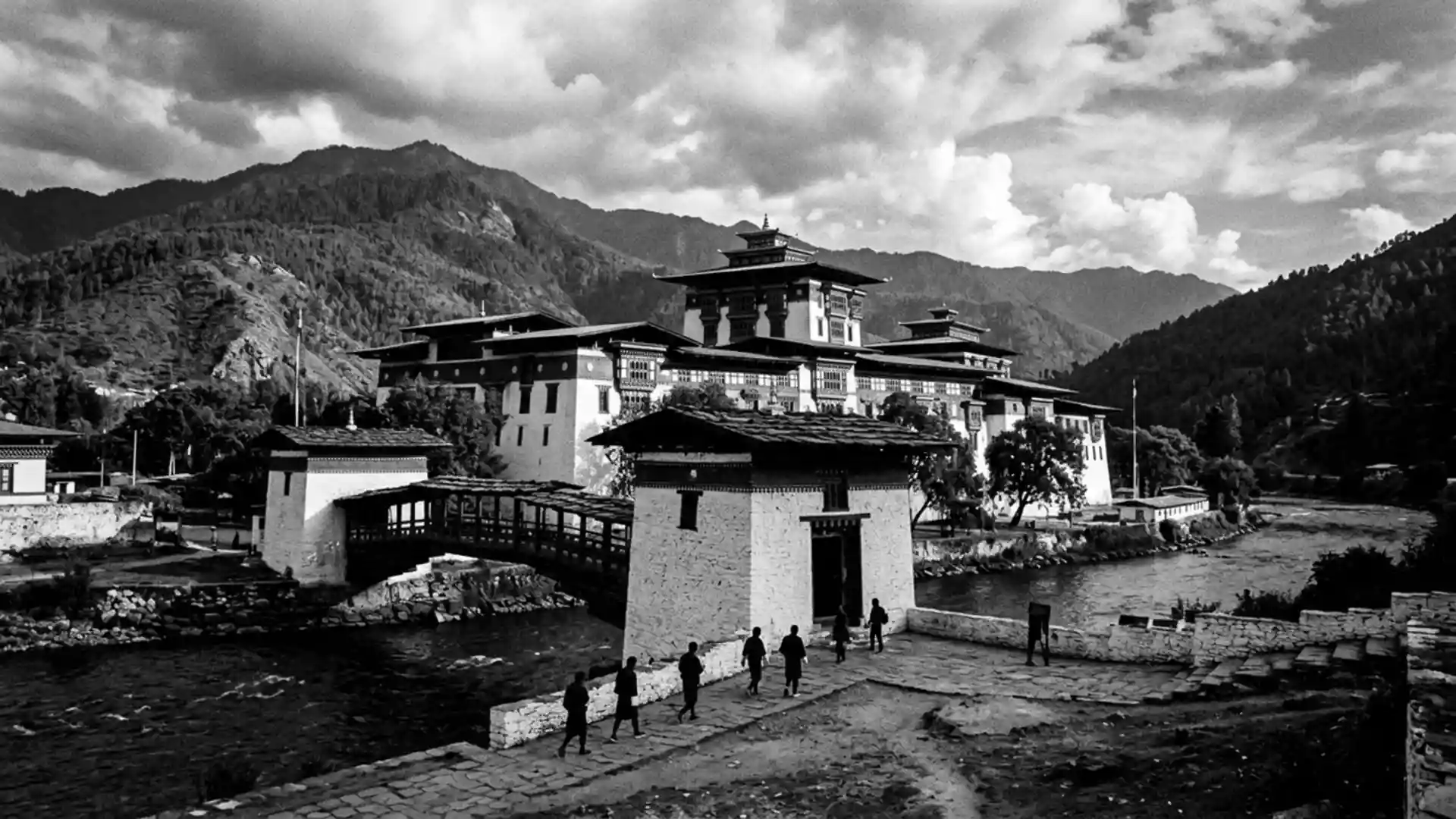
Pungthang Dewachen Phodrang, the palace of great happiness in Punakha
Published on 09/11/2026 at 17:13 | Editorial responsibility: Rafael Müller, Editor-in-Chief AD HOC NEWS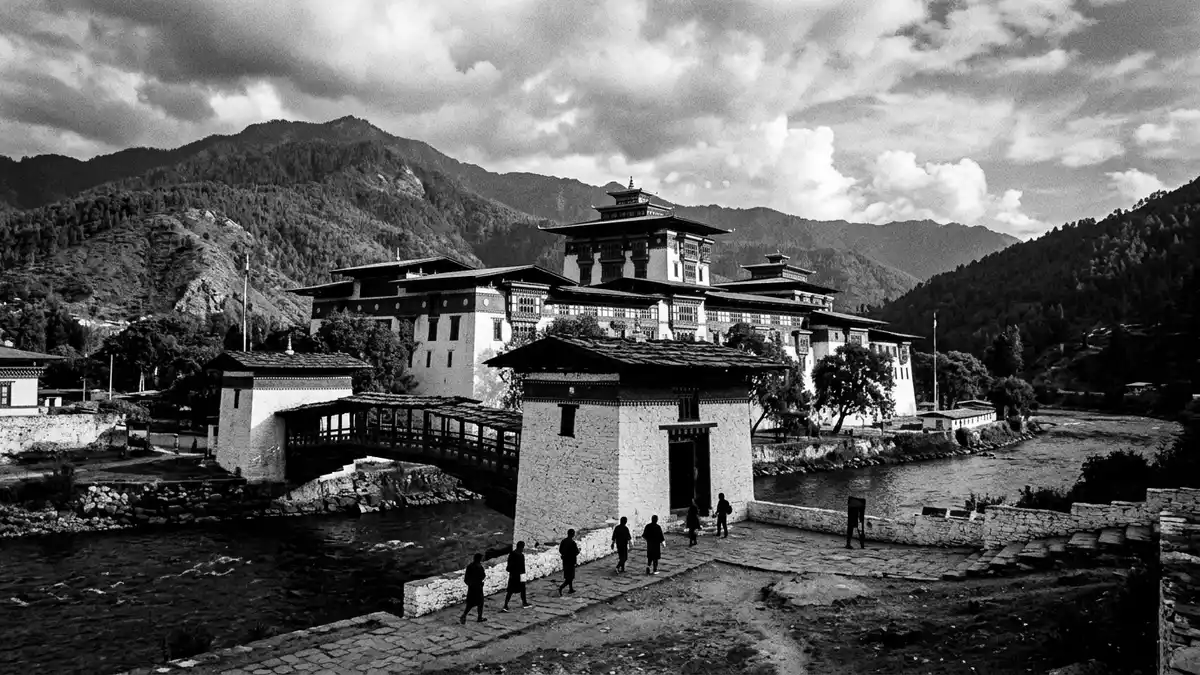
Pungthang Dewachen Phodrang in Punakha, western Bhutan, is a vast fortress?monastery raised in the seventeenth century at the meeting of two mountain rivers. Known in English as the Palace of Great Happiness, it has long combined religious life and district administration within one walled complex, making it a central landmark in Bhutanese history.
A fortress?monastery between two rivers
Pungthang Dewachen Phodrang stands on a tongue of land where the Mo Chhu, the “mother” river, meets the Pho Chhu, the “father” river, in the Punakha valley of western Bhutan.confluence of the Mo Chhu and Pho Chhu The site lies at an elevation of roughly 1,200 m (3,937 ft), in a valley lower and milder than many of Bhutan’s high passes.about 1,200 metres elevation From the outside, the dzong reads clearly as a fortress: long white walls with a broad band of red ochre beneath the roofline, few openings in the lower sections and projecting timber galleries above.
The overall plan stretches for around 180 m (590 ft) in length and about 72 m (236 ft) in width, enclosing multiple courtyards and temple blocks within its perimeter.180 metres in length with a width of 72 metres At each end rise great towers and roofed structures, their timberwork trimmed in intricate painted patterns. The dzong’s position between two rivers, backed by terraced hillsides, gives visitors clear views of water, cultivated land and distant forested slopes from different points around the complex.
A seventeenth?century palace of great happiness
The dzong was commissioned by Zhabdrung Ngawang Namgyal, the Tibetan lama who unified Bhutan, and construction took place in 1637 and 1638.constructed by Ngawang Namgyal in 1637–38 It is described formally as Pungthang Dewa Chhenbi Phodrang or Pungthang Dewachen Phodrang, phrases which translate as palace of great happiness or great bliss.also known as Pungthang Dewa Chhenbi Phodrang Within Bhutan’s network of dzongs, large fortified monasteries that serve both religious and civil functions, this one is the second?oldest and the second?largest, and it became a pattern for later buildings across the country.second oldest and second largest dzong in Bhutan
For centuries, Pungthang Dewachen Phodrang served as the seat of government for Bhutan and as a major monastic centre in its own right.for more than three centuries it was the country's capital The first hereditary king, Ugyen Wangchuck, was crowned here in 1907, and important treaties shaping Bhutan’s modern history were signed within its halls.first hereditary king, Ugyen Wangchuck, was crowned here The dzong remains the winter residence of Bhutan’s central monastic body led by the Je Khenpo, and it continues to house sacred relics of the southern Drukpa Kagyu school of Buddhism, including remains of Zhabdrung Ngawang Namgyal and the tertön Pema Lingpa.sacred relics of the southern Drukpa Lineage
Courtyards, temples and gilded pinnacles
Within its walls, Pungthang Dewachen Phodrang is organised into several courtyards, known as docheys, separated by internal gates and stairways.three docheys (courtyards) One side accommodates the administrative offices of Punakha District, while other sections are devoted to temples and monk housing, reflecting the dual role that dzongs play in Bhutanese society.district administration on one side and hundreds of monks on the other The main temple structures rise above the courtyards as tall, many?roofed blocks with gilded pinnacles and finely detailed timber balconies.Pungthang Dewachenpoi Phodrang has five gilded pinnacles
Visitors encounter carved doors, painted columns and dense decorative work in gold, red and deep blue along rooflines and window surrounds. The contrast between the bright detailing and the plain white plastered walls gives the complex a clear visual rhythm: massive structural surfaces below and delicate ornamentation concentrated around the upper levels. The combination of bridges, outer gateways, inner courtyards and temple halls creates a sequence of enclosed and open spaces that mark the transition from secular to sacred areas within the dzong.
Visiting Pungthang Dewachen Phodrang: what travellers from Western Europe should know
- Pungthang Dewachen Phodrang stands in the Punakha valley of western Bhutan, at the junction of the Mo Chhu and Pho Chhu rivers, east?north?east of the capital Thimphu.Punakha valley lies about 77 kilometres northeast of Thimphu by road
- The approach from the valley floor includes a low bridge over the river and a series of steps and ramps up into the first courtyard, followed by further staircases between different levels inside the complex.
- The surrounding terrain consists of a riverbank setting backed by cultivated terraces and hillsides, with views of the Mo Chhu and Pho Chhu and of the broader Punakha valley from points around the dzong.
- The official language is Dzongkha and the currency is the Bhutanese ngultrum.
- Entry requirements depend on your nationality; UK travellers can check the FCDO travel advice at gov.uk/foreign-travel-advice, Irish travellers the Department of Foreign Affairs at ireland.ie.
Searching for Pungthang Dewachen Phodrang on social platforms
These links open searches for Pungthang Dewachen Phodrang on each platform.
Frequently asked questions about Pungthang Dewachen Phodrang
Where is Pungthang Dewachen Phodrang?
Pungthang Dewachen Phodrang stands in the Punakha valley of western Bhutan, on land between the Mo Chhu and Pho Chhu rivers within Punakha District.
What should visitors expect inside the dzong?
Visitors encounter long white walls, multiple courtyards, richly decorated temple halls, administrative offices and monastic living quarters arranged within a single fortified complex.
What makes Pungthang Dewachen Phodrang distinctive among Bhutan’s dzongs?
It is the second?oldest and second?largest dzong in Bhutan, built in 1637–38 by Zhabdrung Ngawang Namgyal, and it occupies a river junction with strong historical and religious significance.