
Pungthang Dewachen Phodrang and the river confluence
Published on 09/15/2026 at 14:19 | Editorial responsibility: Rafael Müller, Editor-in-Chief AD HOC NEWS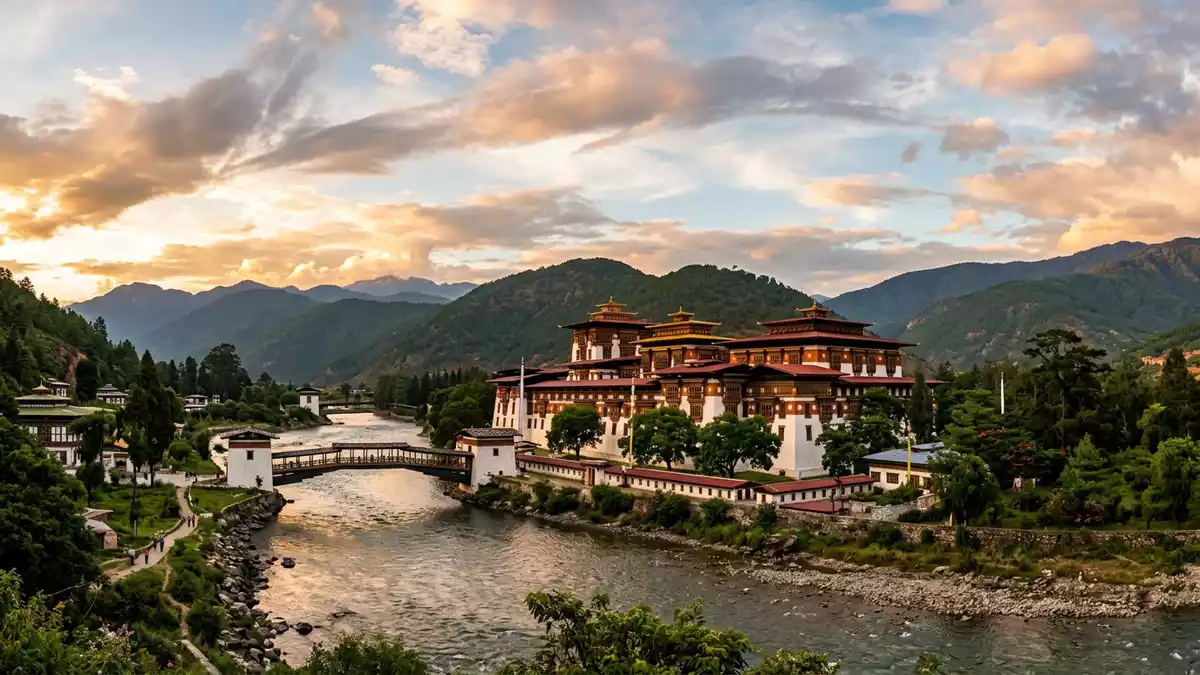
Pungthang Dewachen Phodrang stands at the meeting of the Mo Chhu and Pho Chhu in Punakha, where white walls, courtyards and a tall central tower gather into one Bhutanese fortress-monastery. Built under Zhabdrung Ngawang Namgyal in 1637–38, it remains one of the strongest historical markers of Punakha.
Pungthang Dewachen Phodrang at the river junction
The dzong sits on a narrow spit of land between two rivers in western Bhutan. Its setting, at about 1,200 metres, gives the complex a low valley position within the Punakha landscape. The river confluence is the visual idea that frames the whole site.
The main mass is enclosed by walls and organised around courtyards. The form is unmistakably dzong architecture: fortress outside, monastic rooms and temples inside. The name Pungthang Dewachen Phodrang is linked with the idea of a place of great happiness, and that ceremonial title sits naturally beside the building’s severe outer walls.
Zhabdrung Ngawang Namgyal and the seventeenth century
The building is associated with Zhabdrung Ngawang Namgyal, the founder of Bhutan’s state tradition, and the opening years of the seventeenth century. Construction began in 1637 and reached completion in 1638, placing it among the earliest major dzongs in the country. The year 1637 remains one of its defining anchors.
The complex later became central to government and religious life in Bhutan. That dual role is part of its identity, and it explains why the dzong is discussed not only as a monument but also as an institution in built form. Zhabdrung Ngawang Namgyal gives the site its historical frame.
Royal ceremonies and sacred rooms
Punakha’s place in Bhutanese memory is tied to royal ceremonies as well as religious authority. Ugyen Wangchuck was enthroned here on 17 December 1907, and later kings have also been invested in the dzong’s courtyards. The 1907 coronation gives the building a national political role that goes beyond its appearance.
Inside, the most important spaces are temples, assembly halls and relic rooms linked to the Drukpa Kagyu tradition. The architecture is not ornamental in a narrow sense; it is layered, heavy and formal, with timber, masonry and painted surfaces working together in a strictly ordered composition. The central monastic body is part of that living structure.
Visiting Pungthang Dewachen Phodrang: what travellers from Western Europe should know
- The dzong stands in Punakha valley in western Bhutan, where the Mo Chhu and Pho Chhu meet. It is reached by road through Punakha district.
- The site sits at about 1,200 metres and occupies a narrow river junction. The approach passes across a bridge before the enclosed courtyards begin.
- Stone walls, timber galleries and a central tower dominate the complex. The river setting and the layered courtyards are the most visible features.
- English is not the official language of Bhutan, and the currency is the Bhutanese ngultrum.
- Entry requirements depend on your nationality; UK travellers can check the FCDO travel advice at gov.uk/foreign-travel-advice, Irish travellers the Department of Foreign Affairs at ireland.ie.
Searching for Pungthang Dewachen Phodrang on social platforms
These links open searches for Pungthang Dewachen Phodrang on each platform.
Frequently asked questions about Pungthang Dewachen Phodrang
Where is Pungthang Dewachen Phodrang?
It stands in Punakha, in western Bhutan, at the meeting point of the Mo Chhu and Pho Chhu. The setting is a river junction within Punakha valley.
What does a visit involve?
The place is a fortress-monastery with courtyards, temples and a central tower. The route into the complex crosses a bridge and enters a built enclosure of walls and galleries.
What makes it distinctive?
Its river setting, seventeenth-century foundation and role in Bhutanese state ritual set it apart. Zhabdrung Ngawang Namgyal, the 1637–38 construction and the 1907 coronation are its clearest anchors.


