
Puente Romano de Salamanca and the stone route into the old city
Published on 08/29/2026 at 21:07 | Editorial responsibility: Rafael Müller, Editor-in-Chief AD HOC NEWS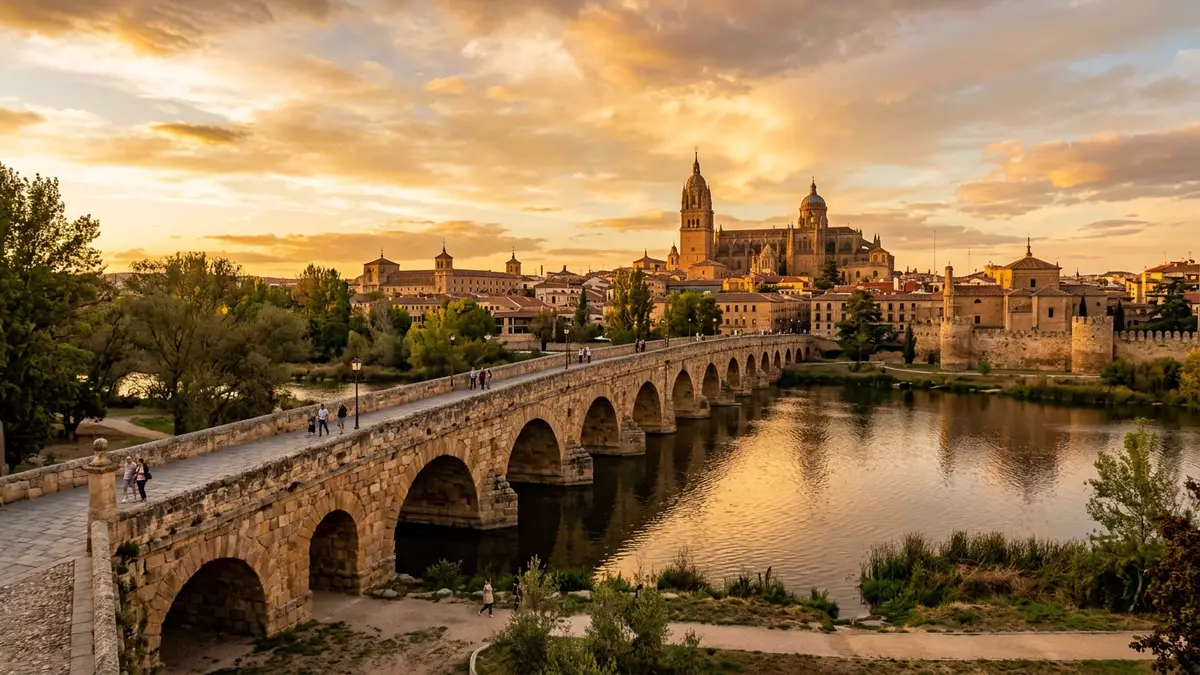
Puente Romano de Salamanca is the stone gateway across the River Tormes into Salamanca’s historic centre, a Roman bridge whose surviving arches still lead towards the city’s skyline. Set on the southern edge of Salamanca in Castile and León, it has carried travellers towards the old core of the city since the early imperial period of Rome, making it one of the defining structures in this part of western Spain.
A Roman bridge on the River Tormes
The structure known as Puente Romano de Salamanca crosses the River Tormes on the southern side of the city, linking Salamanca with the wide floodplain and the Arrabal district beyond. The bridge is traditionally dated to the first century AD, when Roman engineers established a stone crossing on this broad section of the river as part of the route through Hispania.first century AD Built in dressed stone and carried on a series of arches, it forms part of the historic Vía de la Plata, the long-distance Roman road that connected Mérida with Astorga and linked the south and north of the Iberian Peninsula.Vía de la Plata
The bridge is known locally by older names such as Puente Mayor del Tormes and Puente principal, labels that reflect its historic role as the principal crossing towards Salamanca’s old core.Puente Mayor del Tormes Its stone arches form a low, elongated profile across the river, following the line of the current and resting on robust piers that sit on a rocky riverbed. Standing on the bridge, the traveller is roughly level with the lower parts of the riverside parkland, with the water spreading out beneath the arches and the historic city rising to the north.
Arches, materials and layered construction
Puente Romano de Salamanca is a masonry bridge composed of a sequence of arches supported by solid piers, built predominantly in pale granite stone typical of the region. The arches are evenly spaced along the length of the crossing, creating a rhythm of repeating spans and shadowed recesses above the water.sequence of arches The overall structure extends for around 176 m (577 ft), with a relatively narrow roadway on top that once accommodated wheeled traffic and now serves as a stone deck for people on foot.around 176 m
The bridge represents more than one construction phase. The section closest to the historic centre retains Roman fabric from the early imperial period, while later parts further from the city reflect rebuilding carried out after major floods and other damage in the late medieval and early modern centuries.later rebuilding This layered history makes Puente Romano de Salamanca a composite of Roman engineering and post-Roman repairs, all expressed through continuous masonry and a single flowing line across the Tormes. The repeating arches, weathered stone and modest scale emphasise function and durability rather than ornament, yet in combination they form one of Salamanca’s most recognisable silhouettes when seen from the riverbanks.
From river crossing to historic monument and viewpoint
Puento Romano de Salamanca has long served as the southern approach into Salamanca’s historic centre, channelling movement from the river plain towards the city’s stone streets and religious buildings. It stands directly below the rise on which the Catedral Vieja and Catedral Nueva are built, so that the twin cathedral towers form a backdrop when looking towards the city from the bridge.twin cathedral towers The alignment of the roadway directs the line of sight straight towards the cluster of domes, towers and sandstone façades that mark the old core.
The official recognition of Puente Romano de Salamanca reflects its importance in Spain’s architectural and cultural heritage. It was declared a Monumento Histórico Artístico on 3 June 1931, and later inscribed as a Bien de Interés Cultural in 1998, placing it within the national register of protected heritage sites.Bien de Interés Cultural For a traveller crossing the bridge, these designations are not visible in themselves, but they underpin the careful conservation of its stone fabric and its integration into the riverside promenades. The bridge now forms part of a wider walkway and green space along the Tormes, inviting a slow approach to Salamanca’s old centre along a route once defined by carts and travellers on the Roman road.
Visiting Puente Romano de Salamanca: what travellers from Western Europe should know
- Puente Romano de Salamanca stands on the southern edge of Salamanca, crossing the River Tormes between the Arrabal district and the rise leading towards the historic centre; it is reached on foot from the old city streets and riverside promenades.
- The bridge deck is paved in stone, with a gentle gradient and low parapets, and is approached by walkways that run beside the river, so a visit involves walking on solid surfaces exposed to the elements rather than enclosed passageways.
- Salamanca lies in Spain, where the official language is Spanish and the currency is the euro.
Searching for Puente Romano de Salamanca on social platforms
These links open searches for Puente Romano de Salamanca on each platform.
Frequently asked questions about Puente Romano de Salamanca
Where is Puente Romano de Salamanca located?
Puente Romano de Salamanca crosses the River Tormes on the southern side of Salamanca, in the Castile and León region of Spain, linking the city with its river plain.
What should a visitor expect when walking across the bridge?
A visit involves crossing a stone bridge with a sequence of arches over the river, moving along a relatively narrow paved deck exposed to the sky and connected to riverside walkways.
What makes Puente Romano de Salamanca distinctive among Spanish bridges?
Its combination of Roman-period masonry, layered later repairs, formal protection as a Bien de Interés Cultural and direct visual connection to Salamanca’s twin cathedrals makes it a distinctive historic river crossing in Spain.


