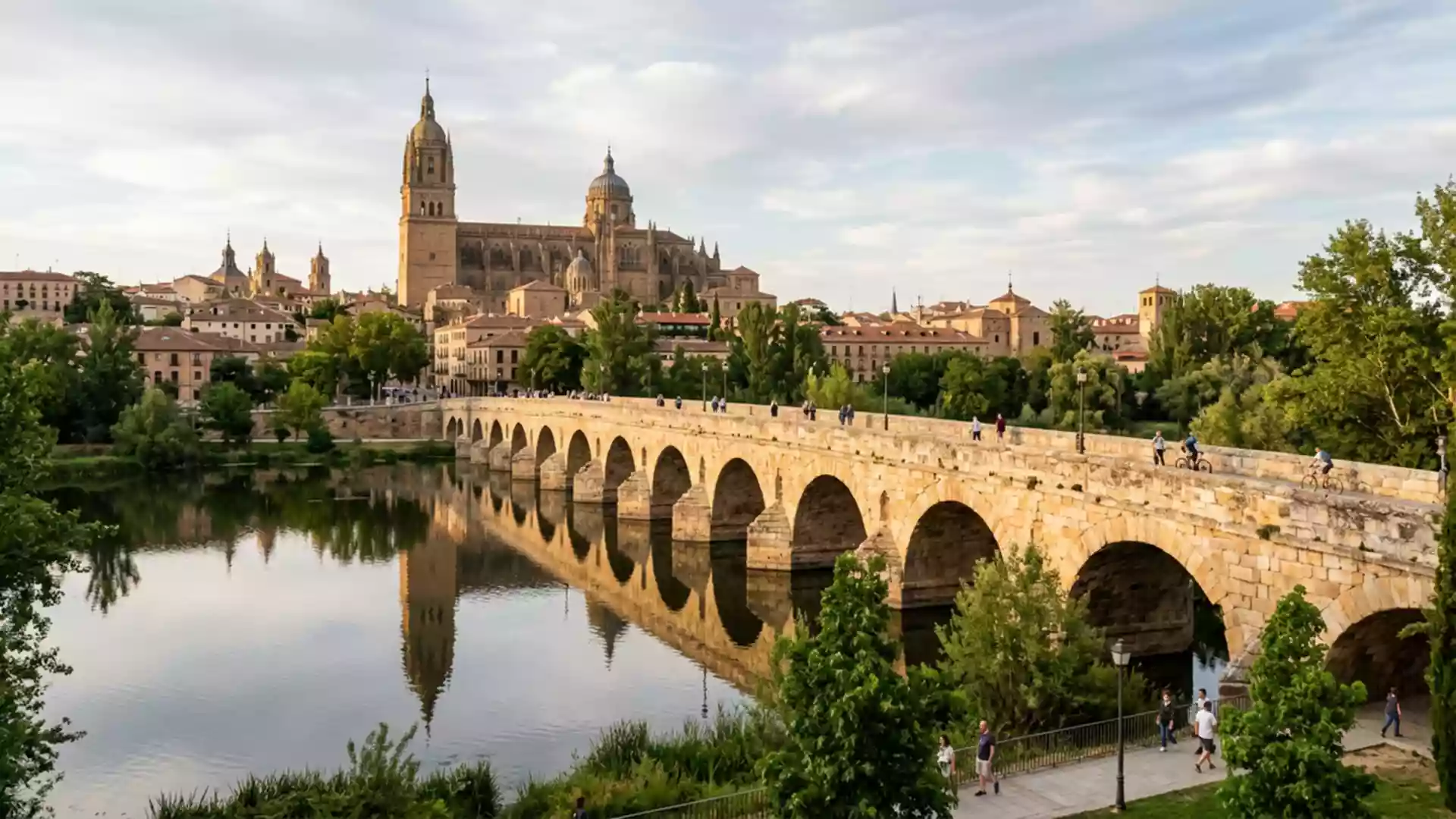
Puente Romano de Salamanca and its stone route across the Tormes
Published on 09/15/2026 at 07:46 | Editorial responsibility: Rafael Müller, Editor-in-Chief AD HOC NEWS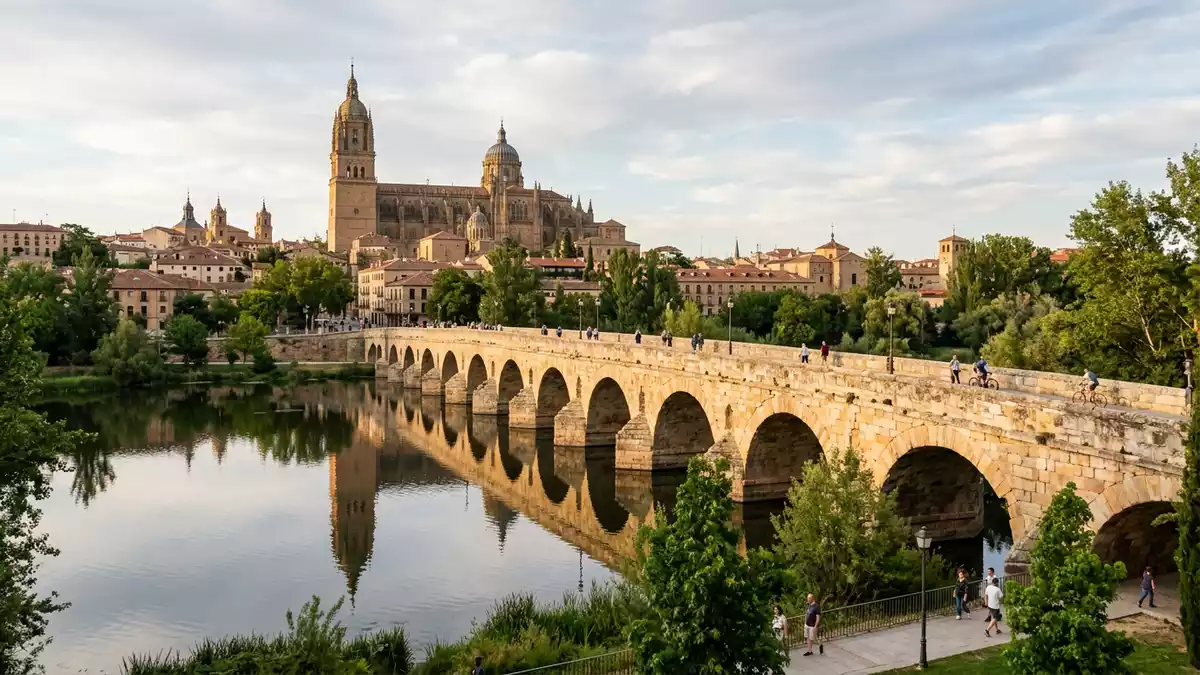
Puente Romano de Salamanca is the Roman bridge that carries the old stone route into Salamanca across the River Tormes, its line of arches drawing the eye towards the city’s historic skyline. Built in the first century AD under Emperor Trajan as part of the Roman Vía de la Plata, it still links the southern bank with the old core of Salamanca in Castile and León, Spain, anchoring the relationship between river, road and city.
A Roman river crossing shaped in stone and arches
The defining feature of Puente Romano de Salamanca is its long, low sweep of masonry crossing one of the broadest sections of the River Tormes, set on rocky subsoil that provides a firm base for its piers.Its 176 m length and 3.70 m width give the bridge a substantial presence without overpowering the river valley, creating a measured horizontal line beneath the taller silhouettes of Salamanca’s cathedrals.The structure carries 26 arches of masonry arranged in a steady rhythm, each arch resting on robust stone piers that stand out clearly when the river level is low.
The bridge is made of dressed granite blocks, laid in regular courses that emphasise the precision of Roman engineering and the durability of the material in a river environment.Golden granite typical of the region gives Puente Romano de Salamanca a warm colour that changes subtly with the light, moving from pale tones in midday sun to deeper hues at dusk. The masonry has been repaired and supplemented over many centuries, yet the visual impression remains that of a single, continuous stone crossing aligned carefully to follow the river’s course.
From Trajan’s Vía de la Plata to Salamanca’s historic approach
Puente Romano de Salamanca forms part of the Vía de la Plata, the Roman route that linked Mérida with Astorga and provided a north–south artery through the western Iberian Peninsula.The bridge is positioned where that road needed to cross the Tormes, leading travellers towards the plateau on which Salamanca developed. Stonework dating from the first century AD is traditionally associated with the reign of Emperor Trajan, reflecting a period when Roman infrastructure across Hispania was consolidated and expanded.Construction in the first century AD places the bridge among the earlier substantial river crossings in the region.
Over time, Puente Romano de Salamanca has been supplemented and repaired after major floods, and the bridge that visitors see combines Roman fabric with later work.Fifteen arches closest to the city retain Roman origin, while the remaining spans reflect seventeenth- and eighteenth-century reconstructions following heavy rises of the Tormes. Despite this layered history, the bridge has remained the principal southern approach to Salamanca, and its alignment continues to guide movement towards the old streets that climb past the cathedrals into the historic centre.
Views towards the twin cathedrals and the river landscape
Puente Romano de Salamanca offers a direct visual axis towards Salamanca’s Catedral Vieja and Catedral Nueva, the older and later cathedrals that rise together from the northern bank above the houses and river terraces.From the bridge the skyline steps up from the river to these towers, with the stone arches framing water, trees and architecture in a single composition. The contrast between the long horizontal of the bridge and the vertical elements of the cathedrals gives this view its particular character.
Looking sideways from Puente Romano de Salamanca reveals the structure’s relationship with the Tormes itself: one side faces the broader upstream water and gravel banks, the other opens towards the downstream bend where the river narrows and the city’s fabric begins to thicken. The bridge leads towards the Arrabal district on the southern bank, a quarter that occupies the floodplain beyond the river, and it also connects with riverside paths where stone, grass and water lie alongside one another.
Visiting Puente Romano de Salamanca: what travellers from Western Europe should know
- Puente Romano de Salamanca crosses the River Tormes on the southern edge of Salamanca, linking the historic centre with the Arrabal district and the riverside paths.
- The bridge surface is level but paved in stone, and access from the old town involves a descent from the cathedral area down streets and steps to the river.
- Salamanca lies in Spain, where the official language is Spanish and the currency is the euro (EUR).
Searching for Puente Romano de Salamanca on social platforms
These links open searches for Puente Romano de Salamanca on each platform.Frequently asked questions about Puente Romano de Salamanca
Where is Puente Romano de Salamanca located?
Puente Romano de Salamanca spans the River Tormes on the southern side of Salamanca, in the Castile and León region of western Spain.
What can visitors expect when walking across the bridge?
Visitors experience a stone bridge of Roman and later arches, with views along the river and towards Salamanca’s twin cathedrals rising above the northern bank.
What makes Puente Romano de Salamanca distinctive among river crossings?
Its combination of first-century Roman construction under Emperor Trajan, integration into the Vía de la Plata and direct visual link to Salamanca’s historic skyline gives the bridge its distinctive character.