
Puente Romano de Cordoba and the long stone crossing of the Guadalquivir
Published on 09/04/2026 at 20:08 | Editorial responsibility: Rafael Müller, Editor-in-Chief AD HOC NEWS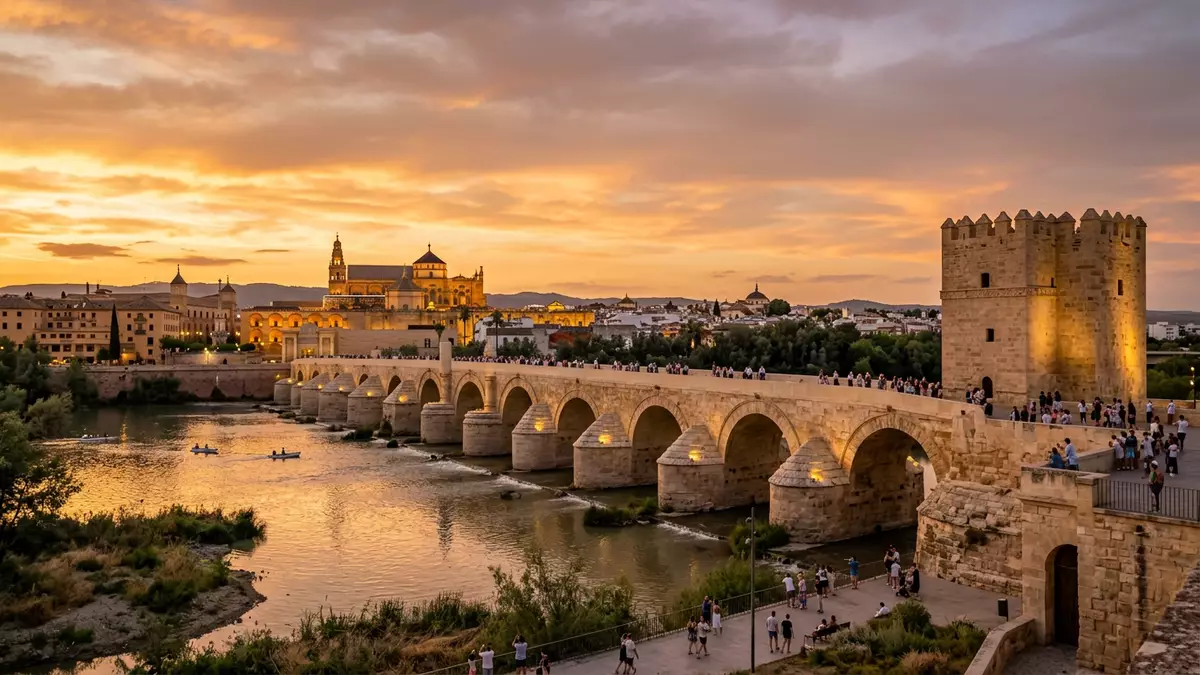
Puente Romano de Cordoba is a long stone bridge over the Guadalquivir in Cordoba, Spain, carrying a broad pedestrian way between the historic centre and the river’s southern bank. Built in the Roman period and reshaped in the Middle Ages, it ties more than twenty centuries of engineering and urban life into a single crossing in Andalusia.
A Roman line rebuilt through the centuries
The bridge’s origins lie in the early Roman imperial period, when engineers laid out a stone crossing here as part of the Via Augusta road network linking Cordoba with other cities in southern Hispania.Roman bridge of Córdoba Cordoba was an important provincial centre, and the river crossing completed the route between the town and the wider territory of the Guadalquivir valley.Via Augusta road network
Through later centuries the structure was repeatedly repaired and rebuilt, above all under the Umayyad rulers of Al-Andalus, so that most of the visible stonework dates from medieval interventions rather than the first Roman fabric.medieval structure and 1876 intervention The bridge became known locally as the Puente Viejo, the “Old Bridge”, because for roughly twenty centuries it remained the only permanent way across the Guadalquivir within the city until the construction of Puente de San Rafael in the twentieth century.Puente Viejo and sole crossing
Stone arches over the Guadalquivir
Puente Romano de Cordoba runs as a straight stone line across the river, composed of a series of arches resting on solid piers that rise from the Guadalquivir. In its present form the bridge carries sixteen arches, their rhythm giving the crossing a measured, almost processional character between city and southern bank.sixteen arches description
The total length is recorded at around 331 m (1,086 ft), making Puente Romano de Cordoba a substantial element in the river landscape and a prominent feature of Cordoba’s skyline when seen from the embankments.bridge length 331 metres Along the parapet a stone balustrade defines the edges of the walkway, and near its centre rises a statue of San Rafael, sculpted in the sixteenth century by Bernabé Gómez del Río, adding a vertical accent to the otherwise horizontal line of the bridge.San Rafael statue by Bernabé Gómez del Río
From city gate to riverside promenade
For much of its history Puente Romano de Cordoba formed part of the main approach into the city from the south, linking the countryside on that bank with the fortified core around the Mezquita and the Alcázar de los Reyes Cristianos.link to city and countryside At the northern end the bridge connects directly with streets of the historic centre, while at the southern end it meets the Torre de la Calahorra, a defensive tower guarding the entry.
In its present form the bridge functions as a pedestrian crossing carrying walkers and cyclists rather than vehicles, turning the deck into a linear public space with views along the river and towards the mosque–cathedral.pedestrian and bicycle use The Roman alignment, medieval stonework and river setting together make Puente Romano de Cordoba a central element in Cordoba’s historic centre, which is recognised as a UNESCO World Heritage Site.historic centre World Heritage
Visiting Puente Romano de Cordoba: what travellers from Western Europe should know
- Puente Romano de Cordoba spans the Guadalquivir immediately south of Cordoba’s historic centre, connecting streets near the Mezquita-Catedral with the area around the Torre de la Calahorra.
- The bridge deck is level and paved, with low stone parapets and no vehicular traffic, so crossing it involves a straightforward walk on a broad surface exposed to the open air.
- From the northern side short streets lead directly into the dense fabric of the old town, while the southern end sits beside the tower and riverside paths along the Guadalquivir.
- The official language in Spain is Spanish and the currency is the euro.
Searching for Puente Romano de Cordoba on social platforms
These links open searches for Puente Romano de Cordoba on each platform.
Frequently asked questions about Puente Romano de Cordoba
Where is Puente Romano de Cordoba located?
Puente Romano de Cordoba crosses the Guadalquivir in the city of Cordoba in Andalusia, southern Spain, linking the historic centre with the river’s southern bank near the Torre de la Calahorra.
What should visitors expect when crossing the bridge?
Visitors find a long, level stone walkway reserved for pedestrians and cyclists, with a sequence of arches below, stone parapets, and open views along the river and towards the Mezquita-Catedral.
What makes Puente Romano de Cordoba distinctive among bridges?
The bridge combines a Roman alignment from the early imperial period, medieval reconstruction under the rulers of Al-Andalus and its role within Cordoba’s UNESCO-listed historic centre, all expressed in one extended stone crossing.


