
Puente Nuevo in Ronda: stone bridge over a sheer gorge
Published on 09/16/2026 at 13:00 | Editorial responsibility: Rafael Müller, Editor-in-Chief AD HOC NEWS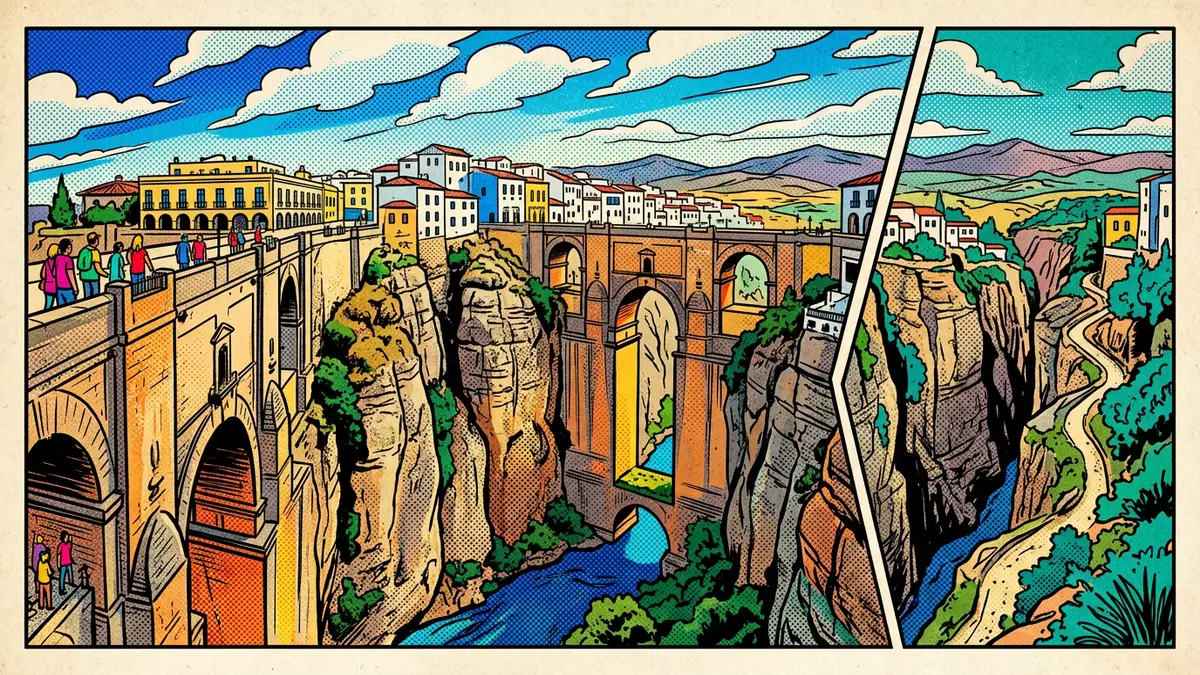
Puente Nuevo in Ronda is a high eighteenth-century stone bridge that carries the roadway across the El Tajo gorge, joining the two halves of the Andalusian town above the Guadalevín River. Completed in 1793 after a lengthy construction in the second half of the eighteenth century, it has become the defining built structure of Ronda’s skyline and a fixed point in the town’s relationship with the surrounding landscape.
A bridge between two halves of Ronda
Puente Nuevo spans the deep El Tajo gorge that cuts through Ronda and divides the historic quarter from the later part of the town.El Tajo gorge carries the Guadalevín River, which lies far below the level of the streets on either side, so the bridge’s roadway sits high above water and rock. On the one side is La Ciudad, the older district shaped under Moorish and later Christian rule, while on the other is the newer area often referred to as El Mercadillo, developed as Ronda expanded beyond its medieval core.La Ciudad and El Mercadillo
The bridge functions as an ordinary road connection, carrying everyday traffic and pedestrians between these two quarters, yet the drop on either side is anything but ordinary. The gorge is around 120 m (390 ft) deep, and Puente Nuevo rises about 98 m (322 ft) from base to top, figures that make its profile striking even against Ronda’s surrounding plateau.98 m high Standing on the roadway, visitors look out across tiled roofs and hills, then down into a narrow canyon cut into the rock by the river over long periods of time.
Eighteenth-century stone engineering above the Guadalevín
The present Puente Nuevo belongs to the eighteenth century and was completed in 1793 after work that ran through several decades from the 1750s.completed in 1793 It is the newest and largest of three bridges that span the El Tajo gorge in Ronda, reflecting a period when masonry construction was the dominant structural technique.newest and largest of three bridges Built in stone and laid out with multiple arches above a tall supporting mass, it presents a robust vertical face to the canyon while carrying a level roadway above.
The architect most closely associated with Puente Nuevo is José Martín de Aldehuela, whose work in Ronda also includes the town’s bullring, while the chief builder was the stonemason Juan Antonio Díaz Machuca.José Martín de Aldehuela The bridge’s span is about 66 m (217 ft) from side to side, giving it a presence across the canyon that matches its height.around 66 m long The stonework carries a series of openings framed within larger masses of masonry, so from below the structure reads as a stack of arches and supports rising from the river level to the town streets.
Views, levels and the surrounding landscape
Because Puente Nuevo sits at the narrowest, highest section of the El Tajo gorge, it offers clear views of both the canyon and the broader Ronda plateau.narrowest section of the gorge From the bridge itself, visitors can look along the line of the gorge and see how the Guadalevín River has cut into the rock, leaving almost vertical walls beneath the town’s houses. At other points around Ronda, paths and viewpoints allow different perspectives on the bridge, revealing the full height of its stone piers and the way it anchors the town to the canyon edge.
Seen from below, Puente Nuevo appears as a tall stone structure rising from the gorge floor to the level of the town, with the arches carrying the roadway across the gap. The drop to the river is significant, so the relationship between stone, water and the town’s buildings is visually tight: whitewashed houses stand close to the cliff edge, while the bridge ties their streets together above rock carved by the river. In this setting, Puente Nuevo is not only a piece of infrastructure but also part of a wider composition of canyon, plateau and urban fabric that defines Ronda’s character as a hill town in Andalusia.
Visiting Puente Nuevo: what travellers from Western Europe should know
- Puente Nuevo stands in Ronda in southern Spain, carrying a road across the El Tajo gorge between La Ciudad and the newer quarter around Plaza de España.
- The bridge’s main viewing points are on the roadway itself and at terraces and paths along the rim of the gorge, where the approach involves uneven ground and stone steps.
- Ronda lies inland in Andalusia, reached by road and rail links from other towns; within Ronda, Puente Nuevo is signposted from central streets near Plaza de España.
- The official language is Spanish and the currency is the euro.
Searching for Puente Nuevo on social platforms
These links open searches for Puente Nuevo on each platform.
Frequently asked questions about Puente Nuevo
Where is Puente Nuevo located?
Puente Nuevo stands in the town of Ronda in Andalusia in southern Spain, spanning the El Tajo gorge above the Guadalevín River between two urban quarters.
What should visitors expect when crossing the bridge?
Visitors cross on a stone roadway with parapets on either side, with views outward to the surrounding plateau and down into the gorge where the river runs below.
What makes Puente Nuevo distinctive among bridges in Spain?
Puente Nuevo combines eighteenth-century stone construction, a height of around 98 m above a natural gorge and a role in linking Ronda’s old and newer districts across the Guadalevín River.


