
Puente Nuevo and the stone gorge that divides Ronda
Published on 09/18/2026 at 08:43 | Editorial responsibility: Rafael Müller, Editor-in-Chief AD HOC NEWS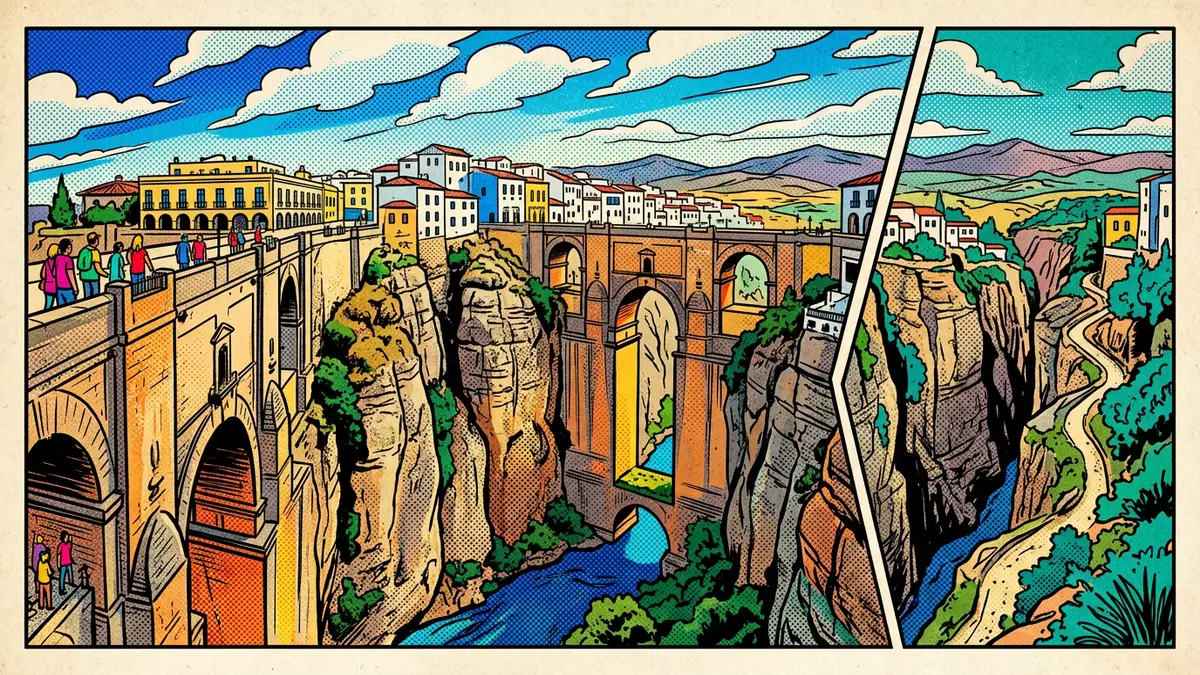
Puente Nuevo in Ronda is an eighteenth-century stone bridge that carries a road and pavements across the sheer chasm of the El Tajo gorge, binding together two halves of the Andalusian hill town high above the Guadalevín River. Built in the eighteenth century and completed in 1793, it replaced an earlier crossing and turned the cliff edge from a barrier into a line of views over inland Spain.
A stone bridge anchored in a vertical gorge
Puente Nuevo stands above the Guadalevín River where it runs through the El Tajo gorge, a natural cleft that cuts deep into the limestone plateau on which Ronda is built.Guadalevín River in El Tajo The bridge is a masonry structure with three arches carried on massive piers of dressed stone, rising around 98 m (322 ft) from the riverbed to the roadway.rising 98 metres above The overall length from one cliff face to the other is about 66 m (217 ft), giving the crossing a compact footprint compared with the height of the drop below.total length of Puente Nuevo
The bridge carries vehicular traffic and pedestrians between the older quarter on the south side of the gorge and the newer streets on the north side.connects La Ciudad and El Mercadillo Above the central opening, the stonework contains a chamber that has been used for municipal functions and interpretation displays, its windows looking straight out onto the void of the gorge. From the parapets, the views reach out over the surrounding sierras and down to the patchwork of terraces and rock ledges that line the river.
Eighteenth-century construction and earlier crossings
The bridge seen today belongs to the second half of the eighteenth century, a period when Ronda’s authorities undertook major works to link the town across the chasm. Construction of Puente Nuevo began in the 1750s and the structure was completed in 1793, following a long building phase that reflected the difficulty of working at height in a narrow rocky cleft.Baubeginn 1751 und Fertigstellung 1793 The design is associated with architects Domingo Lois de Monteagudo and José Martín de Aldehuela, with local builder Juan Antonio Díaz Machuca directing construction on the site.Domingo Lois de Monteagudo and José Martín de Aldehuela
Before Puente Nuevo, the town relied on earlier bridges further downstream and an initial crossing on the same line as the present span. In the 1730s a bridge with a single large arch was erected here under the reign of Philip V, but it collapsed a few years after completion, causing many deaths among people crossing the gorge.earlier bridge collapsed The stone for the replacement bridge was quarried within the gorge itself and hauled up to form the tall piers and arches that now define Ronda’s skyline.
Ronda divided and reconnected above El Tajo
Puente Nuevo spans the point where the plateau of Ronda splits into two distinct rims separated by the gorge, leaving the historic core of La Ciudad on one side and the later commercial district of El Mercadillo on the other.old Moorish town and new town Crossing the bridge on foot, the stone parapets give alternating views along the gorge, out over the surrounding countryside and into the streets that converge on Plaza de España near the northern abutment.Plaza de España in Ronda
Seen from below, the three arches stack above one another between the rock faces, with the lowest arch framing the river and the upper opening carrying the roadway high above. Terraces and paths on the slopes beneath the town offer different perspectives on the stonework, the height of the piers and the way the bridge and cliff form a single wall along the edge of the plateau.
Visiting Puente Nuevo: what travellers from Western Europe should know
- Puente Nuevo stands in the centre of Ronda in southern Spain, crossing the El Tajo gorge between La Ciudad on the south side and the district around Plaza de España on the north side.
- The approaches to the bridge on both sides of the gorge run along streets that rise and fall with the plateau, and paths leading to viewpoints below involve steep gradients and staircases over uneven rock.
- Ronda lies in Andalusia and is reached overland from other Spanish cities; the official language is Spanish and the currency is the euro.
- Entry requirements depend on your nationality; UK travellers can check the FCDO travel advice at gov.uk/foreign-travel-advice, Irish travellers the Department of Foreign Affairs at ireland.ie.
Searching for Puente Nuevo on social platforms
These links open searches for Puente Nuevo on each platform.
Frequently asked questions about Puente Nuevo
Where is Puente Nuevo?
Puente Nuevo is in Ronda in Andalusia in southern Spain, crossing the El Tajo gorge above the Guadalevín River and linking the historic quarter with the newer town.
What should visitors expect on a visit?
Visitors find a stone bridge carrying traffic and pavements across a deep gorge, with viewpoints from the parapets and from paths and terraces on different levels around the cliff.
What makes Puente Nuevo distinctive?
Puente Nuevo is distinctive for its height above the river, its three stacked arches anchored directly into the gorge and its role in linking two cliff-top districts of Ronda.


