
Puente Nuevo and the stone chasm that divides Ronda
Published on 08/16/2026 at 14:08 | Editorial responsibility: Rafael Müller, Editor-in-Chief AD HOC NEWS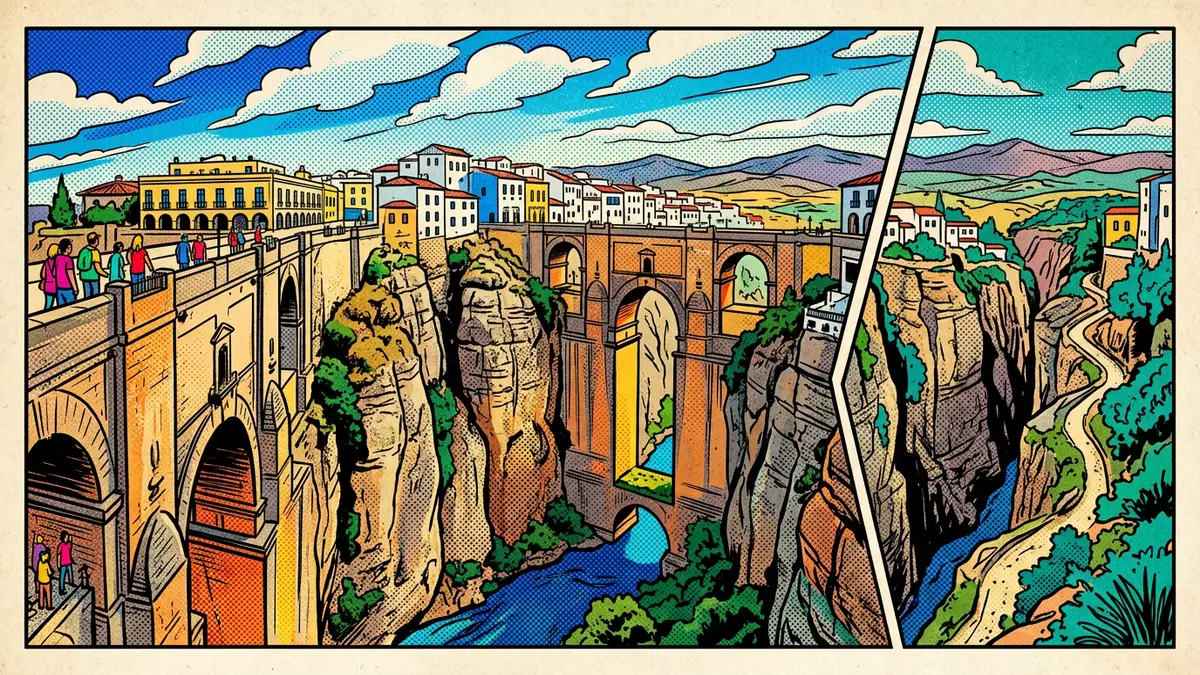
Puente Nuevo in Ronda is an eighteenth-century stone bridge that carries a roadway high above the El Tajo gorge, linking the older and newer quarters of this Andalusian hill town. Completed in 1793 under the architect José Martín de Aldehuela, it rises close to 100 m (around 330 ft) above the Guadalevín River and has become the defining silhouette of Ronda’s skyline.
An eighteenth-century bridge suspended over rock and river
Seen from below, Puente Nuevo appears as a stone wall rising directly out of the limestone cliffs of El Tajo, with a series of arches cut through the mass to carry the road across the void. The structure spans the Guadalevín River where it flows through the deep chasm that splits Ronda, so the bridge connects the historic La Ciudad quarter on one side with the more recent El Mercadillo district on the other.The Puente Nuevo is the newest and largest of the bridges over this gorge.
Construction of the current Puente Nuevo began in the 1750s and continued into the 1790s, giving the bridge a clear place in the late Baroque period of Spanish engineering.It was started in 1759 and completed in 1793. Built of dressed stone anchored into the sides of the gorge, it carries vehicular traffic as well as pedestrians across its deck, turning what would otherwise be a natural barrier into the main axis of the town.
Arches, chambers and the vertical drama of El Tajo
Puente Nuevo is organised around three main stone arches that step across the gap, supported by thick vertical piers that descend towards the riverbed.The bridge stands about 98 m above the Guadalevín and spans roughly 66 m from side to side. Above the central opening sits a small masonry chamber, set directly over the drop, which has served different functions over the centuries and now houses an interpretation space explaining the bridge’s history.
From the roadway, low parapet walls frame views straight down to the Guadalevín River as it threads along the base of the gorge. The rock faces on either side show the layered strata of the limestone, cut back almost vertically where the chasm has been eroded. Looking outwards rather than down, the deck also gives long views over the surrounding Andalusian landscape, where fields, scattered farm buildings and distant hills sit beyond the compact stone fabric of Ronda.
Puente Nuevo in the life and layout of Ronda
The bridge’s position at Plaza de España places it directly on the edge of the historic core of Ronda, where streets from La Ciudad and El Mercadillo converge at the brink of the gorge.It stands at the El Tajo de Ronda, a short way south of the railway station. On the southern side, narrow streets lead back into the older Moorish quarter, while to the north broader avenues run through the later extensions of the town.
Beyond its practical role as a road bridge, Puente Nuevo has become closely associated with Ronda’s identity. The stone fabric of the bridge echoes the masonry of nearby houses, churches and the bullring also linked with José Martín de Aldehuela, so that the span reads as an extension of the town’s architecture across the void.Spanish-language accounts describe it as the most emblematic monument in Ronda. Around it, a series of viewpoints and paths trace the rim and the slopes of the gorge, giving changing angles on the masonry and the drop beneath.
Visiting Puente Nuevo: what travellers from Western Europe should know
- Puente Nuevo stands in Ronda in the province of Málaga in southern Spain, a short walk south from Ronda’s railway station along Avenida de Andalucía and Calle Virgen de la Paz.
- The immediate surroundings include steep streets and paths along the gorge; approaches to viewpoints below the bridge involve descents on uneven ground and stepped walkways.
- The official language is Spanish and the currency is the euro.
- Entry requirements depend on your nationality; UK travellers can check the FCDO travel advice at gov.uk/foreign-travel-advice, Irish travellers the Department of Foreign Affairs at ireland.ie.
Searching for Puente Nuevo on social platforms
These links open searches for Puente Nuevo on each platform.
Frequently asked questions about Puente Nuevo
Where is Puente Nuevo?
Puente Nuevo stands above the El Tajo gorge in Ronda, in the province of Málaga in Andalusia in southern Spain.
What can visitors expect when crossing the bridge?
Visitors cross on a stone roadway shared by vehicles and pedestrians, with parapets offering views down to the Guadalevín River and out towards the surrounding countryside.
What makes Puente Nuevo distinctive among bridges in Spain?
Its combination of eighteenth-century masonry, three-arch composition and height above the limestone gorge makes Puente Nuevo a defining landmark of Ronda’s urban landscape.


