
Predjamski grad: a castle fused with cliff and cave above Postojna
Published on 09/10/2026 at 08:26 | Editorial responsibility: Rafael Müller, Editor-in-Chief AD HOC NEWS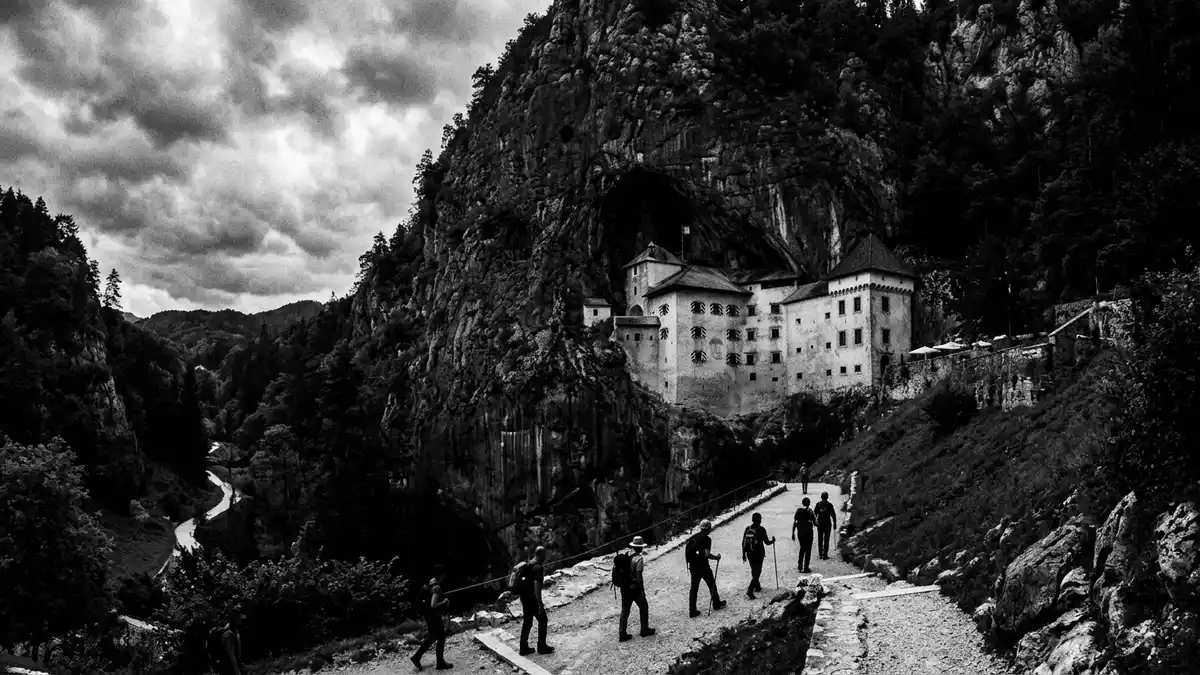
Predjamski grad above Postojna in Slovenia is a Renaissance castle built directly into a limestone cliff, where stone walls and raw rock share the same vertical face. Standing in the village of Predjama in Inner Carniola, it is a fortified residence embedded at the mouth of a cave in the karst landscape north of Postojna, giving the building and the terrain a single, dramatic profile.
A castle in the cliff: architecture and karst setting
Predjamski grad is a multi-storey castle recessed into a high limestone cliff, with masonry rising from the rock ledges and the upper part standing against bare stone above a cave entrance.Predjama Castle cliff The Slovene name Predjamski grad literally describes a castle in front of a cave, and the building occupies that position in a karst ravine, with the rock acting as both backdrop and structural partner.Slovene name Predjamski grad The cliff rises to more than 100 m (328 ft), and the castle is perched partway up its face, presenting a facade of white-rendered walls, defensive openings and timber balconies above a steep, wooded slope.
The castle is attached to a cave system known as the Cave under Predjama Castle, and parts of the interior connect to chambers within the rock.Cave under Predjama Castle Behind the outer walls, the rock recedes into passages and caverns, creating a layered spatial arrangement where built rooms sit against natural stone and some levels continue deeper into the hill. The surrounding landscape belongs to the Slovene Karst plateau, characterised by sinkholes, ravines and caves, and Predjamski grad stands where a small valley cuts into this limestone terrain.
From medieval fortress to Renaissance residence
Written records first mention a castle on this site in 1274 under the German name Luegg, when a Gothic-style fortress was associated with the Patriarchate of Aquileia.first mention in 1274 The early fortification was built into the rock cavity, using the cave entrance and the sheer cliff as part of its defensive arrangement.original Gothic fortress In the fifteenth century the castle became associated with Erasmus Lueger, also known as Erazem of Predjama, a knight who held the fortress during a period of conflict with Habsburg authority and whose story remains closely tied to the site.
In the early sixteenth century an earthquake heavily damaged the structure, and a new castle was built on the ruins before further rebuilding gave Predjamski grad its present Renaissance appearance around 1570.Renaissance rebuilding in 1570 The resulting residence presents a regularised facade with rows of windows, projecting galleries and internal rooms arranged over several floors, while retaining the cave relationship of the medieval fortress. The structure is recognised as a cave castle and is recorded in reference works as the largest cave castle in the world, combining built fabric and karst geology in a single composition.largest cave castle in the world
Caves, legends and the wider Predjama landscape
The Cave under Predjama Castle extends beneath and behind the fortress, forming a multi-level karst system with several named sections, including areas known as the Stables and the Cave of Names.multi-level cave system Archaeological finds in these chambers include remains from the Stone Age and artefacts from Roman times, and inscriptions in one part of the cave date back to the sixteenth century, indicating long human interaction with the underground spaces. The cave is described as the second longest show cave in Slovenia, with its floors connected in a vertical sequence beneath the castle.
Predjamski grad lies about 9 km north of Postojna, in a rural setting of fields, forest and karst hills, and the castle forms a landmark above the village of Predjama.location near Postojna The wider area includes the well-known Postojna Cave, and the relationship between surface architecture and subterranean geology is a recurring theme in the region. At Predjamski grad that relationship is especially direct, with the fortified residence occupying the cliff face and the cave continuing into the hill behind it.
Visiting Predjamski grad: what travellers from Western Europe should know
- Predjamski grad stands in the village of Predjama, north of Postojna in south-central Slovenia, and is reached by road from Postojna and the nearby A1 motorway.
- The approach to the castle involves a steep uphill stretch and solid paths, and the interior includes stairways between levels and passages that follow the rock.
- The surrounding landscape is rural karst terrain with wooded slopes and limestone formations, and viewpoints near the castle look across the valley and towards the hills around Postojna.
- The official language is Slovene and the currency is the euro.
Searching for Predjamski grad on social platforms
These links open searches for Predjamski grad on each platform.
Frequently asked questions about Predjamski grad
Where is Predjamski grad located?
Predjamski grad stands above the village of Predjama, north of Postojna in Inner Carniola, in south-central Slovenia, within the country’s karst landscape.
What can visitors expect when exploring Predjamski grad?
Visitors encounter a multi-storey castle built into a high limestone cliff, with interior rooms, stairways and passages that connect to chambers in the cave system behind the facade.
What makes Predjamski grad distinctive among European castles?
Predjamski grad combines Renaissance castle architecture with a karst cliff and cave system, and is recorded as the largest cave castle in the world, giving it a rare cliffside profile.


