
Prazsky hrad: a thousand years above Prag
Published on 09/14/2026 at 10:59 | Editorial responsibility: Rafael Müller, Editor-in-Chief AD HOC NEWS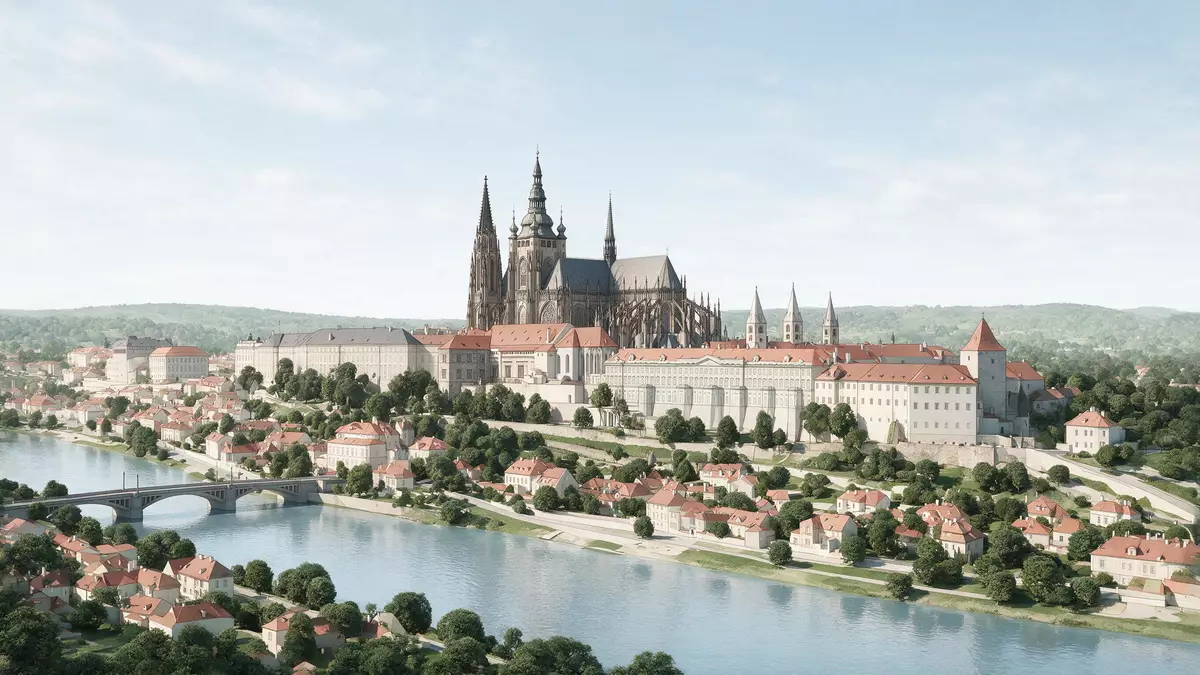
Prazsky hrad, known in English as Prague Castle, stretches along a ridge above the Vltava and gathers more than a thousand years of Czech power and worship into a single fortified complex. Founded in the late ninth century and associated from its earliest phase with Prince Bo?ivoj of the P?emyslid dynasty, it has grown into a layered composition of palaces, churches and towers that still serves as the seat of the president of the Czech Republic.
A hilltop city of courtyards and palaces
Prazsky hrad occupies a long spur on the western side of Prag, overlooking the river and the historic centre below in a position that makes its walls and roofs a constant presence in views across the city. The core of the complex developed from a fortified settlement founded around 880 under Bo?ivoj, whose residence on this hill became the principal seat of early Bohemian rulersfounded around 880. Over the centuries these early defences were replaced and expanded by stone fortifications and residences, turning the ridge into a self-contained precinct with successive palaces for dukes, kings and emperorsseat of Czech princes and later kings.
The complex is organised around a sequence of courtyards framed by grand facades, with ecclesiastical, residential and administrative buildings forming an almost continuous frontage along the plateau. This composition of structures in different styles extends across an area described as covering tens of hectares, and is recognised as the largest coherent castle complex in the world, a status recorded by Guinness World Recordslargest coherent castle complex. Within its walls, the Old Royal Palace retains parts of its Romanesque core, later reworked in Gothic and Renaissance forms, while later wings such as the New Royal Palace and Lobkowicz Palace show changing tastes in courtly architecture through the Baroque and Neoclassical periodspalaces and architectural styles.
Churches, chapels and changing styles
Religion anchors the story of Prazsky hrad as firmly as power. In the early phase of the castle, the first walled building was the Church of the Virgin Mary, marking the consolidation of Christianity among Bohemian elites during the reign of Bo?ivojfirst walled church of the Virgin Mary. In the tenth century, new churches followed: the Basilica of St George, linked with Duke Vratislav, and the Rotunda of St Vitus connected to Duke Wenceslas, established the hilltop as a centre of worship with stone structures that replaced earlier timber buildingsBasilica of St George and Rotunda of St Vitus. The foundations of some of these early buildings can still be traced within the castle precinct, underscoring how later constructions rose directly alongside or above their predecessors.
St Vitus Cathedral dominates the skyline of Prazsky hrad as the largest church in the complex and the spiritual heart of the Czech lands. Work on its Gothic replacement began in the fourteenth century under King Charles IV, who elevated the Prague bishopric to an archbishopric and laid the cornerstone of a new cathedral, engaging architect Matthias of Arras and, after his death, Peter ParlerCharles IV and cathedral builders. The cathedral was only completed in the twentieth century, when Neo-Gothic elements were added to finish the western part of the churchGothic and Neo-Gothic elements. Elsewhere in the complex, St George’s Basilica preserves its Romanesque character beneath later Baroque additions, and convent buildings nearby recall its role as the site of the first convent in Bohemiafirst convent in Bohemia.
From P?emyslid stronghold to Czech presidential seat
Prazsky hrad traces the political evolution of the Czech lands from a P?emyslid power base to a modern republic. From the tenth century onwards it functioned as the seat of Czech princes and later kings, anchoring the authority of the Bohemian crownseat of Czech princes and kings. In the fourteenth century, under Charles IV as king of Bohemia and Holy Roman Emperor, the royal palace was rebuilt in Gothic style and the castle’s fortifications were strengthened, reflecting its dual role as a dynastic residence and imperial strongholdroyal palace rebuilt in Gothic style. Later rulers, including Vladislaus II and Maria Theresa, commissioned further alterations, from the construction of the expansive Vladislav Hall in the late fifteenth century to eighteenth-century remodelling that gave many facades their present appearanceVladislav Hall and Maria Theresa remodelling.
In the twentieth century, Prazsky hrad was reshaped again as the capital of a new state. From 1918 it became the seat of the president of Czechoslovakia and, later, the Czech Republic, a function it continues to fulfilseat of the president. During the era of the First Republic, the Slovenian architect Josip Ple?nik oversaw extensive renovations, including gardens and courtyards, giving parts of the complex a distinctive twentieth-century classicising character while respecting older structuresJosip Ple?nik renovations. The entire castle area forms part of a UNESCO World Heritage site alongside the historic centre of Prag, recognised for its continuity of development, range of architectural styles from Romanesque to Baroque and Neo-Gothic, and its role as a symbol of Czech statehoodUNESCO recognition and architectural range.
Visiting Prazsky hrad: what travellers from Western Europe should know
- Prazsky hrad stands on the western side of Prag above the Vltava, reached from the historic centre by crossing the river and ascending streets or paths to the castle district.
- Within the complex, routes between courtyards and major buildings involve walking over paved surfaces and negotiating stairways, including some narrow flights in towers and historic interiors.
- Seasonal weather in Prag can affect conditions in the open courtyards and gardens, with winter bringing cold air and potential ice on stone surfaces and summer bringing strong sun on exposed walks.
- English is widely used in visitor information, but the official language is Czech and the currency is the Czech koruna.
- Entry requirements depend on your nationality; UK travellers can check the FCDO travel advice at gov.uk/foreign-travel-advice, Irish travellers the Department of Foreign Affairs at ireland.ie.
Searching for Prazsky hrad on social platforms
These links open searches for Prazsky hrad on each platform.
Frequently asked questions about Prazsky hrad
Where is Prazsky hrad located within Prag?
Prazsky hrad occupies a ridge on the western bank of the Vltava, above the historic centre, in the Hrad?any district of Prag.
What can visitors expect inside the castle complex?
The complex contains courtyards framed by palaces, churches such as St Vitus Cathedral and St George’s Basilica, defensive towers and gardens set within historic fortifications.
What makes Prazsky hrad distinctive among European castles?
Its continuous development from around 880, range of styles from Romanesque to Baroque and Neo-Gothic, and role as the Czech presidential seat give it an unusually layered character.


