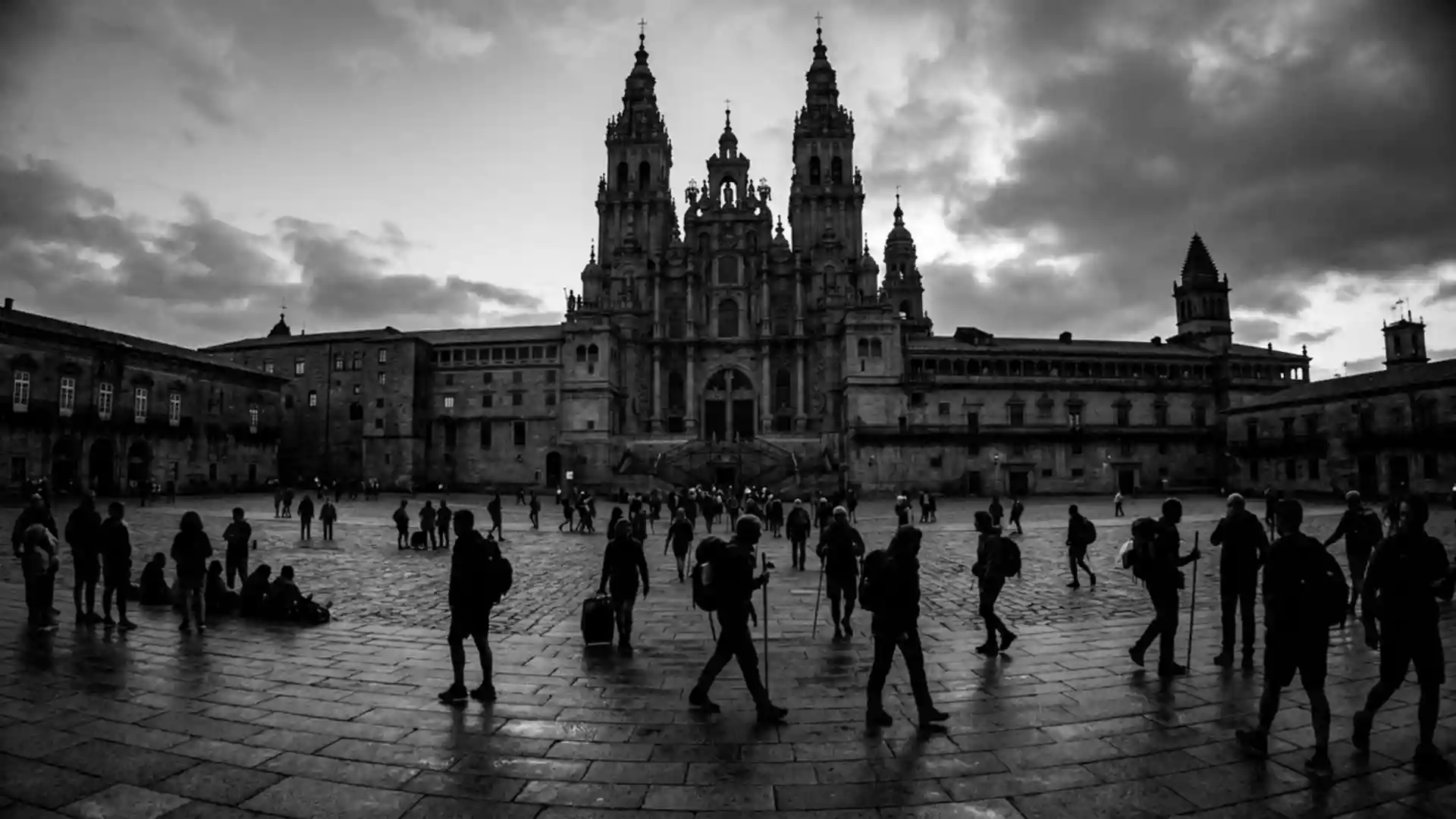
Praza do Obradoiro and the four faces of Santiago de Compostela
Published on 09/02/2026 at 21:33 | Editorial responsibility: Rafael Müller, Editor-in-Chief AD HOC NEWS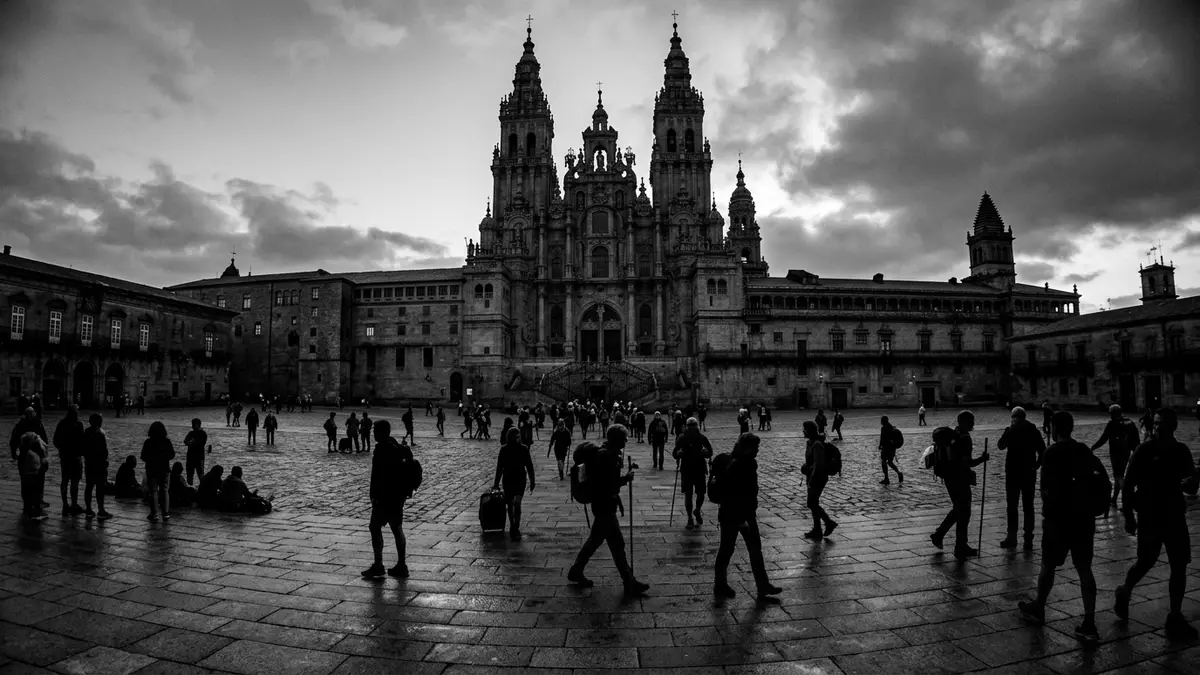
Praza do Obradoiro in Santiago de Compostela is the granite stage where pilgrims, civic power, learning and hospitality gather face to face around the city’s cathedral. At the western edge of the old town, this broad square frames the Baroque façade of the Cathedral of Santiago de Compostela and anchors the historic core that forms part of the UNESCO World Heritage listing for Santiago’s old town.
A granite square framed by four powers
Praza do Obradoiro lies directly in front of the main western façade of the Cathedral of Santiago de Compostela, the church that grew around the cult of Saint James in the medieval period.Santiago de Compostela old town The square’s name refers to the stonemasons’ workshops that once stood here while the cathedral’s ornate front was under construction, a reminder that this open space began life as a place of labour as much as celebration.
The ground of Praza do Obradoiro is paved in granite and marked by a pattern of eight rays that meet at a central plaque. This plaque records the role of Santiago de Compostela as the end point of the Camiño de Santiago, the network of pilgrimage routes that converge on the cathedral and the remains of Saint James.plaque for the Camino de Santiago Pilgrims crossing the open space see the cathedral on one side and three other historic buildings closing the other sides, so that every direction is defined by stone walls, arcades and sculpted façades rather than shops or traffic.
Cathedral, palace, hostel and university in one view
The square is framed by four principal buildings, each associated with a different role in Santiago de Compostela’s life. To the east stands the Cathedral of Santiago de Compostela with its celebrated Baroque façade, part of a church whose core includes Romanesque work from the twelfth century and later additions that reshaped its exterior towards the eighteenth century.Praza do Obradoiro and cathedral setting The façade that faces the square rises in towers and sculpted stone, acting as the visual focus for anyone crossing the open space.
On the north side, the former Hospital de los Reyes Católicos, now known as Hostal de los Reyes Católicos, recalls the role of royal patronage and hospitality. Founded by the Catholic Monarchs Ferdinand and Isabella in the late fifteenth century as a hospital for pilgrims, it later became a historic hostal that still lines the edge of the square.Hostal de los Reyes Católicos on the square Opposite the cathedral on the west stands the Pazo de Raxoi, a Neoclassical palace commissioned by Archbishop Bartolomé Rajoy in 1766 and designed by Carlos Lemaur, whose long façade with a granite colonnade now houses the city council and offices of the Galician administration.Raxoi Palace facing the cathedral
The workshop square at the heart of a World Heritage city
Closing the south side of Praza do Obradoiro is the Colexio de San Xerome, whose gateway leads into the building that serves as the rector’s offices for the University of Santiago de Compostela.Colexio de San Xerome on the square The four edges of the square are therefore closely associated with the church, civil government, university and the historic hostel, a composition sometimes described in terms of the four powers of Santiago de Compostela.
Praza do Obradoiro is part of the historic core of Santiago de Compostela recognised as a World Heritage Site, with the square itself described as one of the city’s most monumental spaces.Obradoiro square within the World Heritage old town The open space is mainly pedestrian, with only limited vehicle access, and there is no line of street cafés or shops on the paving itself, which leaves the central granite surface clear. Standing here brings all four façades into a single panorama, from the cathedral towers through the Neoclassical front of Pazo de Raxoi to the former hospital and the university building.
Visiting Praza do Obradoiro: what travellers from Western Europe should know
- Praza do Obradoiro stands on the western side of the Cathedral of Santiago de Compostela in the historic centre of Santiago de Compostela, in the region of Galicia in north?west Spain.
- The square is paved in granite and kept free of traffic in most of its area, so crossing it involves walking over an open stone surface with gradual changes in level rather than steep flights of steps.
- Praza do Obradoiro forms part of the old town of Santiago de Compostela, which is reached through narrow historic streets where vehicle access is restricted and many routes towards the square are on foot from surrounding lanes and small plazas.
- The official language in Santiago de Compostela is Spanish alongside Galician, and the currency is the euro.
- Entry requirements depend on your nationality; UK travellers can check the FCDO travel advice at gov.uk/foreign-travel-advice, Irish travellers the Department of Foreign Affairs at ireland.ie.
Searching for Praza do Obradoiro on social platforms
These links open searches for Praza do Obradoiro on each platform.
Frequently asked questions about Praza do Obradoiro
Where is Praza do Obradoiro located within Santiago de Compostela?
Praza do Obradoiro lies on the western side of the Cathedral of Santiago de Compostela, in the historic centre of the city in Galicia in north?west Spain.
What should visitors expect when they enter the square?
Visitors enter a broad granite-paved space framed by the cathedral, the former pilgrims’ hospital, the Pazo de Raxoi and the Colexio de San Xerome, with no shops or cafés on the paving itself.
What makes Praza do Obradoiro distinctive among Spanish squares?
Praza do Obradoiro is distinctive for bringing together the cathedral, a royal-founded hostel, a Neoclassical government palace and a university building around one open square within a UNESCO-listed historic city.