
Praza do Obradoiro and the four faces of Santiago de Compostela
Published on 08/29/2026 at 18:43 | Editorial responsibility: Rafael Müller, Editor-in-Chief AD HOC NEWS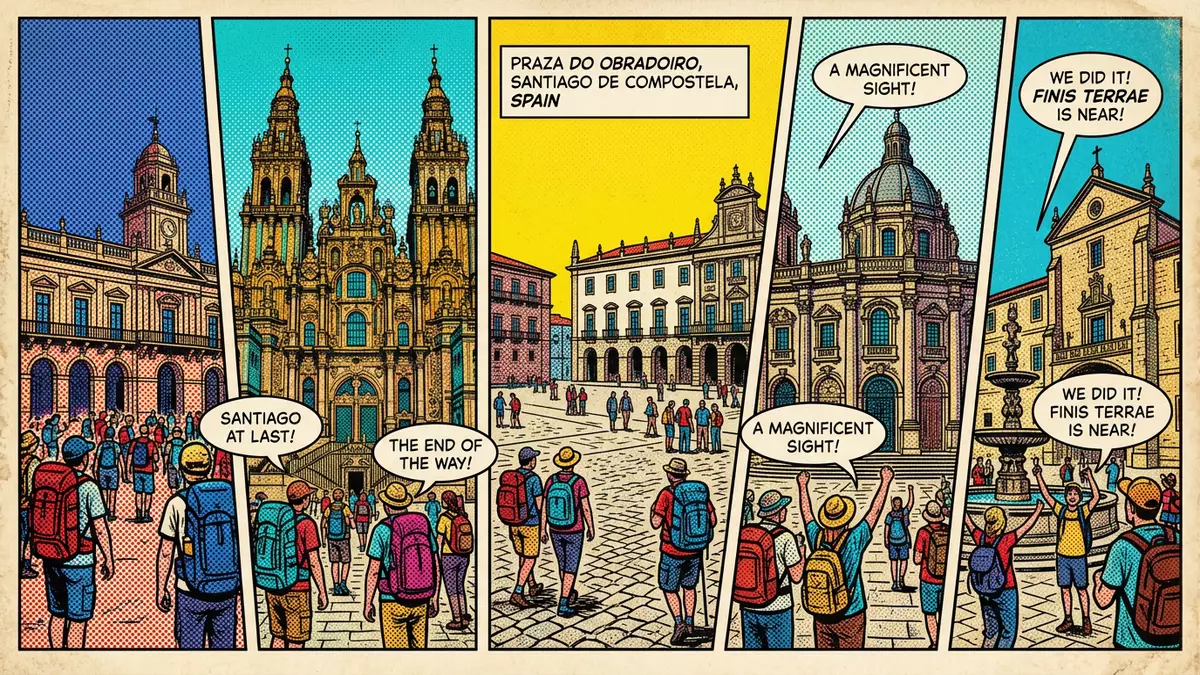
Praza do Obradoiro is the stone-paved square that gathers Santiago de Compostela’s cathedral, palace, university and former pilgrim hospital around a single open space at the western edge of the old town. The name “Obradoiro” refers to the workshops of stonemasons that once operated beside the unfinished cathedral façade during the great building campaigns of the seventeenth and eighteenth centuries.
A rectangle framed by four monumental neighbours
Praza do Obradoiro forms a broad rectangular platform in front of the cathedral’s western façade, known locally as the Obradoiro façade, which rises above the paving with layered Baroque towers and sculpted stonework. The present façade was completed in the middle of the eighteenth century under the architect Fernando de Casas Novoa, bringing a Baroque front to the medieval church behind.Fernando de Casas Novoa The cathedral complex on this side of the square also includes the Pazo de Xelmírez and museum spaces that occupy parts of the historic fabric.Pazo de Xelmírez and the cathedral museum
Each side of the rectangle is taken up by a major building that represents a different institution in the city. On one long side stands the cathedral front, while directly opposite on the other long side rises the Pazo de Raxoi, an eighteenth-century palace that now houses the city council of Santiago de Compostela and the presidency of the regional government.Pazo de Raxoi on the western side On the shorter sides, the Real Hostal dos Reis Católicos occupies the northern edge and the Pazo de San Xerome, now the rector’s office of the University of Santiago de Compostela, defines the southern edge.four representative buildings
Stone, elevation and the end of the Camino
The paving of Praza do Obradoiro is laid in stone slabs that create a broad, gently sloping surface running away from the cathedral steps. The elevation of the square, set on a shoulder of ground in the old town, gives long views towards the surrounding city when standing near the cathedral wall. The absence of through-traffic across the paving leaves the rectangular space clear for people to cross in any direction between the four doorways.
For many visitors who arrive on foot, Praza do Obradoiro marks the symbolic end of the Camino de Santiago routes that converge on the city. Pilgrims approach along streets that funnel them into the square at the level of the cathedral’s main west door, passing across the stone slabs to stand before the Obradoiro façade and, beyond it, the Romanesque Pórtico da Gloria that lies inside the church.Pórtico da Gloria behind the façade The Real Hostal dos Reis Católicos on the north side began its life in the early sixteenth century as a hospital and hostal for pilgrims commissioned by the Catholic Monarchs, Isabel I of Castile and Fernando II of Aragon, and retains its four internal courtyards within the block.Hostal dos Reis Católicos and its courtyards
Styles and stories around the edges
Walking the perimeter of Praza do Obradoiro is a way to read several centuries of Galician architecture in a single circuit. The cathedral front blends Baroque towers with a medieval core; the Hostal dos Reis Católicos on the north side carries Renaissance and Plateresque elements that reflect its sixteenth-century origins as a royal project; and the Pazo de Raxoi facing the cathedral presents an eighteenth-century classical façade with long rows of windows and a central balcony. On the south side, the Pazo de San Xerome retains a Romanesque-Gothic portal from the fifteenth century that was transferred from an earlier site to form the entrance to the present rector’s office.Romanesque-Gothic portal of San Xerome
The square’s name itself reflects working life around the unfinished cathedral during its construction phases. “Obradoiro” in Galician means “workshop”, a reminder of the stonemasons and other craftspeople whose workshops once stood close to the site while the Obradoiro façade rose in stages.meaning of Obraidoiro as workshop As a result, the square today carries both formal institutional architecture and the memory of construction work that shaped the city’s most recognisable front.
Visiting Praza do Obradoiro: what travellers from Western Europe should know
- Praza do Obradoiro lies in the historic centre of Santiago de Compostela in Spain’s Galicia region, immediately west of the cathedral’s main façade and reached along narrow streets of the old town.
- The square is paved in large stone slabs and has steps at the cathedral side, so moving across it involves walking on uneven surfaces and using short flights of steps to reach the church entrances.
- Santiago de Compostela is served by Santiago–Rosalía de Castro Airport to the south of the city, from where buses run towards the centre and onward streets lead to Praza do Obradoiro.
- The official language in this part of Spain is Spanish alongside Galician, and the national currency is the euro.
Searching for Praza do Obradoiro on social platforms
These links open searches for Praza do Obradoiro on each platform.
Frequently asked questions about Praza do Obradoiro
Where is Praza do Obradoiro located?
Praza do Obradoiro is in the historic centre of Santiago de Compostela, in the province of A Coruña in Galicia, Spain, immediately in front of the cathedral’s western façade.
What should visitors expect when they arrive in the square?
Visitors step onto a broad stone-paved space framed by the cathedral, a former pilgrim hospital, a palace housing civic institutions and a university building, with people crossing between the four façades.
What makes Praza do Obradoiro distinctive among Spanish squares?
Praza do Obradoiro is distinctive for bringing together religious, royal, civic and academic buildings from different centuries around a single open rectangle that also marks the end point of the Camino de Santiago routes.


