
Praza do Obradoiro and the four faces of Santiago de Compostela
Published on 08/27/2026 at 21:33 | Editorial responsibility: Rafael Müller, Editor-in-Chief AD HOC NEWS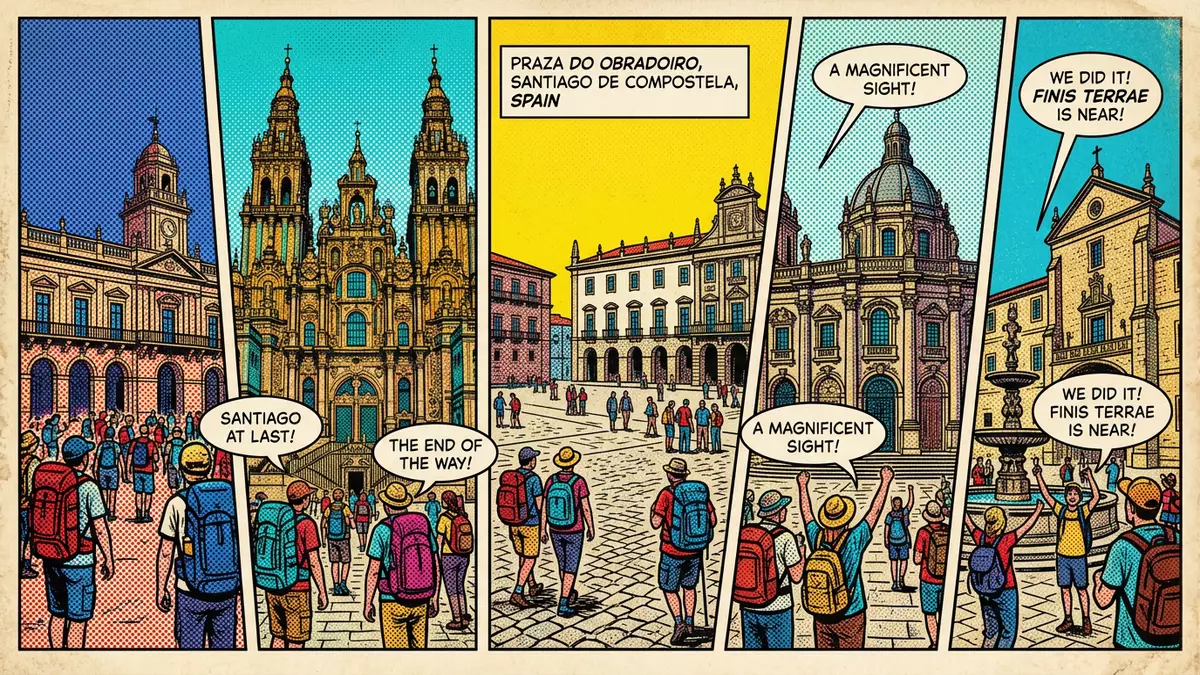
Praza do Obradoiro in Santiago de Compostela is a broad stone square where the city’s cathedral, government palace, university and former pilgrim hospital face one another across an open space of granite paving. It is the principal square of the historic centre and the traditional end point of the Camino de Santiago pilgrimage routes.
A rectangle of stone framed by four monumental neighbours
Praza do Obradoiro forms an elongated rectangle paved in stone, with its sides taken up by four grand buildings that define much of Santiago de Compostela’s civic and religious life.Four grand buildings frame the square On one of the longer sides stands the western front of the Cathedral of Santiago de Compostela, whose Obradoiro façade rises directly from the edge of the square.The cathedral’s west façade faces the square
On the opposite long side is the Pazo de Raxoi, an eighteenth-century palace that serves as the city hall and seat of regional government. One of the shorter sides is occupied by the Hostal dos Reis Católicos, a former pilgrims’ hospital founded in the early sixteenth century by the Catholic Monarchs Ferdinand and Isabella, which functions as a Parador hotel.The Hostal dos Reis Católicos dates from the early sixteenth century The remaining side belongs to the Colegio de San Xerome, now the rectorate of the University of Santiago de Compostela and fronted by a historic Romanesque and Gothic portal.Pazo de Raxoi, San Xerome and the cathedral define the square
Workshop square and the ending of the Camino de Santiago
The name “Obradoiro” comes from the Galician word for “workshop”, reflecting the stonemasons’ and craftsmen’s workshops that were once set up outside the cathedral while major building work was under way.The square’s name derives from workshops Over generations the immediate space around these workshops took on the name Obradoiro, and later building campaigns reinforced the square’s role as a focus for the city’s main institutions.The space around the medieval workshops acquired the name Obradoiro
Praza do Obradoiro is closely associated with the Camino de Santiago, the pilgrimage routes that converge on the shrine of Saint James in the cathedral. In the centre of the square lies a granite stone marking kilometre zero for the Camino, making this open rectangle the customary final stop for pilgrims reaching Santiago de Compostela.A granite stone marks kilometre zero of the Camino The Hostal dos Reis Católicos at one side began as a royal hospital for sick or exhausted pilgrims, underlining the square’s connection with the long routes across Galicia and wider Europe.Hostal dos Reis Católicos originated as a pilgrim hospital
Stone surface, proportions and uses of the square
The surface of Praza do Obradoiro is laid out in granite slabs with no permanent traffic lanes, giving the whole space the character of a pedestrian plaza. The square measures about 100 m across in one direction and around 65 m in the other, covering roughly 6,000 m².Dimensions of the square’s granite rectangle The absence of cafés or shops directly on the paving keeps its large central area open to views of the surrounding architecture.Buildings rather than shops line the square
The cathedral’s western steps rise straight from the edge of the paving, while the other buildings front the square with their own entrances, arcades and façades. Pilgrims, local residents and other visitors make use of the open space to gather, rest or take in the contrasting fronts of the cathedral, palace, hotel and university buildings. A stone marker in the middle, recording European recognition of the Camino as a cultural route, provides a point of focus within the granite surface.A granite plaque commemorates recognition of the Camino
Visiting Praza do Obradoiro: what travellers from Western Europe should know
- Praza do Obradoiro lies in the historic centre of Santiago de Compostela in north-west Spain, immediately in front of the western façade of the Cathedral of Santiago and bordered by the Pazo de Raxoi, Hostal dos Reis Católicos and Colegio de San Xerome.
- The square consists of a broad expanse of granite paving without raised kerbs, and approaches from surrounding streets include gentle gradients and sets of steps up to the cathedral and other buildings.
- Santiago de Compostela is in Spain, where the official language is Spanish alongside Galician and the currency is the euro.
- Entry requirements depend on your nationality; UK travellers can check the FCDO travel advice at gov.uk/foreign-travel-advice, Irish travellers the Department of Foreign Affairs at ireland.ie.
Searching for Praza do Obradoiro on social platforms
These links open searches for Praza do Obradoiro on each platform.
Frequently asked questions about Praza do Obradoiro
Where is Praza do Obradoiro located?
Praza do Obradoiro is in the historic centre of Santiago de Compostela in Galicia, north-west Spain, directly in front of the western façade of the city’s cathedral.
What should visitors expect on a visit to Praza do Obradoiro?
Visitors encounter a wide granite-paved square framed by the Cathedral of Santiago, the Hostal dos Reis Católicos, the Pazo de Raxoi and the Colegio de San Xerome, with the granite Camino marker in its centre.
What makes Praza do Obradoiro distinctive among European squares?
Praza do Obradoiro stands out for the way it brings together cathedral, former pilgrim hospital, government palace and university building around one open stone rectangle that marks the traditional end of the Camino de Santiago.


