
Prasat Sut Ja-Tum, Pattaya’s vast wooden vision in teak and faith
Published on 09/12/2026 at 09:28 | Editorial responsibility: Rafael Müller, Editor-in-Chief AD HOC NEWS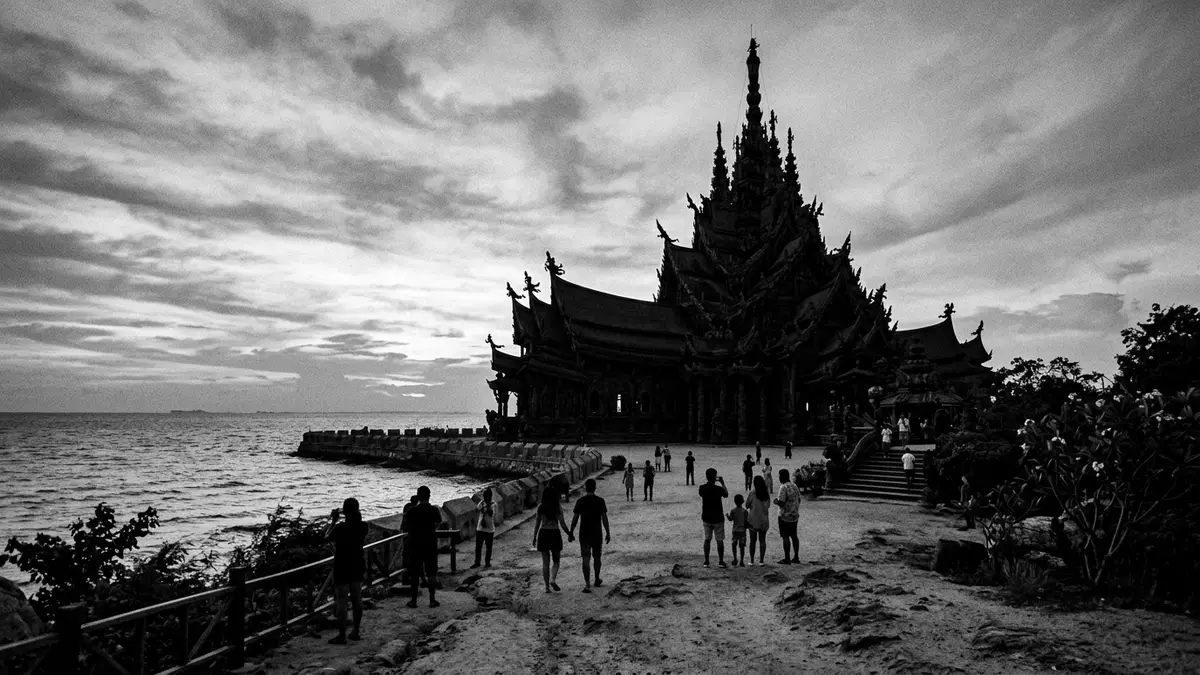
On the low shoreline of Pattaya, Prasat Sut Ja-Tum stands as a towering wooden sanctuary facing the Gulf of Thailand, a building where every surface is carved. Conceived by Thai businessman Lek Viriyaphan in the late twentieth century, it began rising in 1981 and has grown into a multi-storey hall of timber and sculpture that visitors reach through gardens and a descent towards the sea.
A wooden palace of spires above the Gulf
Prasat Sut Ja-Tum occupies a coastal plot in the Naklua area of Pattaya, set on land at Laem Ratchawet on the northern edge of the city where the ground drops towards the water. The sanctuary’s timber mass stands free on this headland, with the Gulf spreading out behind it and low vegetation, ponds and walkways forming the approach from the entrance area inland.Laem Ratchawet in Naklua The location places the structure slightly away from central Pattaya, within the Chonburi coastline but with its own enclave of gardens and viewing platforms.Muang Pattaya, Amphoe Bang Lamung
The building itself rises as a complex cluster of wooden spires from a broad base, with the tallest point reaching about 105 m (344 ft) above the platform.the tallest spire reaching 105 m From a distance it reads as a single palace-like volume surrounded by subsidiary towers and roofs, its exterior packed with projecting tiers, finials and carved figures. Seen close up, the scale becomes more apparent: long façades carry stacked ranks of statues and panels, and high above them, the main spire rises with further carvings set against the sky.
Teak, traditional joinery and ongoing construction
Unlike masonry temples and concrete museums elsewhere in Pattaya, Prasat Sut Ja-Tum is constructed entirely from wood. Sources describe a mix of hardwoods including Mai Deang, Mai Takien, Mai Panchaat and extensive teak, all assembled using carpentry joints rather than metal nails.constructed entirely out of wood This reliance on timber defines the architecture: heavy columns, beams and braces form the structural skeleton, while every available surface becomes a field for carving, from eaves and balustrades to the internal roof trusses.
Lek Viriyaphan began the project in 1981 and the sanctuary has been in construction since then, with carpenters and woodcarvers working on-site.construction in 1981 The central hall and major spires stand complete enough to receive visitors, but scaffolds and work platforms can still be present around sections of the structure, and work continues on new panels and figures. Inside, the main enclosed volume covers over 2,000 m² (about 21,500 sq ft), organised as a high hall ringed by side spaces where columns and roof beams are covered with carved scenes.an internal space of 2,115 m²
Symbolism across four wings and a live museum
Prasat Sut Ja-Tum functions as a hybrid of temple-like sanctuary, museum and open workshop. The plan extends from a central hall into four wings, each carrying themed carvings that draw from Buddhist, Hindu, Khmer and Chinese traditions, among others.combining Buddhist, Hindu, Khmer and Chinese imagery Visitors move through spaces where deities, mythological scenes and allegorical figures line the walls, interspersed with panels and pillars that explore ideas of cosmology, morality and the human place in the universe. The density of carving means that even structural elements become part of the narrative surface.
At the same time, the sanctuary operates as a museum of craft, with active woodcarving visible in some areas and displays that show tools, techniques and stages of work.built entirely of valuable wood without a single metal nail The project was designed by Lek Viriyaphan, who is also known for commissioning other Thai cultural attractions, and it has become a demonstration site for large-scale timber architecture as much as a place of contemplation.designed by Thai businessman Lek Viriyaphan Standing inside the main hall, visitors see layers of structure, ornament and ongoing work above and around them, all carried by the same material.
Visiting Prasat Sut Ja-Tum: what travellers from Western Europe should know
- Prasat Sut Ja-Tum stands in the Naklua district of Pattaya, on a coastal headland north of the city centre, reached along Pattaya–Naklua Road and Soi Naklua 12.
- The sanctuary’s approach includes outdoor paths, changes of level and staircases within the timber structure, so a visit involves walking on sloping ground and climbing internal steps.
- The site lies beside the Gulf of Thailand, and the grounds include ponds, gardens and open platforms where wooden walkways and railings are part of the route.
- The official language is Thai and the currency is the baht.
- Entry requirements depend on your nationality; UK travellers can check the FCDO travel advice at gov.uk/foreign-travel-advice, Irish travellers the Department of Foreign Affairs at ireland.ie.
Searching for Prasat Sut Ja-Tum on social platforms
These links open searches for Prasat Sut Ja-Tum on each platform.
Frequently asked questions about Prasat Sut Ja-Tum
Where is Prasat Sut Ja-Tum located?
Prasat Sut Ja-Tum stands in Pattaya’s Naklua district in Chonburi Province, on a coastal site at Laem Ratchawet reached from Pattaya–Naklua Road and Soi Naklua 12.
What can visitors expect inside the sanctuary?
Visitors find a high timber hall and adjoining wings where every surface is covered with wooden carvings, alongside areas that show active woodcarving and displays about tools and techniques.
What makes Prasat Sut Ja-Tum distinctive among Pattaya’s attractions?
Its all-wood construction with traditional joinery, the 105 m main spire and decades-long ongoing carving work create a single large-scale sanctuary where structure, ornament and craft merge.


