
Prasat Sut Ja-Tum, Pattaya’s all-wood vision over the sea
Published on 09/15/2026 at 08:40 | Editorial responsibility: Rafael Müller, Editor-in-Chief AD HOC NEWS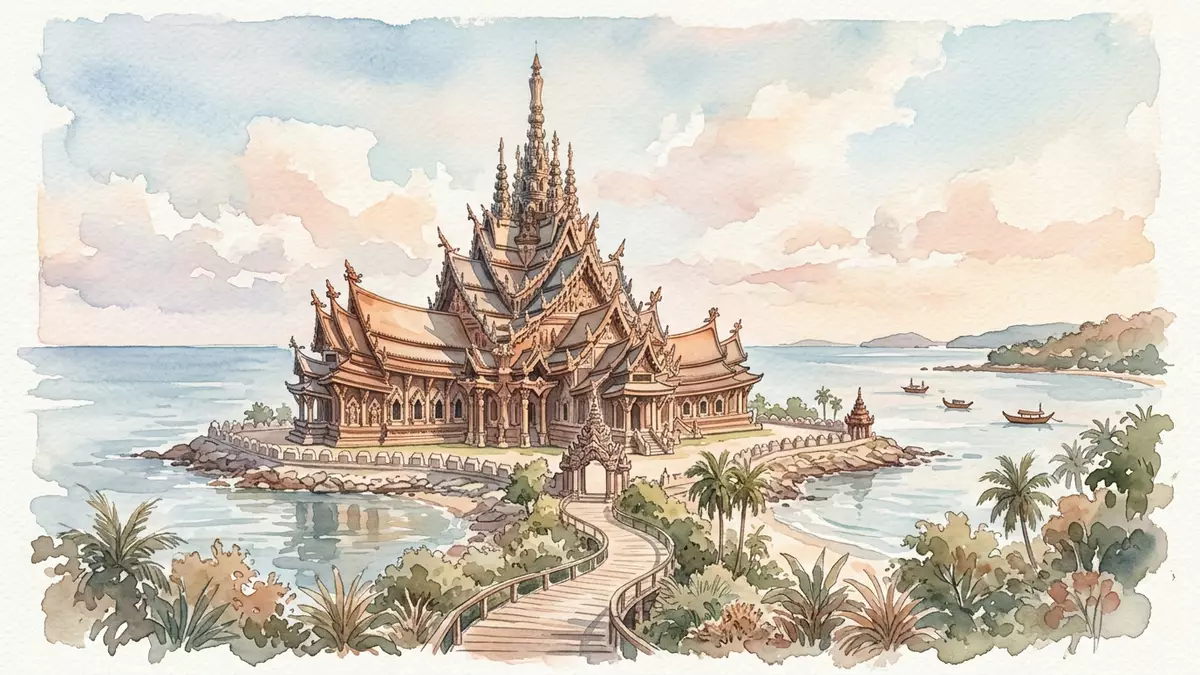
Prasat Sut Ja-Tum in Pattaya is a vast wooden complex rising above the shore of the Gulf of Thailand, conceived in 1981 by Thai businessman Lek Viriyaphan as an ornate hall of carved philosophy that fuses religious and cultural traditions in timber.
A coastal wooden monument without concrete
Prasat Sut Ja-Tum stands on a headland in North Pattaya, its main structure pushing forward towards the sea so that its timber base meets the coastal edge at Laem Ratchawet.??n Prasat Sut Ja-Tum The complex is built as a temple-castle in tropical hardwood, with the principal hall rising to around 105 m (344 ft) and covering an area of several thousand square metres.wooden construction 105 metres high Every visible surface, from the columns and beams to the friezes and roof ridges, is carved, producing a continuous skin of timber relief that covers both exterior and interior.
The construction draws on traditional Thai carpentry practice, using wooden joinery and dowels rather than metal nails or concrete in the main body of the building.built without the use of metal nails or concrete Tropical hardwoods such as teak and other dense species are used for the pillars, roof frames and sculpted cladding, chosen for their strength and for the fine detail they can hold in carving.tropical hardwoods including Mai Deang and teak Seen from the water, the building reads as a cluster of spires and gables ascending from a broad timber base, while from the land side the approach passes through landscaped grounds and down a slope that reveals the hall against the backdrop of the Gulf.
Lek Viriyaphan’s late twentieth-century project
The origin of Prasat Sut Ja-Tum lies in the late twentieth century, when Thai-Chinese businessman Lek Viriyaphan initiated the project as one of several large cultural constructions linked to his name.Construction first began in 1981 Construction began in 1981 and has continued as a long-running endeavour, with artisans carving and maintaining timber sections across decades.begonnen Anfang der 1980er Jahre The project belongs to the period when Pattaya was developing as an international resort city, yet Prasat Sut Ja-Tum diverges from concrete hotel blocks by reviving an all-wood idiom on a large scale.far-sighted Thai businessman Lek Viriyaphant
Viriyaphan is also associated with other cultural sites in Thailand, including the Ancient City near Bangkok and the Erawan Elephant Museum, which similarly combine architecture with mythic and historical themes.founded the Ancient City and the Erawan Elephant Museum At Prasat Sut Ja-Tum, his ambition took the form of a monumental wooden hall that could carry philosophical ideas in carved images rather than in written treatises.museum of philosophy The resulting structure links the coastal location north of central Pattaya with a constructed world of deities, symbols and narratives taken from various Asian traditions.
Philosophical carvings across Thai, Khmer, Hindu and Buddhist traditions
Inside and outside Prasat Sut Ja-Tum, timber panels and freestanding sculptures present scenes and figures from Buddhist and Hindu teachings, from Thai and Khmer historical imagery, and from Chinese and Indian iconography.blending Hindu and Buddhist influences The iconography combines these strands to explore ideas about the creation of the universe, the relationship between humans and nature, and the continuity between ancestors and descendants.different directions of belief Visitors walk beneath timber vaults where carved celestial beings, elephants, mythical birds and human figures occupy every surface, including the supporting columns and the roof bracing.
The main hall is organised around a central space beneath the tallest spire, from which smaller halls extend towards the cardinal points, each associated with a particular aspect of philosophical reflection such as the heavens or the earth.four main towers faces a cardinal direction Carved inscriptions and narrative friezes accompany the figures, linking them to themes such as the cycle of life, the pursuit of wisdom and the balance of the elements.ideas about philosophy, religion and human “truth” The building functions as a museum of philosophy in which walking from one timber chamber to another means moving through different strands of Asian religious and cosmological thought.
Visiting Prasat Sut Ja-Tum: what travellers from Western Europe should know
- Prasat Sut Ja-Tum stands in North Pattaya on Soi Naklua 12 in the Naklua area of Chonburi province, reached by road from central Pattaya and Jomtien along the coastal urban streets.
- The complex occupies a coastal headland with gardens, sloping paths and stairways; reaching the main wooden hall involves descending towards the sea along outdoor routes with steps and uneven ground.
- The official language is Thai and the currency is the baht.
- Entry requirements depend on your nationality; UK travellers can check the FCDO travel advice at gov.uk/foreign-travel-advice, Irish travellers the Department of Foreign Affairs at ireland.ie.
Searching for Prasat Sut Ja-Tum on social platforms
These links open searches for Prasat Sut Ja-Tum on each platform.
Frequently asked questions about Prasat Sut Ja-Tum
Where is Prasat Sut Ja-Tum located?
Prasat Sut Ja-Tum stands on a coastal headland in the Naklua area of North Pattaya in Chonburi province in eastern Thailand, reached by urban roads from central Pattaya.
What should visitors expect inside the complex?
Visitors encounter a multi-level wooden hall filled with carved timber pillars, narrative panels and sculpted deities drawn from Thai, Khmer, Hindu and Buddhist traditions, linked by stairways and galleries.
What makes Prasat Sut Ja-Tum distinctive among Thai landmarks?
Its distinction lies in being a very tall all-wood construction initiated by Lek Viriyaphan in 1981, combining traditional carpentry and coastal siting with an interior conceived as a museum of philosophy.


