
Praia das Catedrais and the stone arches of Galicia’s north coast
Published on 09/12/2026 at 09:47 | Editorial responsibility: Rafael Müller, Editor-in-Chief AD HOC NEWS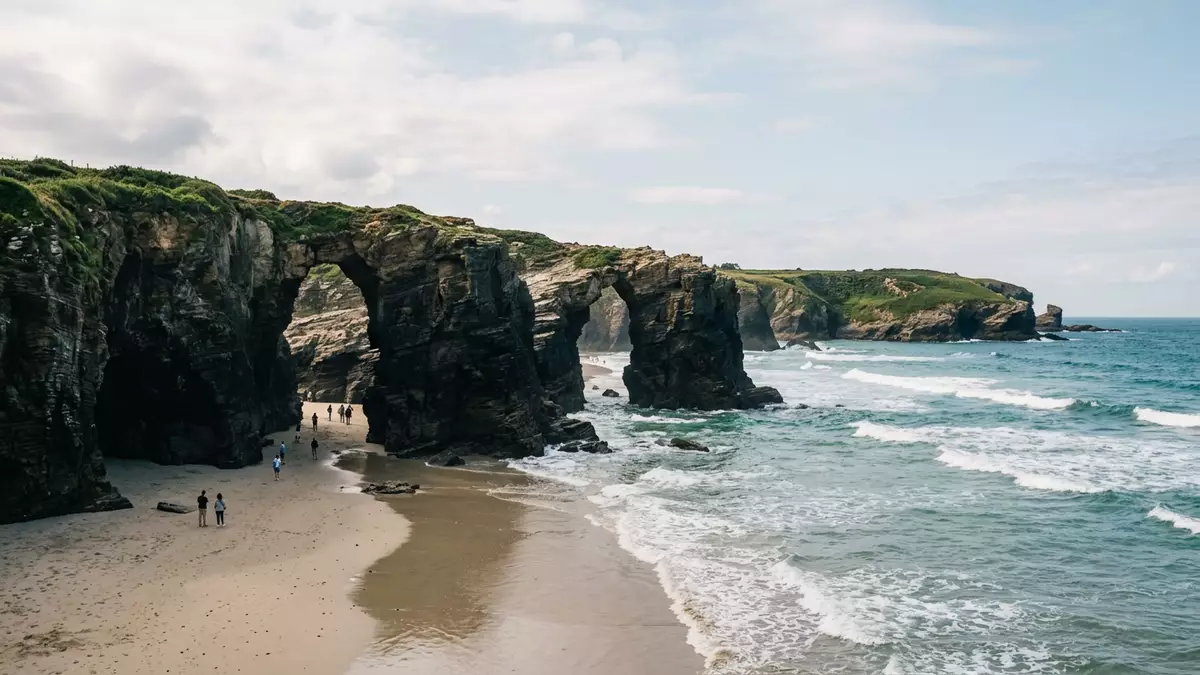
Praia das Catedrais on Spain’s north coast is a stretch of Atlantic shoreline where the rock itself forms something that resembles a vast, roofless cathedral. On the Cantabrian coast of Galicia, near the town of Ribadeo in the province of Lugo, the beach is known locally as Praia de Augas Santas, the “Beach of the Holy Waters”, and its name Praia das Catedrais refers to the way the cliffs break into arches, buttresses and caves along the tide line.Praia de Augas Santas The protected status as a natural monument fixes it not only as a holiday beach but as a recognised geological and landscape site.
Stone arches carved by the Cantabrian Sea
The core of Praia das Catedrais is a band of cliffs where the sea has cut tunnels, overhangs and freestanding arches out of dark, finely layered rock along a line of shoreline that runs for more than a kilometre.stone arches along the coast At lower tides, the sand lies between these rock forms, and the vertical walls of the cliffs rise in repeated bays and recesses. In places the arches connect one bay to the next, with pillars of rock holding up masses of cliff that stride out towards the water, a shape that underlies the idea of the beach as a “cathedral” made by erosion rather than by builders.
Geologically, the cliffs belong to a sequence of slate and schist with bands of harder quartzite laid down in the early Palaeozoic era, a time when the rocks that now surface in Galicia were forming on the bed of ancient seas.slate, schist and quartzite sequence The combination of relatively soft, fissile rocks and more resistant layers has given the sea something it can cut into bays, stacks and caves while leaving harder ribs and arches standing. The result is not a single isolated formation but a sequence of stone structures that repeat along the sandy floor of the beach between Augas Santas and neighbouring sands.
A protected coastal monument in Lugo
Praia das Catedrais lies to the west of Ribadeo on the Cantabrian coast, in the extreme north-east of the province of Lugo.location near Ribadeo The official protection covers an area of about 28.94 hectares as a natural monument, with most of that surface in the terrestrial zone but a significant part extending into the sea.28.94 ha natural monument Around this core, a wider strip of coast between Barreiros and Ribadeo forms a designated conservation zone with several hundred hectares of cliffs, shore platform and nearshore waters.
The beach sits within the Eo, Oscos e Terras de Burón Biosphere Reserve and is part of the European Natura 2000 network of protected sites, reflecting both its geology and its value for coastal habitats and birdlife.biosphere reserve and Natura 2000 The protection framework recognises the stretch of cliffs, sands and shallow waters as a single natural unit, with the Monumento Natural designation added in 2005 to anchor its special status on the Lugo coast.Monumento Natural since 2005 For visitors this means a coastal landscape where the rock forms, sand and sea are part of a safeguarded environment rather than a purely recreational strip.
Tides, sand and the experience of the beach
The distance between the cliff foot and the sea changes markedly with the tide at Praia das Catedrais, and that movement of the water is one of the defining features of a visit. At higher tides, the sea reaches the cliff base and the main viewpoint is from the top of the cliffs, looking down on the arches and caves from the grassy edge above. At lower tides, broad bands of pale sand open up around the bases of the rock forms, and the arches become passages on the beach itself, with long perspectives through the stone towards the open water.
The main band of sand runs for several hundred metres in a gently curving bay that retains its character as a beach even when the sea has cut deeply into the cliffs.length and sandy composition At lower tides, access to the sand lies by stairways from the clifftop, and the route down passes close to the rock faces, giving views into some of the caves as well as out towards the arches that stride across the foreshore. The combination of vertical stone, horizontal sand and the moving edge of the sea makes the whole beach feel like a sequence of spaces that alternately open and close with the tide rather than a single static strip of coast.
Visiting Praia das Catedrais: what travellers from Western Europe should know
- Praia das Catedrais lies on Galicia’s Cantabrian coast in Spain, west of Ribadeo in the province of Lugo, reached by local roads that turn off the N-634 route between San Miguel de Reinante and Rinlo.
- The terrain combines clifftop paths with a drop to the beach by stairways, so reaching the sand involves a descent and climb on steps beside the rock walls.
- The beach forms part of the Eo, Oscos e Terras de Burón Biosphere Reserve on Spain’s north coast, with the closest town and port facilities in Ribadeo.
- The official language is Spanish and the currency is the euro.
Searching for Praia das Catedrais on social platforms
These links open searches for Praia das Catedrais on each platform.
Frequently asked questions about Praia das Catedrais
Where is Praia das Catedrais?
Praia das Catedrais is on Spain’s Cantabrian coast in Galicia, in the municipality of Ribadeo in the province of Lugo, west of the town itself.
What should visitors expect on a visit?
Visitors encounter a broad sandy beach backed by cliffs cut into arches, caves and pillars, with views either from the top of the cliffs or from the sand between the rock forms depending on the tide.
What makes Praia das Catedrais distinctive?
The beach combines early Palaeozoic slate and schist cliffs shaped by Atlantic waves into a continuous line of arches and bays, recognised as a natural monument within a wider biosphere reserve.


