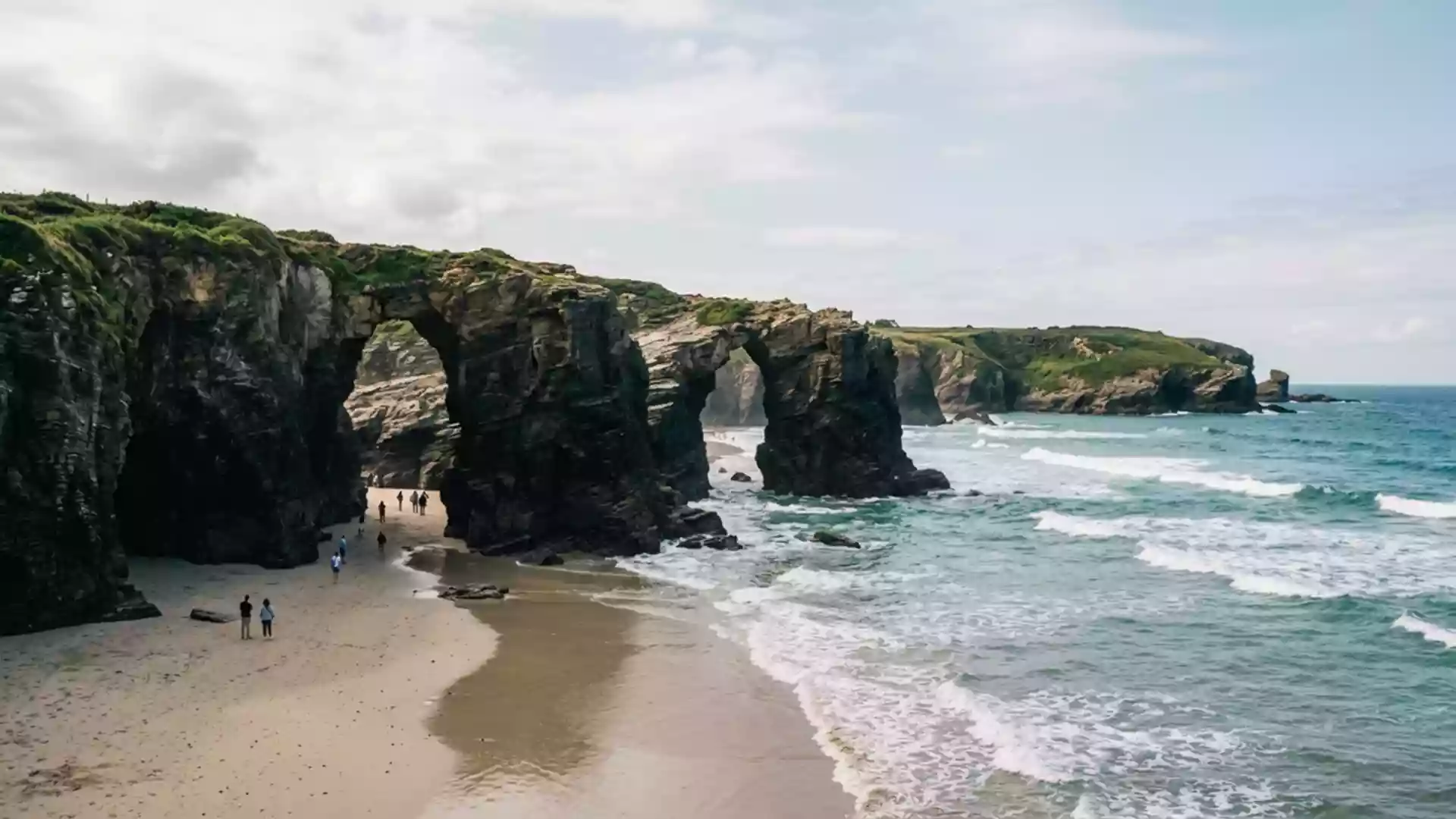
Praia das Catedrais and its sculpted stone arches near Ribadeo
Published on 09/03/2026 at 17:32 | Editorial responsibility: Rafael Müller, Editor-in-Chief AD HOC NEWS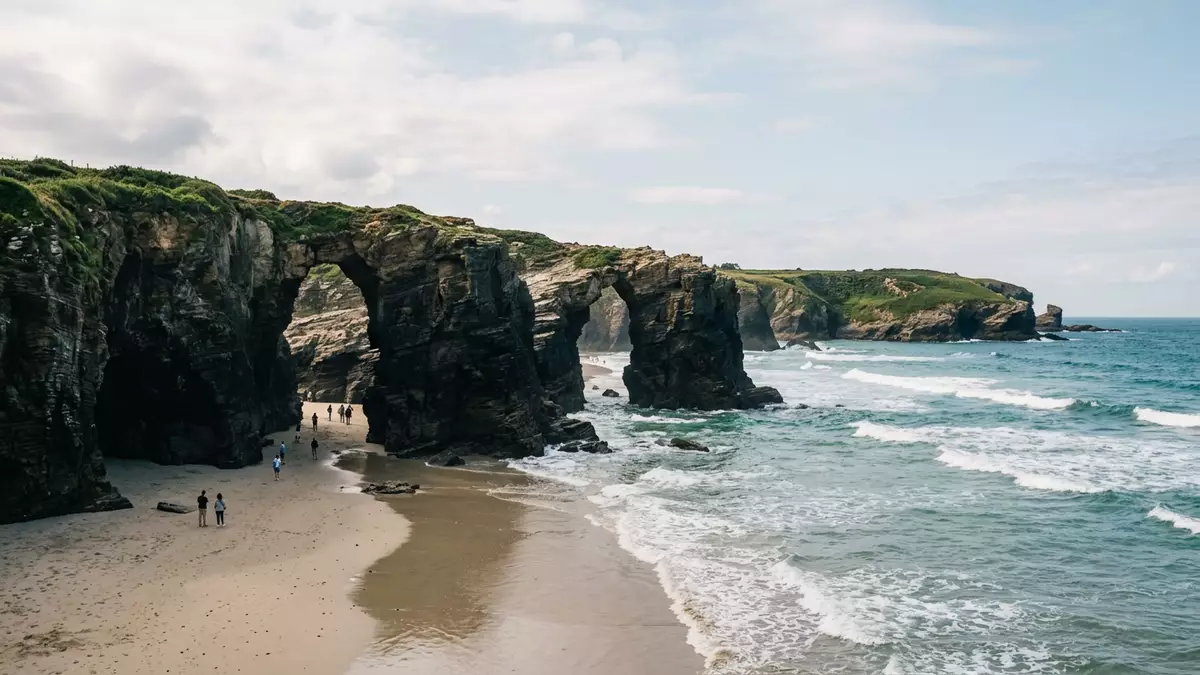
Praia das Catedrais on the Cantabrian coast near Ribadeo in northern Spain is a stretch of sand framed by vast rock arches that resemble a ruined stone cathedral at low tide. Set in the province of Lugo in Galicia, the beach is the tourist name for Praia de Augas Santas, a protected natural monument within a wider coastal conservation area.
A Galician beach turned stone cathedral
Praia das Catedrais lies within the municipality of Ribadeo, along the Lugo coastline known as A Mariña, facing the open waters of the Cantabrian Sea. The beach occupies a section of rocky shore between the sands of Augas Santas and Carricelas, with its cliffs aligned roughly east–west along the coast.between Augas Santas and Carricelas The official designation as a monumento natural recognises both the sand and the cliff formations as part of a single protected landscape.monumento natural
The beach’s widely used name, Praia das Catedrais, refers to the way the cliffs have been carved into towering arcs and buttresses that recall the aisles and vaults of a Gothic church. The underlying beach is officially recorded as Praia de Augas Santas, “Beach of the Holy Waters”, with Praia das Catedrais promoted as its tourist label.Praia de Augas Santas Visitors walking on the sand at low tide move between stone “naves” and “chapels” cut by the sea into the coastal platform, a striking contrast with the more conventional flat beaches that line other parts of Galicia’s shoreline.
Rock, sea and arches on the Cantabrian coast
The cliff line behind Praia das Catedrais consists of sedimentary rock layers aligned parallel to the shore, exposed to Atlantic swells and Cantabrian tides that have carved recesses, caves and detached stacks. Over generations the sea has opened deep passages into the cliff, leaving sequences of free-standing arcs and columns that form natural corridors between the landward wall and the outer edge of the beach.arcs and caves At low tide, these passages stretch out along the shore and reveal cross views through several arches at once.
The sandy strip is recorded as being about 880 m (2,887 ft) in length, with an average width around 50 m (164 ft) measured at the upper part of the beach.880 m in length Access paths run along the clifftop, where fenced viewpoints look down on the pale sand, the dark rock walls and the regular rhythm of the Atlantic swell. The combination of horizontal beach, vertical cliff faces and repeated stone arches gives the place its recognisable outline even when viewed only from above.
Protected status and a carefully managed shoreline
Praiadas Catedrais forms part of a Special Area of Conservation within the European Union’s Natura 2000 network, covering a coastal strip of around 15 km (9.3 miles) between Barreiros and Ribadeo.Special Area of Conservation The beach itself sits inside a smaller natural monument zone, of which a substantial portion is marine water, reflecting the importance of both the rocky foreshore and the shallows offshore.natural monument area This layered protection framework aims to preserve the sculpted cliffs, the sandy platform and the coastal habitats that accompany them.
Management measures on the shoreline include marked access routes from the clifftop and restrictions on where visitors may descend to the sand, directing foot traffic along resilient paths and designated stairways. The wider conservation zone links Praia das Catedrais to nearby segments of coast, including dunes, smaller coves and inland meadows, treating the beach as part of a larger mosaic of marine and terrestrial environments rather than an isolated attraction. For travellers interested in Galicia’s coastal geography, the site illustrates how Atlantic swell, Cantabrian tides and layered rock combine to produce a distinctive form of shore.
Visiting Praia das Catedrais: what travellers from Western Europe should know
- Praia das Catedrais lies on Spain’s north coast in Galicia, around west of Ribadeo, and can be reached by road on the N-634 between San Miguel de Reinante and Rinlo.
- Access to the sand is via steps cut into the cliff, so a visit involves stairways and walking on uneven rock and wet sand that are exposed to Atlantic surf.
- A clifftop path follows the edge of the protected area, with fenced viewpoints overlooking the beach, the arches and the wider Cantabrian coastline towards Asturias.
- The official language is Spanish and the currency is the euro.
Searching for Praia das Catedrais on social platforms
These links open searches for Praia das Catedrais on each platform.
Frequently asked questions about Praia das Catedrais
Where is Praia das Catedrais located?
Praia das Catedrais is on Spain’s Cantabrian coast in Galicia, within the municipality of Ribadeo in the province of Lugo, west of the town of Ribadeo.
What should visitors expect on a visit?
Visitors encounter a sandy beach backed by cliffs cut into high stone arches and passages, with access via stairways from the clifftop path and viewpoints above the shore.
What makes Praia das Catedrais distinctive?
The beach stands out for its long sequence of natural rock arches and columns carved by the sea into cathedral-like forms along a protected stretch of Atlantic coastline.