
Potala Palace in Lhasa: a mountain of walls, chapels and history
Published on 09/18/2026 at 20:19 | Editorial responsibility: Rafael Müller, Editor-in-Chief AD HOC NEWS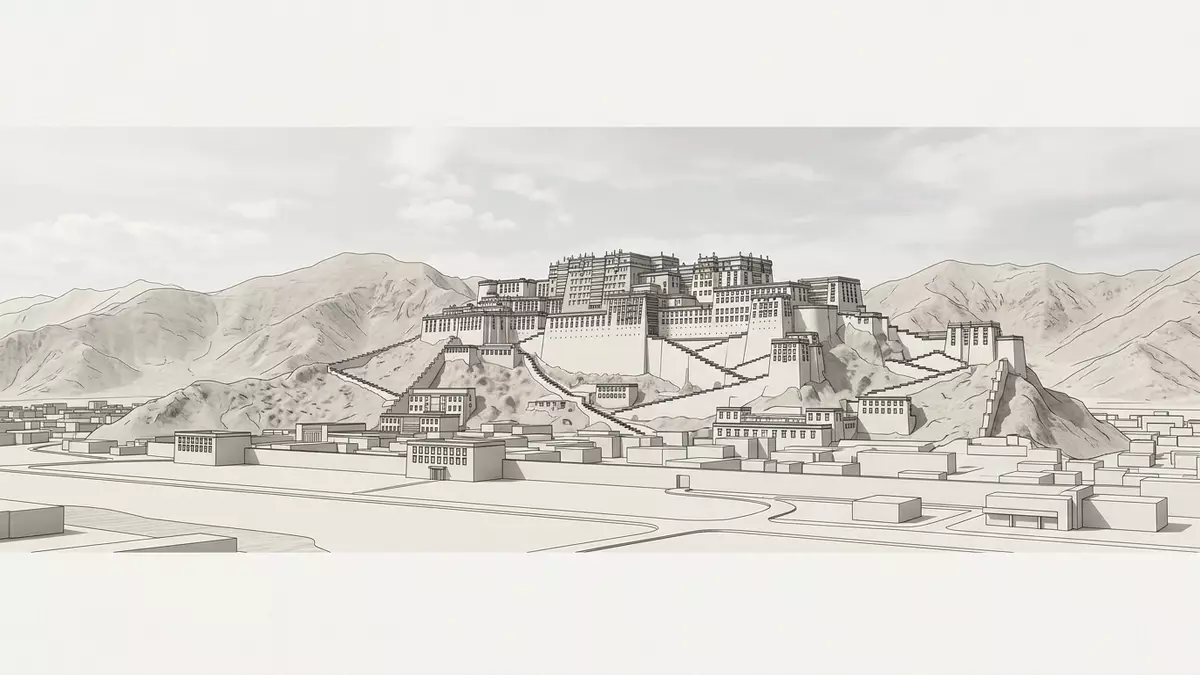
Potala Palace turns the rocky Red Hill above Lhasa into a single vast stepped structure, with white and red walls climbing in terraces high above the old Tibetan city. Built in the seventeenth century as the seat of the Fifth Dalai Lama and his government, it stands on a site first associated with King Songtsen Gampo in the seventh century and has become a defining landmark of Tibetan architecture and religion.
Potala on the Red Hill: palace, fortress and monastery in one mass
Potala Palace stands on Marpo Ri, the Red Hill, in the Lhasa Valley of the Tibet Autonomous Region in China. The rocky outcrop rises above the surrounding streets, and the palace complex spreads across its slopes until the hill and the building read almost as one continuous structure. From the valley floor the walls step upwards in broad terraces, with the roofline of the main blocks forming the skyline of the hill.the palace on the Red Hill The ensemble combines functions that in many cities would be separated: it served as a fortress, a palace and a monastic complex, with defensive outer walls rising around inner courtyards and chapels.
The site is linked to the early spread of Buddhism in Tibet through King Songtsen Gampo, who ruled in the seventh century and is associated with building the first palace on this hill.Songtsen Gampo’s earlier palace That original structure did not survive in its early form, but the association with royal power and religious practice remained, and later rulers chose the same elevation above Lhasa for their residence. The present Potala Palace rises over many storeys from massive stone walls at the base, with copper in the foundations helping to protect the building against earthquakes.stone walls with copper foundations
White Palace and Red Palace: seventeenth-century Tibetan architecture
The form visitors see now took shape in the seventeenth century, when the Fifth Dalai Lama, Lozang Gyatso, ordered a new palace on Marpo Ri. Construction of the White Palace, the Potrang Karpo, began in 1645 and reached completion in 1648, creating a residence and seat of government for the Dalai Lama.Potrang Karpo completed in 1648 Later works added the Red Palace, or Potrang Marpo, in the 1690s under the regent Desi Sanggye Gyatso, extending the complex uphill with further chapels and assembly halls.Red Palace built in the 1690s
The architecture of Potala Palace is characteristic of high Tibetan fortresses: massive sloping masonry walls, flat roofs edged with parapets and timber elements painted in deep colours. The White Palace, with its lighter exterior, held many of the administrative rooms and residential quarters of the Dalai Lama, while the Red Palace concentrated religious spaces, including chapels, reliquaries and halls for ceremonial assemblies. Together they reach a height measured at over 110 m (around 360 ft) above the hill’s base, stacked in thirteen levels of rooms and galleries that adapt to the irregular rock below.thirteen-storey seventeenth-century palace
Religion, government and UNESCO World Heritage status
For centuries Potala Palace served as the winter residence of successive Dalai Lamas and as the centre of Tibetan government, concentrating religious and secular authority in a single complex. The layout reflects this dual role: monastic quarters and temples stand near audience halls and former governmental offices, and stairways and corridors link the two worlds under one roof.winter palace of the Dalai Lamas After the mid-twentieth century the palace ceased to function as the active seat of government and residence of the Dalai Lama, and it was later organised as a museum open to visitors.conversion into a museum
The wider ensemble of Potala Palace, the Norbulingka summer palace and the Jokhang Temple in old Lhasa is recognised as the Historic Ensemble of the Potala Palace and inscribed on the UNESCO World Heritage List, with formal inscription recorded in 1994.Historic Ensemble of the Potala Palace The inscription text describes the ensemble as an example of how Tibetan religious and political life merged in architecture, with Potala Palace in particular representing the apogee of Tibetan palace design during the seventeenth century. Inside the palace, chapels hold statues, wall paintings and reliquaries that reflect Tibetan Buddhist practice, and the thick walls, timber beams and painted façades form a distinct building tradition adapted to the altitude of the Lhasa Valley.
Visiting Potala: what travellers from Western Europe should know
- Potala Palace rises above central Lhasa in the Tibet Autonomous Region, reached from the city’s streets by routes that climb towards the base of the Red Hill.
- The approach and interior involve significant stair climbing, with long flights of stone steps and passages that gain altitude within the palace mass.
- The terrain at the site combines the natural slope of Marpo Ri with built terraces, so visitors encounter uneven stone surfaces and variations in level between courtyards and halls.
- The official language of the region is Chinese, and the currency is the renminbi yuan.
- Entry requirements depend on your nationality; UK travellers can check the FCDO travel advice at gov.uk/foreign-travel-advice, Irish travellers the Department of Foreign Affairs at ireland.ie.
Searching for Potala on social platforms
These links open searches for Potala on each platform.
Frequently asked questions about Potala
Where is Potala Palace located?
Potala Palace stands on the Red Hill, Marpo Ri, above central Lhasa in the Tibet Autonomous Region in China, overlooking the Lhasa Valley.
What should visitors expect inside Potala Palace?
Visitors encounter staircases, corridors and halls arranged over many levels, with chapels, painted interiors and former residential rooms reflecting its roles as palace and monastery.
What makes Potala Palace distinctive among Himalayan sites?
Its stepped mass of white and red buildings on a single hill, its scale across thirteen storeys and its combination of religious and governmental functions distinguish Potala Palace within Tibetan architecture.


