
Potala Palace in Lhasa: a mountain of stone and faith
Published on 08/12/2026 at 14:11 | Editorial responsibility: Rafael Müller, Editor-in-Chief AD HOC NEWS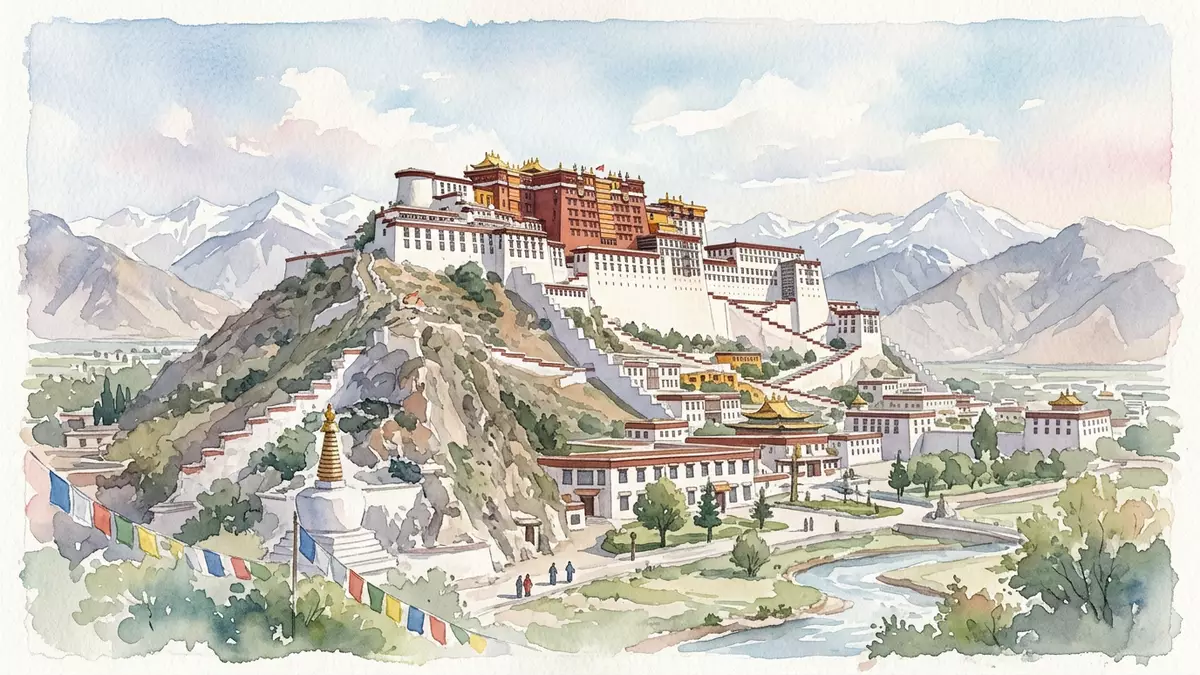
Potala in Lhasa is a vast palace complex built on Red Mountain, where stone walls and tiered roofs rise above the Tibetan plateau in a single monumental silhouette. The present palace was begun in 1645 under the Fifth Dalai Lama, shaping a dzong-style stronghold that became the winter residence and seat of government for Tibet’s spiritual ruler until 1959.
A palace stacked like a mountain
Seen from the valley floor, Potala appears almost like an extension of Red Mountain itself, its masonry terraces stepping up the slope in dense layers of white and red façades. The complex stands at about 3,700 m (12,100 ft) above sea level on Marpo Ri, a rocky hill that rises from the centre of the Lhasa basin.Red Mountain in the centre of Lhasa Valley The palace mass is organised into broad horizontal bands, with sheer exterior walls punctuated by rows of windows and projecting balconies.
The overall form is composed of two main parts embedded in the hillside: the White Palace below and the Red Palace above.White Palace and Red Palace Together they reach thirteen storeys and contain hundreds of rooms, corridors and chapels that are stacked vertically rather than spread across a wide footprint.thirteen-storey Potala complex The visual impression is of a building that has grown upwards in stages, reinforcing its role as both fortress and monastery.
From royal hill to Dalai Lama’s winter palace
Potala’s history reaches back to the seventh century, when the Tibetan king Songtsen Gampo established a palace on this hill above Lhasa.earlier palace attributed to Songtsen Gampo The original structures did not survive intact, but the site retained its association with power and kingship in the Tibetan world. In the seventeenth century, the Fifth Dalai Lama, Ngawang Lobsang Gyatso, and his regent Desi Sanggye Gyatso oversaw the construction of the present palace, marking the reunification of Tibet under the Geluk tradition.built by the Fifth Dalai Lama and his regent
The building process unfolded in two main phases. Between 1645 and 1648 the White Palace was completed as the secular wing housing government offices and living quarters.Potrang Karpo completed in 1648 Later, between 1690 and 1694, the Red Palace was added above as the spiritual heart, with great assembly halls and stupas for the Dalai Lamas.Red Palace built in the 1690s From 1649 until 1959 the combined complex served as the winter palace and central residence of the Dalai Lamas, placing religious and political authority within a single mountain of architecture.winter palace and residence from 1649 to 1959
Architecture, interiors and UNESCO recognition
Architecturally, Potala is often described as a pinnacle of classical Tibetan design, drawing on the tradition of fortified castles and dzong complexes that combine defence, governance and monastic life.epitomises classical Tibetan architecture Its thick stone and rammed-earth walls taper towards the top, while timber beams and flat roofs support upper terraces. The White Palace contains state rooms and former living chambers, whereas the Red Palace is filled with chapels, scripture halls and richly decorated stupas honouring successive Dalai Lamas.central Red Palace and secular White Palace
Inside the complex, travellers encounter long stairways and audience halls lined with murals, thangka paintings and carved pillars that reflect Tibetan Buddhist iconography. Many interiors retain their role as pilgrimage spaces, with chapels dedicated to bodhisattvas, tantric deities and historical figures of Tibetan Buddhism. The complex forms part of the Historic Ensemble of the Potala Palace, Lhasa, inscribed as a UNESCO World Heritage Site in 1994 alongside Jokhang Temple and Norbulingka.Historic Ensemble of the Potala Palace, Lhasa Together these sites illustrate the intertwined secular and religious authority that shaped Tibet over many centuries.ensemble including Norbulingka and Jokhang
Visiting Potala: what travellers from Western Europe should know
- Potala stands on Marpo Ri, south-west of the central districts of Lhasa, in the Tibet Autonomous Region of China. Travellers generally arrive in Lhasa by air or by railway services that cross the plateau before reaching the city.
- The approach to the palace involves a sustained ascent on foot, with exterior stairways and interior flights of steps climbing through multiple levels; altitude at around 3,700 m (12,100 ft) may make the climb feel demanding.
- From Potala’s terraces and windows there are clear views across the Lhasa valley, including towards Jokhang Temple and other historic religious sites that form part of the wider sacred landscape.
- The official language is Chinese and the currency is the renminbi.
- Entry requirements depend on your nationality; UK travellers can check the FCDO travel advice at gov.uk/foreign-travel-advice, Irish travellers the Department of Foreign Affairs at ireland.ie.
Searching for Potala on social platforms
These links open searches for Potala on each platform.
Frequently asked questions about Potala
Where is Potala Palace located?
Potala Palace stands on Marpo Ri, or Red Mountain, in the Lhasa valley in the Tibet Autonomous Region of China, at an elevation of about 3,700 m (12,100 ft).
What should travellers expect on a visit to Potala?
A visit involves climbing substantial stairways through a multi-storey complex, passing through former state rooms and chapels richly decorated with murals, statues and stupas central to Tibetan Buddhism.
What makes Potala distinctive among Himalayan sites?
Potala combines fortress-like construction, a palace for the Dalai Lamas and a major monastic centre in one thirteen-storey complex, and forms part of a UNESCO-listed ensemble with Jokhang Temple and Norbulingka.


