
Potala Palace in Lhasa, a fortress of faith above the valley
Published on 08/30/2026 at 10:11 | Editorial responsibility: Rafael Müller, Editor-in-Chief AD HOC NEWS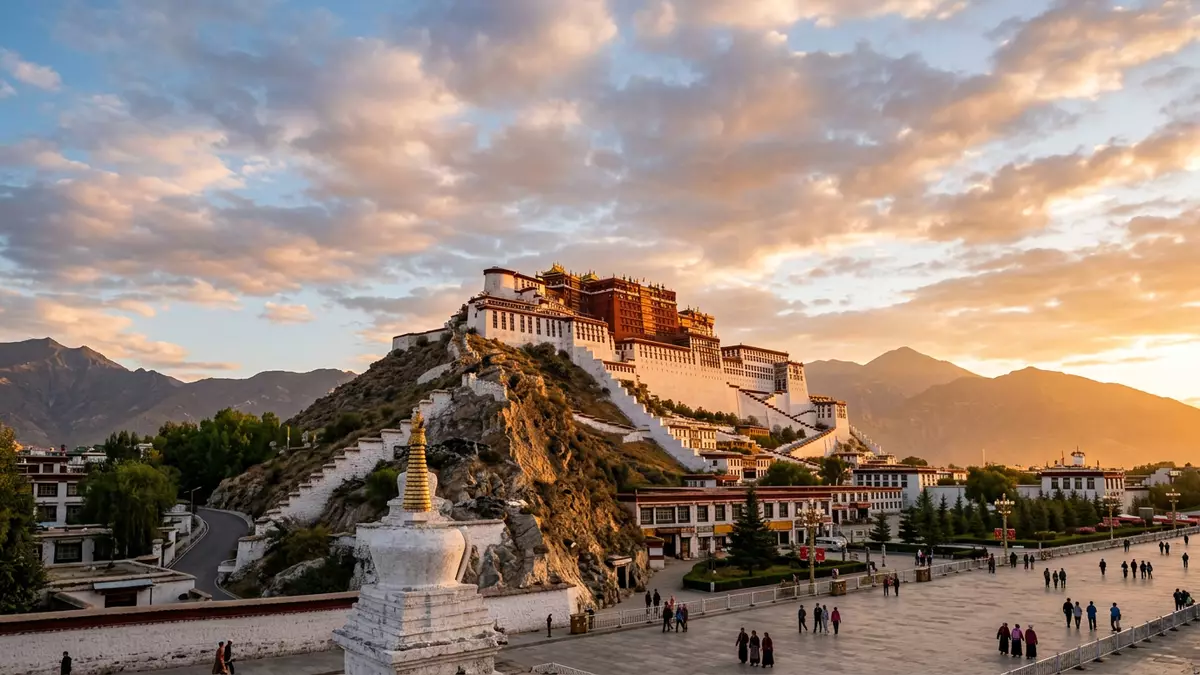
Potala Palace dominates the centre of Lhasa, tiered up the slope of Red Hill in a single vast mass of masonry and timber that reads as fortress, monastery and palace at once. The complex became the main residence of the Dalai Lamas in the seventeenth century, and its historic ensemble in Lhasa is recognised as a UNESCO World Heritage Site for Tibetan architecture and religion.
A fortress-palace climbing Red Hill
Seen from the valley floor, Potala Palace rises as a stepped volume of white and red walls climbing the rocky spine of Red Hill, with terraced bases and inward-banking upper levels that create a layered silhouette against the high-altitude sky. The site stands in the Chengguan District of Lhasa in the Tibet Autonomous Region of China, on a prominence that overlooks the surrounding urban fabric and the plain of the Lhasa River.Historic Ensemble designation
The present palace complex was initiated in 1645 under the Fifth Dalai Lama, Lozang Gyatso, as a seat that combined religious authority with government functions, replacing earlier structures on the same hill.Seventeenth-century reconstruction The ensemble incorporates substantial stone foundations keyed into the slope, thick masonry walls rendered in white and red, and flat roofs that form high platforms above the courtyards and internal halls.
White Palace and Red Palace within one complex
Within the outer mass of Potala Palace, two principal components are distinguished by colour and function: the White Palace, Potrang Karpo, and the Red Palace, Potrang Marpo.White Palace and Red Palace The White Palace, completed in the mid-seventeenth century, served as the seat of the Tibetan government and as the primary residential quarters of the Dalai Lama during the winter season. Its rooms include audience halls, administrative chambers and living suites stepped along the mountain side.
Above and behind, the Red Palace gathers the most sacred spaces of the complex, including chapels, ritual halls and monumental stupas that commemorate past Dalai Lamas.Red Palace religious functions This portion of Potala Palace is dedicated to religious affairs and contains shrines, wall paintings, carved pillars and storage for scriptures, set within a densely layered interior network of rooms rising towards the hilltop.
From royal seat to museum and World Heritage site
The origin of Potala Palace as a royal site reaches back to the seventh century, when the Tibetan king Songtsen Gampo established a palace on Red Hill after moving his capital to the Lhasa Valley, an era remembered as the formative period of centralised Tibetan rule.Songtsen Gampo’s early palace After political upheavals and the decline of earlier structures, the seventeenth-century rebuilding under the Fifth Dalai Lama defined the profile that is familiar today.
Potala Palace functioned as the winter residence of successive Dalai Lamas until 1959, with Norbulingka in western Lhasa serving as a summer estate.Winter residence role The complex has since been organised as a museum while remaining an important site of pilgrimage and a key reference point for Tibetan Buddhism and culture. In 1994, the Historic Ensemble of the Potala Palace, Lhasa, comprising Potala Palace together with Jokhang Temple and Norbulingka, was inscribed on the UNESCO World Heritage List, acknowledging both its architectural scale and its religious significance.UNESCO World Heritage inscription
Visiting Potala: what travellers from Western Europe should know
- Potala Palace stands on Red Hill in central Lhasa’s Chengguan District, reached from the surrounding city streets by stairways and access roads that climb towards the base terraces.
- The approach to the upper levels involves long flights of outdoor steps at high altitude, and the interior circulation follows narrow passages and staircases between densely stacked rooms.
- In winter, frost and occasional snow cover the hill and surrounding valley, while in summer the palace faces strong sunlight at an elevation above 3,600 m (11,800 ft).
- Nearby, Jokhang Temple and Norbulingka form part of the same recognised historic ensemble and can be combined with a visit to Potala Palace within Lhasa.
- The official language is Chinese and the currency is the renminbi yuan.
Searching for Potala on social platforms
These links open searches for Potala on each platform.
Frequently asked questions about Potala
Where is Potala Palace located?
Potala Palace stands on Red Hill in the Chengguan District of Lhasa, in the Tibet Autonomous Region of China, overlooking the central city streets and the valley.
What should visitors expect on a visit to Potala?
Visitors encounter a steep climb up exterior stairways, followed by narrow interior corridors and chambers decorated with murals, sculptures and religious objects within a large palace-monastery complex.
What makes Potala Palace distinctive among world heritage sites?
The palace’s combination of fortress-like massing, twin White and Red palaces and its role as the historic winter residence of the Dalai Lamas give it a singular place in Tibetan architecture.


