
Potala Palace in Lhasa: a fortress of faith above the city
Published on 08/22/2026 at 12:08 | Editorial responsibility: Rafael Müller, Editor-in-Chief AD HOC NEWS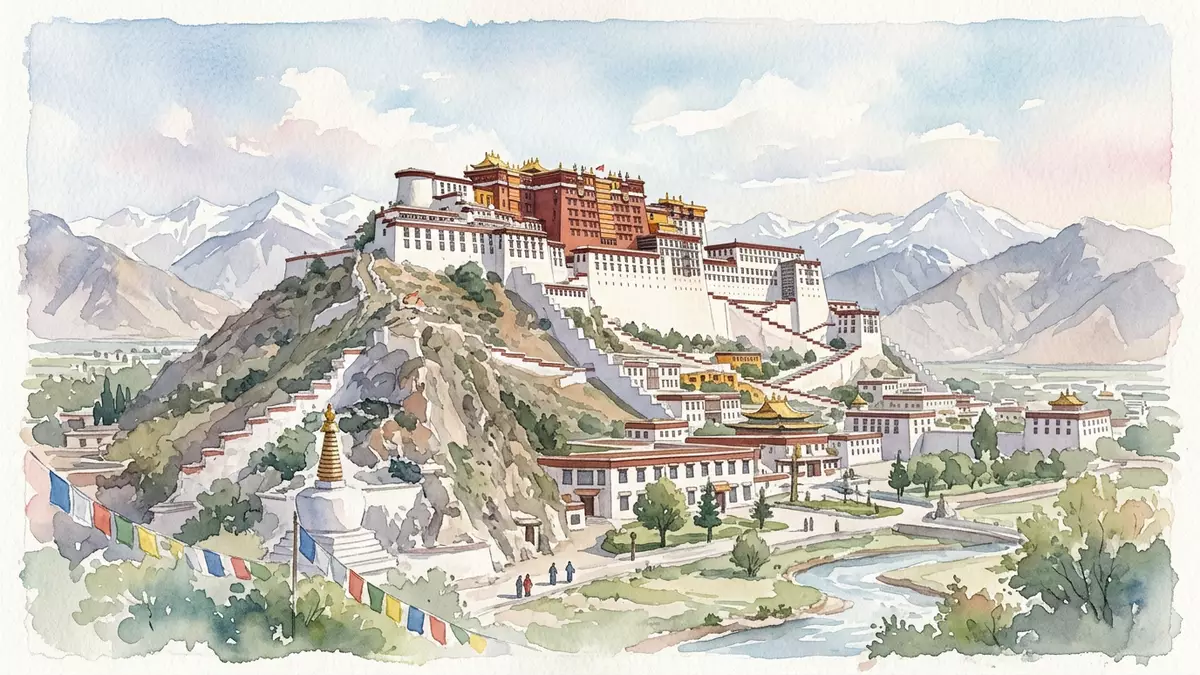
Potala in Lhasa is an immense palace complex rising above the city on Red Hill, its white and red tiers stacked against the high-altitude sky and visible from far across the valley. Built as a royal and later spiritual seat for Tibetan rulers and the Dalai Lamas, it has become one of the clearest architectural symbols of Tibetan Buddhism and of the political authority that once centred on this hill in the Tibet Autonomous Region of China.
Red Hill architecture: a palace shaped by the mountain
Potala stands on Marpo Ri, the Red Hill, in the western part of the old city of Lhasa, with its highest halls reaching an elevation of around 3,767 m (12,359 ft) above sea level.highest hall elevation The complex steps up the slope in successive terraces, creating a tiered silhouette of sloping stone walls, flat roofs and projecting stairways that read as a single fortified mass when viewed from across Lhasa.
The palace complex incorporates the Red Palace at its core and the White Palace around it, creating a distinct colour contrast that marks the separation of religious and former administrative functions within one unified structure.Red Palace and White Palace Its main body rises through thirteen storeys, with thick stone walls at the base that reach several metres in thickness to stabilise the structure on the steep hillside.thirteen-storey main portion From east to west and north to south, the complex extends over hundreds of metres, while the wider historic ensemble on Red Hill covers a very large area recognised in formal descriptions of the site.historic ensemble on Red Hill
From royal fortress to Dalai Lama winter palace
The history of Potala reaches back to the seventh century, when Tibetan king Songtsen Gampo had a palace built on this hill during the era of the Tibetan Tubo Kingdom.seventh-century origin under Songtsen Gampo That early structure is traditionally dated to the period around 631 and is linked with the royal marriage to Princess Wencheng of the Tang dynasty, tying the hill to early contacts between Tibet and imperial China.early palace built for Princess Wencheng
The present Potala took shape in the seventeenth century, when the Fifth Dalai Lama, Lobsang Gyatso, commissioned the reconstruction and expansion of the palace into the vast dzong-style fortress seen today.seventeenth-century rebuilding under the Fifth Dalai Lama From 1649 until 1959, Potala served as the winter palace and main residence of successive Dalai Lamas, combining religious spaces, government chambers and residential suites within its walls.winter residence of the Dalai Lamas Chapels, assembly halls and tomb stupas for several Dalai Lamas occupy the Red Palace, while the White Palace is associated with living quarters and the former seat of the Tibetan government.
UNESCO status and the cultural landscape around Potala
Potala forms the centrepiece of the “Historic Ensemble of the Potala Palace, Lhasa”, inscribed on the UNESCO World Heritage List in 1994 as a site of outstanding cultural value linked to Tibetan Buddhism and Himalayan palace architecture.UNESCO World Heritage inscription in 1994 The ensemble reflects the way religious, administrative and residential functions were concentrated on Red Hill, with Potala overlooking the urban fabric of Lhasa and standing in visual dialogue with other major religious sites in the city.
Within China, Potala has long been recognised as a national key cultural heritage site, and it is presented in official descriptions as a world-renowned ancient palace complex and a representative work of Tibetan architecture.national key cultural heritage status Its construction history spans more than thirteen centuries, and the interior holds a dense collection of murals, sculptures, scriptures and ritual objects that record the exchange of artistic and religious traditions across Central and East Asia.
Visiting Potala: what travellers from Western Europe should know
- Potala stands on Red Hill in the western part of central Lhasa in the Tibet Autonomous Region of China, reached from the city’s streets by approaches that climb towards the palace terraces.
- The palace occupies a steep hillside at high altitude, and access to its upper levels involves long flights of steps and stairways over significant vertical height.
- The surrounding urban area includes other major religious sites in Lhasa, and Potala itself rises clearly above neighbouring districts, making its white and red walls a constant feature in many views across the city.
- The official language is Chinese and the main local languages include Tibetan; the currency is the Chinese yuan (renminbi).
- Entry requirements depend on your nationality; UK travellers can check the FCDO travel advice at gov.uk/foreign-travel-advice, Irish travellers the Department of Foreign Affairs at ireland.ie.
Searching for Potala on social platforms
These links open searches for Potala on each platform.
Frequently asked questions about Potala
Where is Potala located?
Potala is located on Red Hill in the western part of the old city of Lhasa, in the Tibet Autonomous Region of China, overlooking the surrounding urban valley.
What can visitors expect at Potala?
Visitors encounter a large palace complex built in tiers up a steep hillside, with long stairways, high-altitude terraces and interiors that combine chapels, halls and former residential rooms.
What makes Potala distinctive among palace complexes?
Potala combines fortress-like stone architecture, the dual Red and White palace arrangement and a long association with the Dalai Lamas, all concentrated on one high hill above Lhasa.


