
Postojnska jama, Slovenia’s great karst underworld
Published on 08/20/2026 at 19:19 | Editorial responsibility: Rafael Müller, Editor-in-Chief AD HOC NEWS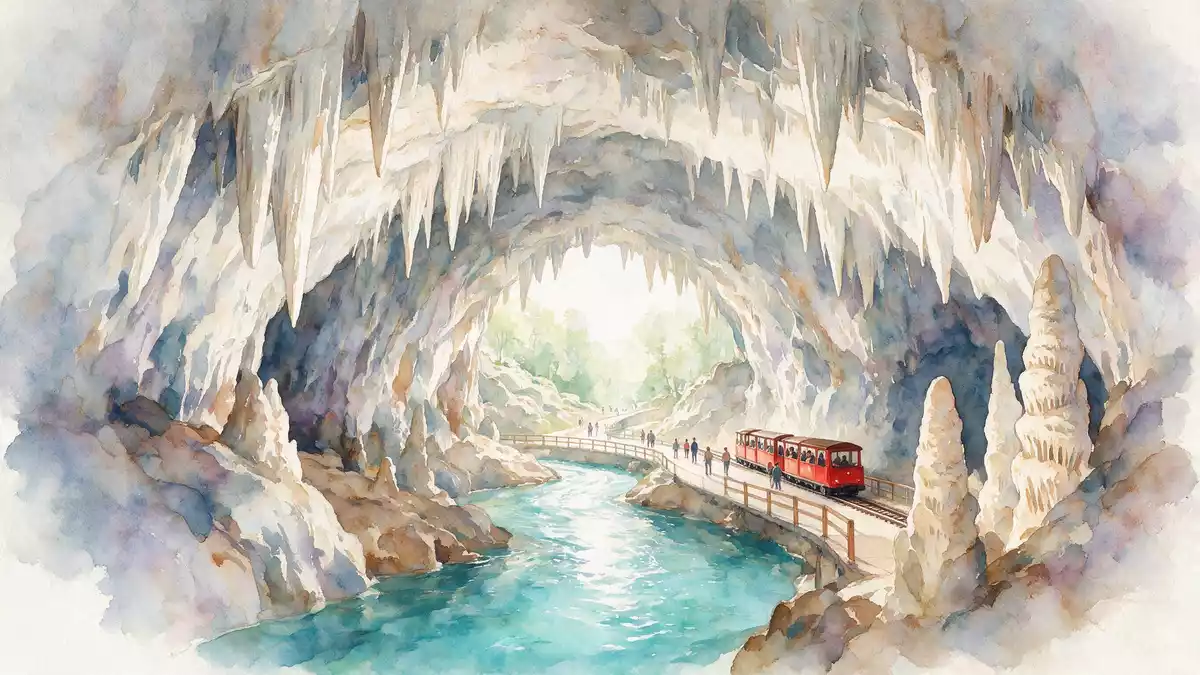
Postojnska jama near the town of Postojna in south?western Slovenia is a vast karst cave system where an underground railway carries visitors into chambers shaped by water over geological time. First formally opened to visitors in 1819, it has become one of Europe’s classic show caves, combining long galleries, stalactite forests and the rare cave?dwelling olm in a single underground landscape.
A karst labyrinth beneath Postojna
Postojnska jama lies just outside Postojna in Slovenia’s Inner Carniola region, in limestone that forms part of the wider Dinaric Karst. The cave system extends for well over 20 km, with surveys documenting more than 20,000 m of passages and shafts beneath the surface around Jamska cesta.Dolga je 20.570 m Within this network, the publicly accessible route forms a long loop through several of the most striking chambers.The 5.3 kilometre-long trail
The cave follows the course of the underground Pivka River, which sinks into the limestone near the entrance and later re?emerges as the Unica on the Planina Plain.Jamo že 2 milijona let ustvarja reka Pivka Over hundreds of thousands of years, flowing water has carved broad tunnels, domed halls and side galleries, leaving behind dripstone formations in calcite where slower trickles descend from the ceiling. The entrance stands at roughly 680 m above sea level, and the cave reaches a depth of about 115 m below the surface on its lowest levels.Globina 115 m
From 17th?century descriptions to electric light
The underground world at Postojna has been known for centuries. The cave was described in the 17th century by the Carniolan polymath Janez Vajkard Valvasor, whose work documented many of the natural features of what is now Slovenia.The cave was first described in the 17th century In 1818 a local, Luka ?e?, recognised a previously unnoticed passage while preparations were under way for an imperial visit, and this discovery opened up a far larger section of the cave system. Postojnska jama was opened to visitors in 1819, placing it among the early show caves of Europe.
Infrastructure followed over the nineteenth century. A tourist railway was introduced in the 1870s, initially with guides pushing simple railcars along the tracks.A tourist railway was added in the 1870s Electric lighting arrived in 1884, making Postojnska jama one of the first caves in the world to be illuminated in this way.electric lighting in 1884 The underground train has since been upgraded, with locomotives replacing manual pushing and modern electric traction in use since the mid?twentieth century. These developments turned the cave into an organised underground route at a time when many similar karst systems remained difficult to access.
Dripstone halls and the cave?dwelling olm
Inside Postojnska jama, chambers and galleries display a wide variety of dripstone formations, built up as calcium?rich water deposits calcite over long periods. Stalactites hang from ceilings, stalagmites rise from the floor, and in places these meet to form pillars that rise through entire halls.calcite Flowstone cascades drape over slopes, and delicate structures such as thin draperies and fragile, needle?like growths appear where the flow of water is particularly slow. Visitors travelling along the public route encounter sequences of wide spaces followed by narrower tunnels, giving a sense of the complex three?dimensional geometry carved by the Pivka.
The cave is also home to distinctive fauna adapted to permanent darkness. The most famous inhabitant is the olm, Proteus anguinus, an amphibian with pale skin and reduced eyes that lives in the underground waters of the Dinaric Karst.the endemic olm This species, sometimes called the “human fish” in Slovene, has become closely associated with Postojnska jama, where dedicated spaces introduce its biology and the broader cave ecosystem. Bats and specialised invertebrates also inhabit the caves, forming an ecosystem that depends on material washed in from the surface rather than on sunlight.
Visiting Postojnska jama: what travellers from Western Europe should know
- Postojnska jama lies on the south?western side of Postojna in Slovenia, reached along Jamska cesta from the town and signposted from the A1 motorway and the railway station.
- The visit combines an underground train ride with walking sections on prepared paths, including stretches with gradients and stairways inside the cave.
- The cave sits in Slovenia, where the official language is Slovene and the currency is the euro.
- Predjama Castle, a fortified residence built into a cliff, stands north of Postojnska jama and is commonly combined with a cave visit.
Searching for Postojnska jama on social platforms
These links open searches for Postojnska jama on each platform.
Frequently asked questions about Postojnska jama
Where is Postojnska jama?
Postojnska jama is a karst cave system near the town of Postojna in south?western Slovenia, in the country’s Inner Carniola region.
What should visitors expect on a visit?
Visitors travel part of the way by underground train and walk along prepared paths through large dripstone chambers, tunnels and galleries within the cave system.
What makes Postojnska jama distinctive?
Postojnska jama combines a long, accessible underground route with historic infrastructure, extensive calcite formations and the presence of the cave?dwelling olm.


