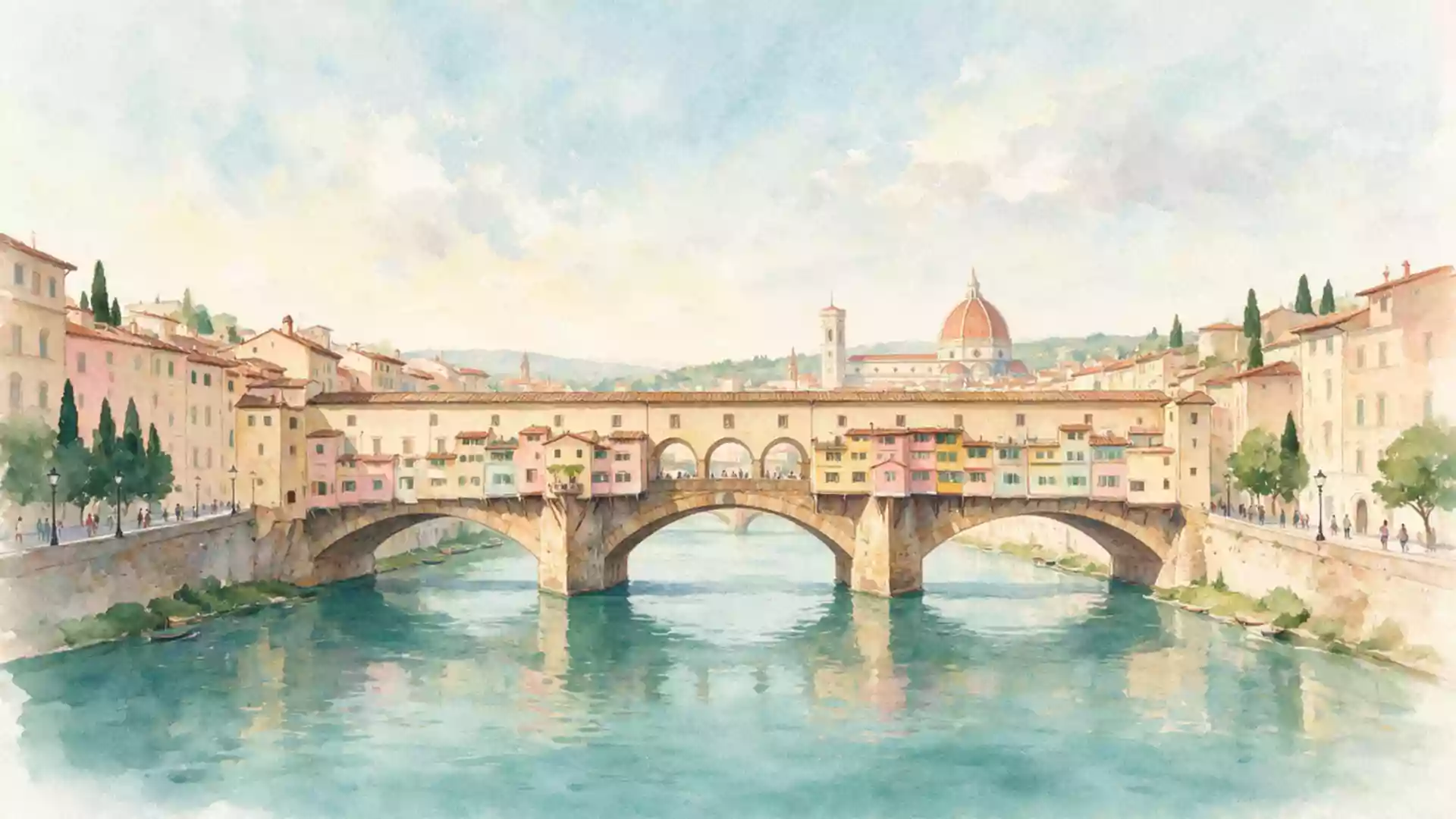
Ponte Vecchio, the inhabited bridge over the Arno
Published on 09/09/2026 at 20:04 | Editorial responsibility: Rafael Müller, Editor-in-Chief AD HOC NEWS
Ponte Vecchio in Florenz is a medieval stone bridge over the Arno River, built in the fourteenth century and lined with shops that turn the crossing into a narrow street of storefronts.
A medieval bridge that became a street of shops
Ponte Vecchio is a stone segmental arch bridge crossing the Arno at one of its narrowest points in Florenz, in central Italy.stone segmental arch bridge The present structure dates to 1345, when a new bridge was completed to replace an earlier crossing destroyed in a major flood of the Arno in 1333.completed in 1345 The bridge carries a continuous row of buildings along both sides, so that anyone walking across passes between shopfronts rather than open parapets.
A bridge has existed at this site since antiquity, when a crossing linked the Roman settlement of Florentia with the Cassia road leading towards northern Italy.Cassia road Over the centuries several earlier bridges were swept away by floods, leaving the fourteenth?century stone structure as the surviving medieval solution to the river’s force.earlier bridges swept away Its segmental arches reduce the number of piers in the water compared with older semicircular designs, an engineering form associated with Taddeo Gaddi, who is among the architects credited with the bridge’s design.segmental arches
Goldsmiths above the river and the Vasari Corridor overhead
The buildings along Ponte Vecchio have housed shops since at least the thirteenth century, reflecting the long?standing habit of using bridge space for commerce in medieval cities.shops since the thirteenth century For many years the bridge was known for butchers, fishmongers and tanners whose work involved heavy use of water and produced considerable waste. In 1593 Ferdinand I de’ Medici issued a decree restricting the premises on the bridge to goldsmiths and jewellers, a decision that reshaped its economic character and left Ponte Vecchio associated with jewellery and precious metal work.Ferdinand I decree
Walking across, the bridge feels like a narrow lane with projecting shop volumes that extend out over the river, many with small rear extensions above the water supported on stone or timber structures.shops along its flanks Above street level an enclosed passage, the Vasari Corridor, runs along the top of the bridge, linking Palazzo Vecchio on one side of the river with Palazzo Pitti on the other.Vasari Corridor Built in 1565 for Cosimo I de’ Medici, this elevated route allows the long gallery of the Uffizi to connect to the former Medici residence without descending to street level.built in 1565
Ponte Vecchio as an enduring crossing of Florenz
Ponte Vecchio is the oldest surviving bridge over the Arno in Florenz and was the city’s only bridge across the river until 1218, a role that underlines how central this crossing has been to the city’s layout.oldest bridge in Florence The bridge’s length is around 84 m (276 ft), enough to span the river with three arches and support an intricate pattern of buildings along its sides.around 84 m During the Second World War it was the only bridge across the Arno in Florenz not destroyed by retreating German forces, leaving its medieval and Renaissance structures standing when many neighbouring crossings had to be rebuilt.spared from destruction
The bridge occupies a central position between the historic core around Palazzo Vecchio and the district around Palazzo Pitti, so that crossing it connects civic buildings on the north bank with former ducal residences and gardens on the south.connect Palazzo Vecchio and Palazzo Pitti Its combination of river views, compact shops and layered architecture makes Ponte Vecchio a place where the infrastructure of a medieval crossing, the commerce of a traditional street and the elevated route of the Vasari Corridor coexist on a single structure. From the riverbanks, the projecting shopfronts, upper galleries and stone arches present a tightly packed façade that is as much a fragment of Florenz’s urban fabric as it is a standalone bridge.
Visiting Ponte Vecchio: what travellers from Western Europe should know
- Ponte Vecchio crosses the Arno in the historic centre of Florenz, between the area of Palazzo Vecchio on the north bank and Palazzo Pitti on the south.
- The bridge surface is a gently sloping pedestrian street paved in stone, with narrow passages between closely spaced shopfronts and some short flights of steps nearby on the riverbanks.
- Florenz is reached by rail from other Italian cities and by air via Florence Airport; from the main railway station, the bridge lies within walking distance through the historic streets.
- The official language is Italian and the currency is the euro.
Searching for Ponte Vecchio on social platforms
These links open searches for Ponte Vecchio on each platform.
Frequently asked questions about Ponte Vecchio
Where is Ponte Vecchio located?
Ponte Vecchio is in the historic centre of Florenz in Italy, crossing the Arno River between the area of Palazzo Vecchio and the district around Palazzo Pitti.
What can visitors expect when crossing Ponte Vecchio?
Visitors walk along a narrow stone street lined with shops on both sides, with occasional openings giving views over the Arno and the buildings stacked above the bridge’s arches.
What makes Ponte Vecchio distinctive among bridges?
Ponte Vecchio combines medieval stone arches, a continuous strip of shopfronts and the elevated Vasari Corridor in a single structure, creating an inhabited bridge that forms part of Florenz’s urban fabric.