
Ponte Vecchio in Florenz, a lived-in mediaeval bridge
Published on 09/08/2026 at 18:17 | Editorial responsibility: Rafael Müller, Editor-in-Chief AD HOC NEWS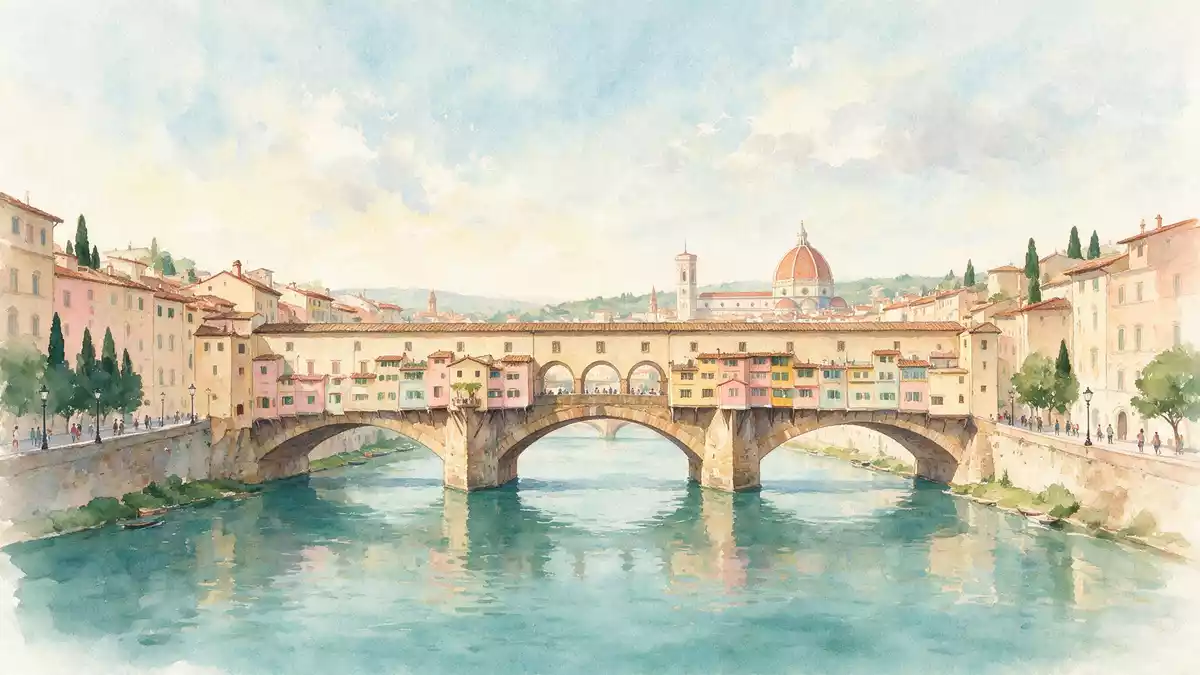
Ponte Vecchio is the oldest bridge across the Arno in Florenz, a stone span dating from the fourteenth century and still lined with shops that project over the water. Built as a segmental arch bridge and completed in 1345 under the Florentine republic, it carries not only traffic but a continuous row of jewellers’ workshops and the elevated Vasari Corridor overhead.
A mediaeval stone bridge over the Arno
Ponte Vecchio crosses the Arno at one of its narrowest points in the historic centre of Florenz, forming a compact, multi-storey structure above the river. The present bridge was built in the 1340s as a replacement for an earlier structure destroyed by the catastrophic flood of 1333, and its completion in 1345 marked a new phase in Florentine engineering with its segmental arches in stone.segmental arch bridge completed in 1345 The stone construction rests on piers that rise from the riverbed and support a roadway lined on both sides by continuous buildings, giving the impression of a narrow street suspended over the water.stone bridge over the Arno at its narrowest point
The bridge has three broad arches spanning the river, a form chosen in the fourteenth century to reduce the number of piers in the water and to cope better with the Arno’s floods. Its masonry parapets frame a central opening on each side where the buildings step back, offering views along the river and towards the hills beyond Florenz. Above the ordinary roadway, a discreet upper passage runs along the eastern side: the Vasari Corridor, commissioned by Cosimo I de’ Medici and completed in 1565 as an enclosed route between Palazzo Vecchio and Palazzo Pitti.built by the Florentine republican government between 1339 and 1346
Shops, trades and the Vasari Corridor
Ponte Vecchio is distinctive for the way its buildings are packed onto the bridge itself, an arrangement that dates back to the Middle Ages when it served as a marketplace as well as a river crossing. By the thirteenth century the bridge carried rows of shops operated by butchers and tanners, who used the flowing water below as a convenient place to dispose of waste.shops on Ponte Vecchio since the thirteenth century The structures projecting from the sides, with their timber framing resting on stone supports, still suggest the tight working spaces of those earlier trades.
In the sixteenth century the character of the bridge changed when Grand Duke Ferdinando I de’ Medici ordered that the meat and leather businesses be removed and the premises allocated to goldsmiths and silversmiths in 1593.shops assigned to gold- and silversmiths in 1593 This decree gave Ponte Vecchio its lasting association with jewellery and precious metals, a use that still dominates the bridge. Above these shops the Vasari Corridor runs as a continuous enclosed gallery, linking the government palace north of the river with the Medici residence at Palazzo Pitti on the southern bank.elevated corridor completed in 1565 From the river below the composition of arches, shopfronts and the upper corridor reads as a stacked sequence of levels, each with its own history.
Survival through floods and war
The history of Ponte Vecchio is closely tied to the Arno’s floods, which have repeatedly destroyed earlier bridges at this crossing since at least the eleventh century. Records mention a bridge here in 996, and the wooden and later stone predecessors were swept away in the great floods of 1117 and 1333, prompting the reconstruction that produced the present fourteenth-century structure.earliest records in 996 and reconstructions after floods The segmental arches of the current bridge offer wider openings than traditional semicircular forms, giving more clearance to floodwaters.
In the twentieth century Ponte Vecchio acquired another layer of historical resonance when it remained the only bridge in Florenz to escape demolition during the German army’s retreat in the Second World War. All other bridges across the Arno in the central city were destroyed, but access to Ponte Vecchio was blocked instead by demolishing the buildings at each end.only bridge across the Arno spared in World War II The bridge also survived the severe flood of 4 November 1966, when the river once again rose far above its usual level, damaging much of Florenz yet leaving the stone arches standing.survival of the 1966 Arno flood
Visiting Ponte Vecchio: what travellers from Western Europe should know
- Ponte Vecchio lies in the historic centre of Florenz, crossing the Arno between the Uffizi complex on the north bank and the Oltrarno district leading towards Palazzo Pitti on the south bank. It is reached on foot from the surrounding streets and piazzas, with road traffic limited to short local stretches.
- The bridge surface is relatively level but paved in stone, with a gentle rise towards the centre and narrow passages between the closely packed shopfronts; there are no long staircases on the main roadway, although short steps appear at some side entrances.
- The official language is Italian and the currency is the euro.
Searching for Ponte Vecchio on social platforms
These links open searches for Ponte Vecchio on each platform.
Frequently asked questions about Ponte Vecchio
Where is Ponte Vecchio located?
Ponte Vecchio stands in the centre of Florenz in Italy, spanning the Arno River between the civic quarter around Palazzo Vecchio and the Oltrarno district.
What should visitors expect on a walk across the bridge?
A walk across Ponte Vecchio leads along a narrow stone roadway lined with continuous shopfronts on both sides, with occasional openings giving views up and down the river.
What makes Ponte Vecchio distinctive among Florentine bridges?
Ponte Vecchio is distinctive as a fourteenth-century stone bridge whose buildings and jewellery shops occupy the span itself, combined with the elevated Vasari Corridor that runs above its eastern side.


