
Ponte Vecchio, Florence’s inhabited stone bridge
Published on 09/17/2026 at 19:38 | Editorial responsibility: Rafael Müller, Editor-in-Chief AD HOC NEWS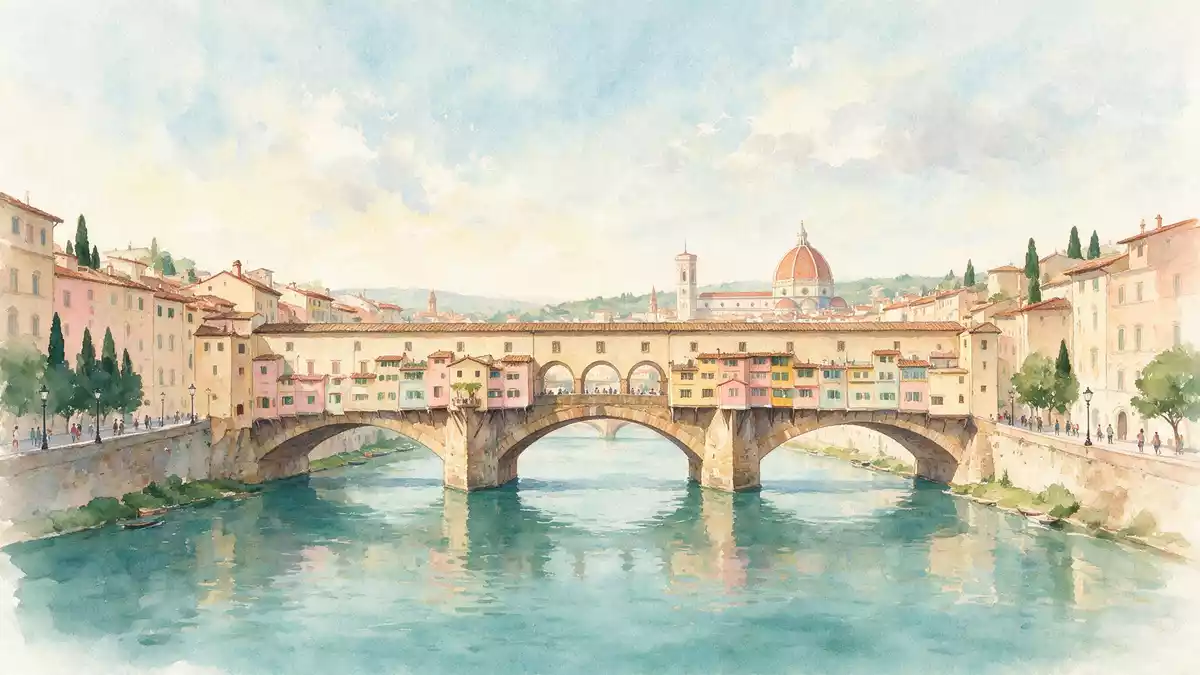
Ponte Vecchio is a medieval stone bridge in Florenz, Italy, whose line of shops turns a simple crossing of the Arno into an inhabited street above the water. Built in 1345, during the fourteenth century, it combines a robust stone structure with a continuous row of small premises that still define its appearance.
An inhabited medieval bridge over the Arno
Ponte Vecchio spans the Arno River at one of its narrowest points in the historic centre of Florenz, linking the riverbanks where the medieval city grew up along the valley. The present stone bridge dates to 1345, replacing earlier structures that had been damaged by floods that swept away much of the crossing at this point.The current bridge was rebuilt in 1345 The structure stands on stone piers in the river, carrying a deck that supports both the roadway and the buildings that line it on either side.
The bridge takes the form of three stone arches resting on mid-river supports, a layout that gives the deck a relatively flat profile compared with earlier semicircular spans.The segmental stone arches were completed in 1345 Above the arches, a compact row of shops flanks the central roadway, creating the impression of a narrow street flanked by irregular façades. Towards the centre of the bridge, small projecting rooms extend out over the water, adding to the dense, layered silhouette viewed from the river embankments.Retrobotteghe supported by brackets were added in the seventeenth century
From meat market to bridge of goldsmiths
Shops have stood on Ponte Vecchio since at least the thirteenth century, turning the crossing into a market street as well as a route between neighbourhoods.There have been shops on Ponte Vecchio since the thirteenth century In the fifteenth century the city’s authorities required butchers to move their premises onto the bridge, making use of its position over running water when disposing of waste and keeping these trades away from more prestigious streets inland.Butchers were obliged to move their stores onto the bridge in 1442
The sixteenth century brought a change in the character of the bridge when the Medici rulers reorganised its trades. In 1593 Ferdinand I de’ Medici ordered fishmongers, butchers and tanners to leave, reserving the premises for goldsmiths and jewellers, whose refined wares matched the status of the surrounding palaces.Ferdinand I’s 1593 order replaced butchers with goldsmiths The bridge’s shops have since been associated with jewellery and fine metalwork, and their displays line the narrow roadway, creating a continuous band of crafted objects between the riverbanks.
The Vasari Corridor and a bridge that survived war
Above the busy line of shops, an elevated passage known as the Vasari Corridor runs along part of Ponte Vecchio. Designed by Giorgio Vasari and completed in 1565 for Cosimo I de’ Medici, this enclosed walkway links the Palazzo Vecchio and the Uffizi complex on the north bank with the Pitti Palace on the south bank, crossing the Arno by passing along the top of the bridge.The Vasari Corridor was built in 1565 for Cosimo I de’ Medici Its upper gallery forms a second level above the shopfronts, adding another inhabited layer to the already dense structure.
Ponte Vecchio has endured repeated flooding of the Arno and the destruction wrought on Florenz during the twentieth century. During the Second World War it was the only bridge over the Arno in the city not demolished by retreating German forces; access was blocked instead by the removal of nearby buildings.It was the only Arno bridge spared by German demolition in the Second World War The bridge also withstood the major Arno flood of 4 November 1966, a disaster that damaged large parts of the city’s historic fabric but left the stone arches standing.Ponte Vecchio survived the 1966 Arno flood
Visiting Ponte Vecchio: what travellers from Western Europe should know
- Ponte Vecchio crosses the Arno in the historic centre of Florenz, linking the area around the Uffizi on the north bank with streets leading towards the Pitti Palace on the south bank.
- The bridge carries a narrow roadway shared by pedestrians and lined with small shops, with uneven steps and short slopes along its length and stone parapets overlooking the river.
- The nearest main railway station is Firenze Santa Maria Novella, from which the riverfront streets lead towards Ponte Vecchio through the compact grid of the old town.
- The official language is Italian and the currency is the euro.
Searching for Ponte Vecchio on social platforms
These links open searches for Ponte Vecchio on each platform.
Frequently asked questions about Ponte Vecchio
Where is Ponte Vecchio and what does it cross?
Ponte Vecchio stands in the historic centre of Florenz in Italy and carries its stone arches across the Arno River between the north and south banks.
What should visitors expect when walking across Ponte Vecchio?
Visitors find a narrow roadway lined with small shops and jewellers, irregular façades on either side, and views over the Arno from stone parapets at intervals.
What makes Ponte Vecchio distinctive among European bridges?
The continuous line of inhabited premises, the elevated Vasari Corridor above them and the medieval stone arches together turn Ponte Vecchio into both crossing and compact marketplace.


