
Pont du Gard, the Roman aqueduct above the Gardon
Published on 09/12/2026 at 15:09 | Editorial responsibility: Rafael Müller, Editor-in-Chief AD HOC NEWS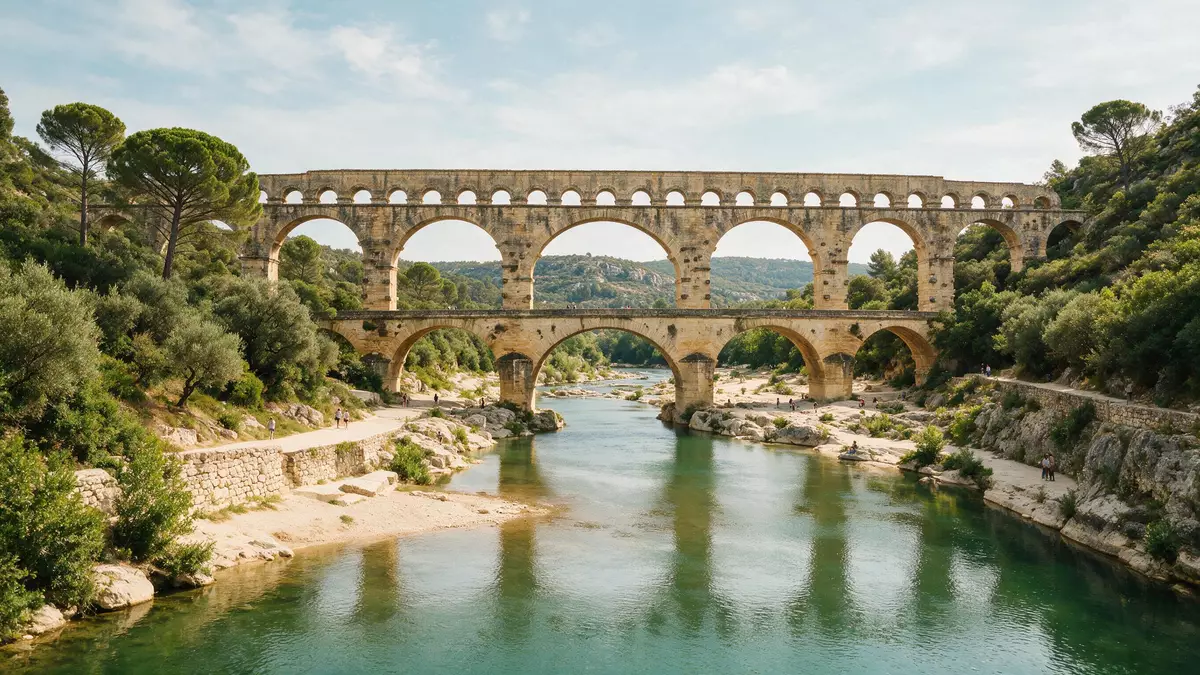
Pont du Gard near Vers-Pont-du-Gard in southern France is an ancient Roman aqueduct bridge that carries the former water supply of Nîmes across the Gardon valley on three stacked tiers of arches.ancient Roman aqueduct bridge Built in the first century AD, it forms the monumental part of an aqueduct of around 50 km (31 mi) that once brought spring water from the Eure source near Uzès to the Roman colony of Nemausus, now Nîmes.aqueduct of Nîmes
Three tiers of Roman engineering
The lead impression of Pont du Gard is its height and layered structure: three vertical tiers of arches rise to nearly 49 m (160 ft) above the river bed, making it one of the tallest surviving Roman aqueduct bridges.three rows of arches The lowest level carries large arches that stride across the Gardon, the middle level repeats the rhythm with slightly smaller spans, and the upper level supports the water channel on a long sequence of modest openings.
The whole bridge runs to about 275 m (902 ft) across the valley in its present form, with the aqueduct’s conduit aligned along the top tier.greatest length 275 m The masonry is made of local limestone blocks carefully cut and laid without mortar, a technique that leaves sharp joints and contributes to the precise geometry of the arcades.built without mortar From below, the structure reads as a stack of repeating curves and solid piers, with the river and banks framed between them.
Part of a long aqueduct from Uzès to Nîmes
Pont du Gard is only one section of the Nîmes aqueduct, but it is its most monumental and visually legible part.most impressive testament The conduit begins at the Eure spring near Uzès and traces a sinuous route of just over 50 km (31 mi) towards Nîmes, descending with an average gradient of roughly 25 cm per kilometre to keep the water flowing gently by gravity.average gradient of 25 cm Along the way it passes through tunnels, over smaller bridges and across basins, with Pont du Gard rising where the line must cross the Gardon river.
The aqueduct was built under the Roman Empire in the first century AD and supplied Nîmes for several centuries, carrying large quantities of water to the city’s baths, fountains and other installations.built in the first century Roman engineers kept the slope low to reduce turbulence and wear, which explains the gentle descent and the need for substantial structures where valleys interrupt the line. Pont du Gard embodies this balance between hydraulic calculation and architectural presence.
World Heritage landscape above the Gardon
Since 1985 Pont du Gard has been inscribed on the UNESCO World Heritage List as an exceptional ancient monument and a masterpiece of human creative genius.listed as a World Heritage Site since 1985 It is recognised as an outstanding example of Roman aqueduct construction and as a rare surviving three-tiered bridge of this type, combining technical purpose with monumental design.seul exemple d'aqueduc à 3 étages The designation also covers the surrounding cultural landscape, where Mediterranean vegetation and the course of the Gardon frame the stone structure.
The bridge stands in the Occitanie region, not far from Nîmes and Uzès, and the river winds through a rocky valley beneath the arches.located in the Occitanie region On the banks, paths and viewpoints give varied angles on the three levels, from near the water to higher terraces further back. The contrast between pale limestone, green vegetation and the Gardon’s channel makes the aqueduct bridge appear as a deliberate line drawn across the valley.
Visiting Pont du Gard: what travellers from Western Europe should know
- Pont du Gard stands near Vers-Pont-du-Gard in southern France, between Nîmes and Uzès, with road access from the wider Occitanie region and public transport links from nearby towns.
- The site sits in a river valley, and reaching the base of the bridge involves walking on uneven paths and stone surfaces along the Gardon, with gentle gradients but some steps.
- Viewpoints exist on both banks of the Gardon, so visitors can expect short walks between parking areas, exhibition spaces and open-air terraces overlooking the three-tiered aqueduct.
- The official language is French and the currency is the euro.
- Entry requirements depend on your nationality; UK travellers can check the FCDO travel advice at gov.uk/foreign-travel-advice, Irish travellers the Department of Foreign Affairs at ireland.ie.
Searching for Pont du Gard on social platforms
These links open searches for Pont du Gard on each platform.
Frequently asked questions about Pont du Gard
Where is Pont du Gard located?
Pont du Gard stands near the town of Vers-Pont-du-Gard in the Gard department of southern France, between Nîmes and Uzès in the Occitanie region.
What can visitors expect when visiting Pont du Gard?
Visitors encounter a three-tiered Roman aqueduct bridge in a river valley landscape, with paths, viewpoints and access to the banks of the Gardon for different perspectives.
What makes Pont du Gard distinctive among Roman aqueducts?
Pont du Gard is distinguished by its three stacked tiers of arches, its height of nearly 49 m (160 ft) and its recognition as a UNESCO World Heritage Site for exceptional Roman engineering.


